If you were paying attention, you would notice a glaring case of two logically incoherent media narratives at play. Specifically, skyrocketing inflation under Biden during a midterm election year was considered a “transitory” blip, but a more tempered inflation rate under Trump during another midterm election year, despite a major war, was cast as setting the economy on the precipice of a complete disaster.
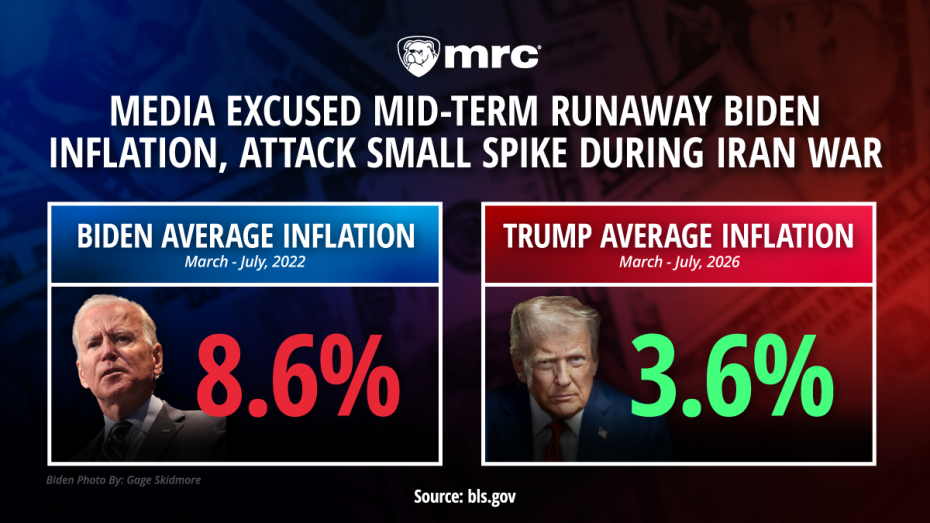
According to the U.S. Bureau of Labor Statistics, the five-month average annual rate of consumer price increases spanning the Iran War (March-July) averaged 3.6 percent. During the same period in 2022 under Joe Biden, with no war underway, the inflation rate averaged a whopping 8.6 percent.
There’s no question the juxtaposition between the two rates is stark, and so was the way the media chose to cover the economy during the two periods.
Here’s The New York Times being completely tone-deaf in May 2022, “For Tens of Millions of Americans, the Good Times Are Right Now.” Times technology writer David Streitfeld pretended Americans hadn’t seen an economy this glorious in over 50 years. “For the 158 million who are employed, prospects haven’t been this bright since men landed on the moon,” he wrote, blurting out paper tiger wage gains that were getting devoured by out-of-control inflation. In fact, two-thirds of American workers said during that month that their salaries weren’t keeping pace with inflation, according to a CNBC survey. So much for exemplary economic prospects.
CNBC senior analyst Ron Insana even had the audacity to still peddle the “transitory narrative” June 2, 2022, even before prices would be reported to have reached their 40-year high June peak at 9.1 percent. “Policymakers should stop apologizing. Inflation really was ‘transitory,’” read Insana’s gaslighting. It got worse:
The various and sundry mea culpas, the action plans to fight inflation and the wholesale criticism of policymakers who had virtually no control over the underlying events that caused a spike in consumer prices, may well look pretty silly in just a matter of months.
It just might be that inflation will, in fact, be transitory after all.
It would actually be Insana that would look “silly” when the June inflation numbers came in, but even Insana had to make the definition of the term “transitory” elastic in order to mean “years” instead of months: “And by transitory, I mean a year or two, not a month or two, as many misinterpreted the Fed’s choice of words last year.”
To be clear, Webster’s Dictionary definition of “transitory” means “brief duration,” which no one with a common grasp of the English language would interpret to have anything to do with years. Under Trump, however, Insana was banging the stagflation drums in a June 2026 piece, “A protracted war with Iran raises the specter of a 1970s re-run in more ways than one.”
But Insana wasn’t alone. Other prominent media figures have prematurely preached cataclysmic economic conditions under Trump, with some outlets apparently forgetting the widespread water-carrying they did for Biden when inflation was truly running amok.
CNN senior business reporter David Goldman — arguably the poster child for absurd spins on the economy at the network — recently accused Trump in early July of playing with “economic fire” by daring to retaliate to Iran violating a ceasefire agreement by striking three commercial vessels in Oman’s territorial waters. Goldman claimed that the previously instituted Memorandum of Understanding didn’t provide enough time for the U.S. to “avoid the looming ‘economic catastrophe’ that Trump feared would earn him comparisons to Depression-era President Herbert Hoover.”
See the difference yet? Oh, don’t worry. There are plenty more examples.
Goldman also outlandishly claimed during the May 26, 2026 edition of CNN’s The Situation Room that Americans wouldn’t see oil dip below $70 a barrel or $3 per gallon of gasoline under 2032 because of Trump and his war with Tehran.
How convenient.
CNN claims gas prices are not going to drop until 2032 (or two presidential election cycles). pic.twitter.com/DIMZAHKQNm— Nicholas Fondacaro (@NickFondacaro) May 26, 2026
But during Biden’s tenure in 2022, you even had late-night comedians giving virtue-signaling lectures about the moral responsibility to pay for skyrocketing energy prices when the president chose to ban Russian oil imports amidst the ongoing inflation crisis. And here’s the irony: The Biden administration was simultaneously exploring a potential shifting of the U.S.’s energy reliance to the tyrannical regimes in Saudi Arabia, Venezuela and — wait for it — Iran!
Then-CBS The Late Show host Stephen Colbert pontificated during a March 2022 segment of his show that Americans shouldn’t really be bothered by $4 a gallon of gas: “A clean conscience is worth a buck or two.” He continued: “I’m willing to pay $4 a gallon. Hell, I'll pay $15 a gallon because I drive a Tesla.”
And let us not forget the Bidenomics savant Paul Krugman, who spent a good portion of his time during the Biden administration simping for the nonsensical “transitory” inflation narrative for The New York Times opinion section. Following reports that the U.S. GDP had contracted two consecutive quarters — which was the generally accepted definition of a recession before the media arbitrarily chucked it out the window — CNN bloviator-in-chief Brian Stelter brought Krugman on during a July 2022 Reliable Sources segment to dismiss that narrative entirely and sugarcoat the inflation situation: “Inflation is high, though maybe inflation is coming down. What does it matter whether you use the R-word or not?” Inflation for the month of July only slowed mildly to 8.5 percent from its June peak of 9.1 percent.
For a clean comparison, consider how CNN Senior Writer Alicia Wallace and Goldman tried to get ahead of expectations in a July 2026 “analysis” that June 2026 inflation data would mark a slowdown in consumer prices from the 4.2 percent May figure. “Don’t be fooled: America’s inflation problems aren’t going away anytime soon,” read their obnoxious headline.” The official BLS data would go on to reveal just after Wallace and Goldman’s piece went live that consumer prices actually declined 0.4 percent on the month and eased to a 3.5 percent rate on the year. That crushed consensus estimates by Dow Jones economists for a 0.2 percent decline on the month and a slight ease to a 3.8 percent year-over-year rate from the 4.2 percent high in May. The monthly decline was the sharpest in six years.
On a yearly basis, inflation in fact cooled 0.7 percentage points, both figures in effect rendering Wallace and Goldman’s premature obfuscations to the contrary appear downright idiotic.
Inflation is likely to come down soon, but some of the improvement will be ... transitory https://t.co/lE8NrWWfn8
— Paul Krugman (@paulkrugman) April 12, 2022
You even had cartoonist Ben Jennings drafting up a silly childish drawing of a morbidly obese Trump baby to make the “Trumpflation” narrative stick in April for The Guardian.
In March, The Independent senior business commentator James Moore tried to be cute with his Trump jabs, “Donald Trump wants his name on everything – so let’s give him ‘Trumpflation,’” and that was when consumer prices were sitting at just a 3.3 percent rate year-over-year, according to the BLS. That’s pretty interesting coming from the same outlet that in April 2021 was mindlessly regurgitating talking points from the Jerome Powell-led Federal Reserve: “Fed keeps key rate near zero, sees inflation as 'transitory.’” For April 2021, the inflation rate was at 4.2 percent, 0.9 percentage points higher than the March 2026 figure.
Under Biden, the liberal wire service Reuters tried to downplay inflation reality too, with reporters Lisa Pauline Mattackal, Divya Chowdhury and Nishara Karuvalli Pathikkal bleating in a July 29 piece that “Central banks and markets may have dropped the narrative that inflation is ‘transitory,’ but there is a strong chance that current spikes in prices are temporary and will soon begin to trend downward.” The headline for their propaganda was pure gaslighting: “Signs emerge that global inflation could be transitory, former policymakers say.”
In April 2022, ABC News was regurgitating the “transitory” ramblings of former Obama economic advisor Jason Furman, who vaunted unwarranted speculation that, “"Some of the inflation is probably transitory. I don't think the underlying true inflation rate in the economy is 8%. But it probably isn't 2%, either. And so inflation should start to come down a bit, but it's unlikely to come anywhere near where the Fed wants it to come.”
CNN reporters Lucy Bayly and Alicia Wallace also tried to downplay the 9.1 percent inflation rate for Biden in June by relying on perceived distortions from volatile energy prices and instead focused on core inflation:
While it’s too soon to say whether inflation has peaked (especially given the broader volatility within the global economy), core inflation appears to have leveled off, and expectations are for it to continue to come down in the year-over-year comparison, said Cailin Birch, global economist at the Economist Intelligence Unit.
Here’s the problem: June 2022 core inflation sat at a huge 5.9 percent rate and would later see an eye-popping uptick to 6.3 percent rate for August two months later. “Leveled off?” Ha!
The March-July 2022 and March-July (Iran War) 2026 average inflation rate contrast (8.6 percent vs. 3.6 percent) is yet another example of the lengths the media writ large will go to exercise political expediency to twist news stories to fit their politics. In this case, the angle on inflation only depended on whose keister was sitting in the Oval Office at the time and whether an upcoming election was in the mix.
CNSNews Managing Editor Craig Bannister contributed to this report.