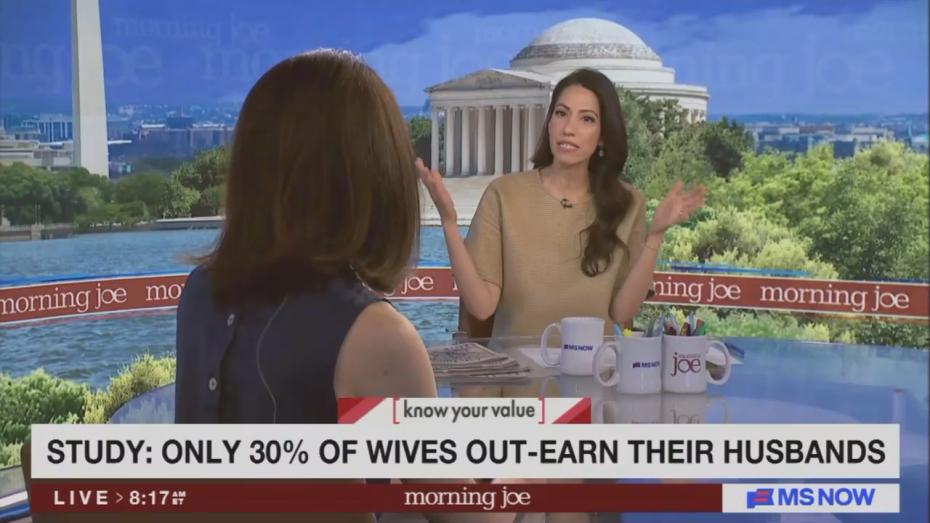
Morning Joe’s Mika Brzezinski turned to her Know Your Value franchise Friday to examine the ostensible problem of what The Economist called “the stubborn scarcity of female breadwinners.”
The magazine found that among dual-income heterosexual couples, just 30% of wives earn more than their husbands — even though women now make up three-fifths of American university graduates.
The premise was explicit: this pattern is a problem. “So why has the male breadwinner model proved so difficult to break?” Mika asked.
The Economist's Charlotte Howard pointed to a gap between stated preferences and reality. Americans claim comfort with women earning more, she said, yet the 30% figure persists. “Gender roles are just very, very sticky,” Howard explained.
Howard said that mentorship programs and higher college attendance rates are not enough. The problem, supposedly, is that couples still look to the model their parents had, as Boomers hand down their more traditional arrangements to younger generations. And even women who earn more, she noted, continue to shoulder a disproportionate share of household responsibilities.
MS NOW contributor Huma Abedin agreed and offered a personal example. “When I was the primary breadwinner in my household, if I didn’t have a male partner at home taking on the majority of the household and childcare work, I couldn’t have done it.”
Left unmentioned: Abedin’s current husband. After divorcing Anthony Weiner, in June 2025 she married Alex Soros. He chairs the Open Society Foundations, the $25 billion empire built by his father, the mega left-wing donor George. The woman who mentioned [bragged] about having been the primary earner has since chosen a life of extraordinary wealth in which her role as primary breadwinner is neither possible nor, apparently, desired.

MS NOW’s Know Your Value Segment Treats Male Breadwinner Norm as a Bug, Not a Feature pic.twitter.com/VfLXPs6V1u
— Mark Finkelstein (@markfinkelstein) August 1, 2026
A second irony: Brzezinski’s own résumé shows years of solid but mid-level work — local reporting and anchoring in Hartford, overnight and desk roles at CBS, short stints at MSNBC — before Joe Scarborough selected her as co-host of Morning Joe. That selection, not an independent climb past structural barriers, turned her into a national figure and the platform for “Know Your Value.”
The research, Abedin said, shows that even primary-earning women still handle most of the work at home. The question, she asked, is what it will take for women’s economic power to match “expectations at home.” [Huma has presumably been relieved of much of the mopping and dusting duties at their digs.]
Howard suggested policies that ease home support, and a cultural shift in which men treat pride in their wives’ higher earnings as “macho rather than undermine their masculinity.” She gave “all credit to Travis Kelce” for saying [in a clip that opened the segment] that his wife Taylor Swift’s drive and success motivate him.
What received zero acknowledgment was any role for biology or genetics. Only women ["our neighbors with a uterus," in case James Talarico is reading] become pregnant, give birth, and are biologically equipped to nurse. Those realities produce discontinuous career paths and different trade-offs between career investment and childcare/related duties.
Complementary roles — men more oriented toward provision and physical protection, women toward childcare — are not a Boomer invention. They appear across cultures and deep into human history for practical reasons. The panel treated the entire pattern as a purely cultural defect waiting to be fixed.
The segment noted one cost of reversing the pattern. When wives become the primary earners, men are roughly 1.5 times as likely to report serious psychological distress — and that distress increases when the wife earns 70% or more of household income. [Abedin, for whom math is apparently not a key skill set, appeared to confuse “one and a half times” with “one and a half percent.”]
More importantly, no one asked the obvious question: since the data show that their desired arrangement is seriously distressing to men, why are these women so intent on forcing the change?
Brzezinski closed by calling the march toward making more women the primary breadwinners “a long struggle.” The struggle is less against "sticky norms" than against the persistent refusal to acknowledge the obvious.
Here's the transcript.
MS NOW
Morning Joe
7/31/26
8:17 am EDT
PAT MCAFEE [from show of 3/10]: Can we talk about Taylor for a second?
TRAVIS KELCE: Of course, always.
MCAFEE: You watching her do her thing, and continue to move and move and move and work. Has that certainly helped you think through this process of like, do I still wanna go? I'm getting older, body doing that. Do you think that is kind of—
KELCE: Without a doubt. She has, we share the same love for what we do, and we've had this, you know, fortunately, we've had this desire since we were kids in our, in our selective professions.
And it's just, it's amazing to see her keep going to the table, keep finding new things to write about, keep finding, you know, new melodies and things like that. And on top of that, still seeing her have that love and joy in what she does. And, yeah, of course that's motivating, that's motivating for anybody to see that.
MIKA BRZEZINSKI: That was NFL star Travis Kelce earlier this year, talking about his now wife Taylor Swift and how her drive and success motivate him.
Swift is also a rare example of a woman who out-earns her husband, one reason the couple is featured in the new analysis in The Economist, which examines why female breadwinners remain the exception.
The Economist found that among dual-income heterosexual couples, just thirty percent of wives earn more than their husbands. It also found that when women become the primary breadwinners, men are one-and-a-half times more likely to report serious psychological distress.
So why has the male breadwinner model proved so difficult to break?
Here to answer is executive editor and New York bureau chief for The Economist, Charlotte Howard. Also here for the conversation, MS NOW contributor Huma Abedin, who is vice chair of the Forbes and Know Your Value 30/50 Summit.
So, Charlotte of The Economist, let's dive into this new research. Women now make up three-fifths of American university graduates. So why are seventy percent of wives still earning less than their husbands?
CHARLOTTE HOWARD: Well, there's a lot of things I found about this article that were very interesting. But one of the things that I found most fascinating is that the stated preference of Americans is that, Americans are, are very comfortable with women earning more than their husbands. And Americans now, women are more likely to have a college degree. They make up a majority of people in the workforce with a university education.
And yet that figure remains, that you have just thirty percent of women out earning their husband. And so I think what that represents is this gap between America's stated preference, women's acquired skills, and the reality of how women exist at home and in the workplace.
HUMA ABEDIN: You know, one of the things, aside from the statistic that Mika just mentioned, that men whose wives or female partners earn one-and-a-half percent, are more of the primary breadwinners are one-and-a-half percent, reporting that they have serious psychological distress, that actually goes up, that when women earn seventy percent or more of the household income, they're even more stressed.
And that the findings haven't changed, that from 2001 to 2011, and then 2013 to 2023, it's about the same. So why do you think this is still happening?
HOWARD: I think there are a number of hypotheses I can put forward, but the main thing, and I'd love to know your view of this, is that gender roles are just very, very sticky.
You know, people can go to college at a higher rate, we can have all these mentorship programs to keep women in the workplace. But some of these norms are generational. You know, people look at the model that their parents had, and it's a big shift to go from, you know, if you think about a millennial now in the workplace, how their baby boomer parents existed in the home. It's very, very different to see a totally different gender dynamic play out.
And you have this self-reinforcing dynamic, I think. When you have a woman who is earning less, they will take on more household responsibilities. You know, even women who earn more, they have a disproportionate share of household responsibilities, and then that has this effect of perpetuating the idea that women are consistently earning less because they're taking on more responsibility at home. They can't invest the time that they would if they didn't have those responsibilities at home. So it's just a very, very sticky cycle.
ABEDIN: You know, you mentioned mentorship, you mentioned the generational shifts, which I completely agree with.
I mean, I take myself as an example. That when I was the primary breadwinner in my household, if I didn't have a male partner at home taking on the majority of the household and childcare work, I couldn't have done it.
And what this research is showing is exactly what you're underscoring, which is that, even when women are the primary breadwinners, they're responsible for the majority of work at home. What do you think it's gonna take? Like, what is the, what was found in this research that it will take for it to become more acceptable for women's economic power to match the new expectations at home?
HOWARD: I think it's, you know, a combination of things, both wonky and cultural. You know, on the wonky side, you could list a whole number of policies that would make it easier for people to have more support at home and exist in the way they want to in the workplace as well.
I also think, candidly, that having men talk about the pride that they take in their women's work, and having that be something that is macho rather than undermine their masculinity is really powerful.
And so, you know, all credit to Travis Kelce for saying that it's motivating to him. I think that there are more role models that you probably need to see across different sectors, that don't just have to do with your wife being a pop star, where men take real, you know, active pride in their wives' work and are willing to do more at home too.
MIKA: This has been a long struggle. You can read more about this phenomenon at theeconomist.com. Executive editor and New York bureau chief at The Economist, Charlotte Howard. Thank you so much for sharing this with us this morning, and Huma Abedin, as always, thank you as well.