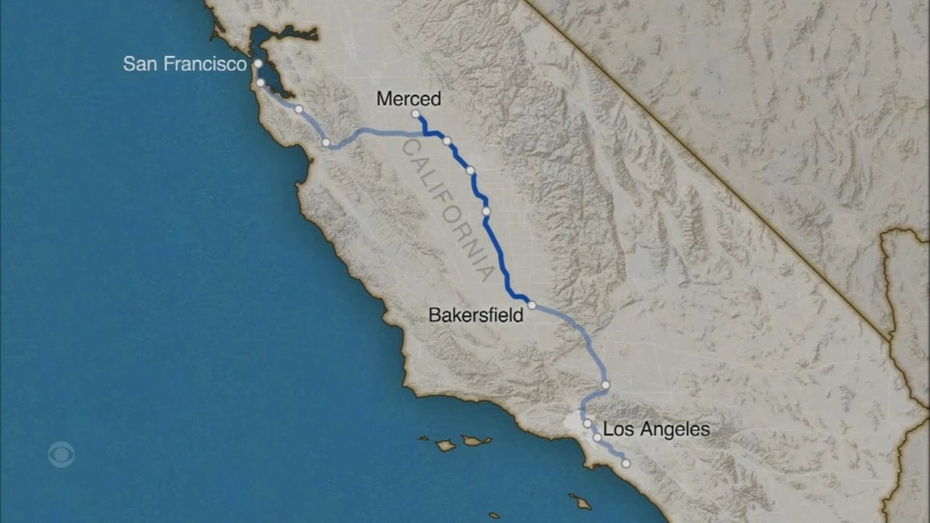
Correspondent John Wertheim laid bare the ugly reality of how America went from having trains as a central part of the country’s history to an afterthought as a jumping off point to an attempt by California for a bullet train “connecting L.A. and San Francisco has lurched, derailed, cost billions and may never happen.”
He opened with a fake-out, touting a reliable high-speed rail system before admitting it’s in Morocco. In contrast, he noted California voters passed nearly 28 years ago “a ballot measure for a train connecting Los Angeles to San Francisco in less than three hours” for “estimated price tag” of $33 billion and expected completion in 2020.
Still thinking of how incredible this ‘60 Minutes’ story was about how much of a disaster California’s Los Angeles-to-San Francisco high-speed rail project was.
— Curtis Houck (@CurtisHouck) April 7, 2026
Just incredible.
John Wertheim’s intro: “It’s hard to exaggerate the role of the train in the American story, or the… pic.twitter.com/I0JrkSlQEM
Unsurprisingly, the current state of the project is less than ideal:
Status update: today, the state’s high-speed rail authority is preparing to lay its first tracks at roughly the same cost. Only, slight course correction here: Instead of L.A. to San Francisco, it will run one-third of that distance, connecting — wait for it — the metropolis of Bakersfield and Merced, population 96,000. Oh, and when will it open? 2033. Maybe.
Central Valley-area Congressman Vince Fong (R-CA) was surprisingly given prime billing off the top and told Wertheim this “nightmare is the probably quintessential example of government waste and mismanagement.”
Wertheim then paraphrased more of what Fong told him: “He says that when California voters first approved high-speed rail, the promise and price tag were more marketing campaign than realistic projection.”
But when Wertheim took these concerns to California Secretary of Transportation Toks Omishakin and rail board member Anthony Williams, Omishakin seemed to argue voters are the real problem in this project for not understanding how difficult it would be to make a reality:
California California's Secretary of Transportation Toks Omishakin first blames VOTERS for the state's failure to not build any high speed rail.
— Steve Guest (@SteveGuest) April 6, 2026
"There were mistakes made. Some of the criticism on this project, I think, are very fair... I don't think the voters fully understood,… pic.twitter.com/zrBIfW1Yby
The next portion focused on how red tape dooms such herculean ambition. Wertheim explained for the uninitiated that, “[t]o get the necessary political buy-in from the whole state, the plan called for the train to run inland, threading the farmland of the Central Valley.”
Left unsaid was that, in essence, the call was to run it through the red part of the state because the blue supermajority doesn’t want it cutting through their neighborhoods.
Even that wasn’t enough: “Yet, the rail authority hadn’t answered basic questions, like precisely where it could lay down its tracks, what’s known as right-of-way.”
Along with land disputes, Wertheim added other pitfalls included “California’s exacting environmental regulations, which triggered all manner of reviews, lawsuits, and delays” and “high U.S. labor and construction costs.”
60 Minutes exposes how California's burdensome environmental regulations prevent anything from being done, particularly with their high-speed rail:
— Steve Guest (@SteveGuest) April 5, 2026
"California’s exacting environmental regulations, which triggered all manner of reviews, lawsuits, and delays. As anyone who's… pic.twitter.com/UuEB2WAnNr
After pointing out far-left Governor Gavin Newsom “didn’t respond to repeated interview requests,” Wertheim said the project changed to run just in the Central Valley as years went by and with nothing to show for it, even though it’d be “a route few clamored for and fewer are likely to ride.”
The visuals of empty concrete beams and overpasses (sans any tracks) put the project’s waste into perspective, bolstered by Wertheim sharing that “[l]ocals here jokingly refer to it as their own Stonehenge.”
60 Minutes EXPOSES California's incomplete high speed rail system, locals in the Central Valley call it "Stonehenge":
— Steve Guest (@SteveGuest) April 5, 2026
"Locals here jokingly refer to it as their own Stonehenge. Ideally, these bridges and viaducts will one day be used to support California high-speed rail. But… pic.twitter.com/FLEDroMPmh
“[F]or now, these are curiosities in a field, monuments to promises that haven’t been met, and plans that haven’t been executed,” he added.
He took a detour for the next few minutes to spotlight Brightline, a private rail company aiming to build a high-speed train that would consist of a two-hour span Los Angeles to Las Vegas in 2029 (versus a five-hour drive).
It currently has a semi-high-speed line in Florida spanning Orlando to Miami and goes 125 miles per hour, but here again, Wertheim found problems with it (even though it should be a leftist dream) (click “expand”):
WERTHEIM: Cultural questions aside, Brightline’s Florida trains run at street level through crowded neighborhoods. And according to numbers compiled by the Miami Herald and local public radio, more than 200 people have been hit and killed by the trains in the near-decade since operations began. Brightline says that running rail in the desert out West — where track crossings won’t be at street level — will be a safer proposition. Then there are the finances: the stratospheric costs of building and running a rail line vastly outstrip revenues. Analysts have downgraded Brightline’s debt to junk, raising questions about private rail as a business. [TO REININGER] To what extent, big picture, do you worry about the future financial viability of Brightline?
REININGER: The business has built slower than we originally expected it to build. We thought we would be carrying more passengers today than we are. The business is, in fact, growing month over month, year over year. That’s a great thing. That solidifies in our mind the viability of the business.
WERTHEIM: Brightline’s West Coast project has already received some federal funding and is hoping for a $6 billion loan from the Trump administration.
REININGER: If you look around the world, for the most part, the infrastructure systems are funded by the public sector.
WERTHEIM [TO REININGER]: You do see a role for government here?
REININGER: Absolutely. We — we welcome it.
The rest of his piece was on the government-run disaster in California with officials telling him this short span from small town to small would cost $126 billion, which Wertheim acknowledged is “more funding than Amtrak has received in its history and still leaves a shortfall of roughly $90 billion.”
Wild stat -- the current portion of Gavin Newsom's so-called high-speed rail running from small towns to small towns and not connecting LA and SF is now up to $126 billion in cost, which is far more than Amtrak has received in its entire history. pic.twitter.com/SoZnwo7LTq
— Curtis Houck (@CurtisHouck) April 7, 2026
Liberals can melt down all they want about this reality check, but the first story — led by Scott Pelley — was more up their alley as it focused on the soaring cost of health insurance and the free health care clinic charity known as Ram.
Shifting to the end of the show, CBS’s other supposed sin was giving Graham — the son of the late American preacher Billy Graham — a few minutes to talk about the connection between Christianity and America (click “expand”):
Evangelist Franklin Graham, who's preached in all 50 U.S. states, says he believes faith in God is the value that played the biggest role in shaping the nation. pic.twitter.com/9Jc6pG07ct
— 60 Minutes (@60Minutes) April 5, 2026
Faith. Faith in God is the value that most shaped America. Remember, the pilgrims, they came to this land to find freedom to live out their faith. And it’s people of faith who have been the bedrock, the driving force behind our nation. In years past, where did people turn after a disaster? Not FEMA, not to the government. It was the church that took them in, fed them, gave them shelter, clothed them. It was people of faith who established our health care in this country. Our higher education was started by people of faith. Harvard, Yale, Princeton were founded to train ministers of the gospel. From the remote villages of Alaska to the tip of the Florida Keys today, you’ll find houses of worship and people of faith making a difference. As a follower of Jesus Christ, I want all people to know that God loves them, that He cares for them. So, I see faith as the most important defining value in our nation and in every single life.
The horror! Check out the vile, unhinged replies and quoted replies seething over an X post of Graham’s simple message about how Americans have turned to churches for education, health care, relief after disaster, and even a search for our meaning.
To see the relevant CBS transcripts from April 7, click here and here.