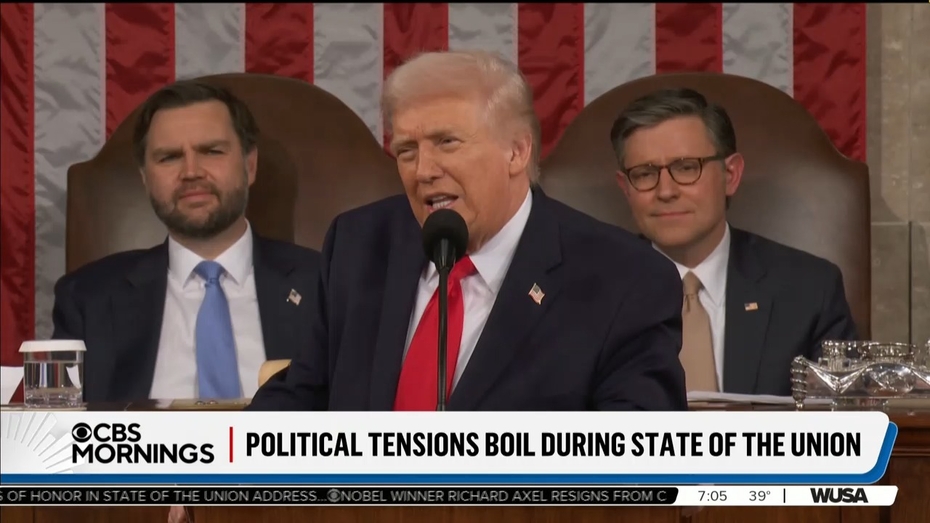
The bias began in the tease with co-host and Democrat donor Gayle King saying Trump gave “a contentious State of the Union Address, claiming victory on the economy, and bashing Democrats.”
Filling in at a show she spent seven years co-hosting, Norah O’Donnell voiced skepticism at Trump “claim[ing] the nation’s economy is strong despite polls showing most Americans feel otherwise” and “clash[ing] with Democrats in the room on a range of issues, including the ICE tactics at the root of the partial government shutdown.”
Wednesday’s ‘CBS Mornings’ was indistinguishable from ABC’s ‘Good Morning America’ on the bias and anti-Trump invective. Don’t listen to anyone trying to insist CBS is now MAGA. It’s still biased as hell.
— Curtis Houck (@CurtisHouck) February 26, 2026
Here was Norah O’Donnell opening their #SOTU recap….
“We’re going to… pic.twitter.com/SeTBnpQHhE
Chief White House correspondent Nancy Cordes scoffed at Trump’s focus on “affordability and the economy” because he “inflat[ed] the impact” his policies “have had already,” adding the night had both “a couple of truly tense moments and some very moving ones that brought the entire room to its feet.”
After alluding to the bipartisan nature of the men’s hockey team bringing the room to its feet (well, except the reporters, but Cordes didn’t mention that), Cordes shifted back to the Trump bashing about his speech containing “plenty of division” and “put[ting] Democrats in a tighter spot on immigration” that resulted in “shouting from a small group of Democrats.”
Cordes jabbed Trump for invoking voter ID, but at least she conceded Trump voiced desire for “another round of tax cuts and he touted a new plan to keep electricity prices low when AI companies and tech companies build data centers.”
After alluding to the various military honors bestowed (including two Medals of Honor), she moved to the Democrat response from Governor Abigail Spanberger (VA) as having “targeted Trump’s personal behavior in office.”
Cordes concluded with allusions to the empty seats from Democrats and the latest hijinks from Congressman Al Green (D-TX), whom she said has a tough reelection primary next week.
Chief Washington analyst Robert Costa came next, opining to O’Donnell that his takeaway was “what was not said” with Trump not offering a preview of what he’d do in Iran. King tried to extend this out further to the Epstein files, but Costa didn’t take that bait and instead said he was struck by Trump’s message discipline on not attacking the Supreme Court justices who struck down most of his tariffs.
“[Y]ou saw him trying to underscore patriotic themes, highlight Americans with compelling stories of service to the country, while also taking on Democrats, calling them ‘crazy’, saying they’re not addressing the issue of immigration or the economy, and you really see ahead of the midterm elections, this is a President who wants to be appealing to the center of the country, the undecided voter,” he added.
The second hour featured two long segments that heavily criticized the President versus genuine concern for Democrats.
As the show has been prone to do following major political nights, they brought in political consultants and CBS News contributors, Democrat Joel Payne and Republican Terry Sullivan.
Payne predictably called the speech one for Trump’s “base” and so he could be “treated like the leader of a dictatorial country” and thus “not…to bring in new people” or truly be challenged.
In his State of the Union address Tuesday night, President Trump made many claims about the economy, which he said is strong, and touched on foreign policy. The president also clashed with Democrats over mass deportation.
— CBS Mornings (@CBSMornings) February 25, 2026
CBS News contributors Joel Payne, a Democratic… pic.twitter.com/RHY3kH3BLR
Sullivan humorously took a different approach by targeting the left’s counter-programming, but was then challenged by co-host Nate Burleson if Trump playing to his base is a hindrance. Of course, that was not asked of Payne (click “expand”):
SULLIVAN: I completely agree because really what middle America cares about are frogs on a stage with Democrat politicians. Like that’s appealing to the middle of America? I mean, look…the point is that, like, both sides play to their base. That’s what they do, and their rival event played to their base. But Trump put a face on his policies. The family that’s getting –paying less in tax, $5,000 less in taxes because of his policies, they were there. The, like, his policies, you know, that he put forth, he was very disciplined last night in telling what he’s done and here’s what it’s done for Americans, and I think putting a face on that was a successful strategy.
PAYNE: You will be surprised that Terry and I had a different takeaway from the speech.
BURLESON: Terry, let me ask you. Is playing to your base like you’re saying President Trump did last night, the right strategy as we close in on the midterms?
SULLIVAN: Look, but I think, like I was saying, I think he played to his base but I think he also played to the middle of America. I mean a working family paying less in taxes matters. Securing our borders matters. I know it was showmanship when the Democrats wouldn’t stand up for his defending - putting Americans over illegal immigrants, you know, but Americans care about that. That’s a winning issue.
O’Donnell dutifully assisted Payne by offering up a softball set-up: “Joel, do you think [Trump’s message on lower taxes] resonates if people are paying less in taxes when they are paying more for other issues because of tariffs?”
Some uninterrupted back-and-forth later with Sullivan countering Trump “stayed on message” and “talked about the issues that help Republicans,” O’Donnell simply asked Payne another softie: “What’s Democrats’ message?” King had a weak toss of her own disguised as a challenging probe about whether Democrats boycotting or heckling was “helpful.”
Burleson and King had one last question for Sullivan, complaining Trump was blaming his circumstances in his second year on the Biden regime (click “expand”):
BURLESON: Terry, can I ask you a question? I have some relatives that voted for Donald Trump and they — they’re tired of the blame game. Do you feel like at this point blaming the other side is as effective as it once was.
KING: Or blaming the Biden Administration still?
SULLIVAN: No, absolutely not. But it works on both sides. Like right now there is far less in policy solutions by both sides and far more, in just, well at least we’re not the other side and that’s what America is voting for in most of these elections. Well, who is the less bad candidate? That’s a terrible spot to be in.
The last half-hour commenced with a dual economy and health care discussion with medical contributor Dr. Celine Gounder and business analyst Jill Schlesinger. O’Donnell first went negative and doomcasting with Schlesinger: “[Y]ou heard the President says the economy is soaring, but if you look at our CBS News poll, more than half Americans think the economy is bad. What’s the disconnect?”
Schlesinger offered welcome nuance that, yes, “the economy grew at a slower pace last year in 2025 than it did in 2024 and for us, consumers, our lived experience on the ground is not about economic numbers, it’s about how much things cost.”
She explained that, yes, inflation was “a surge after COVID” that “pushed prices up,” but thankfully “[t]he rate of increase has come down” but that surge has still had ripple effects “and that is what explains the consumer confidence down, and of course, why people are telling us in these polls they’re not feeling great about the economy.”
Burleson tried to frame those happy with the Trump economy as only the rich (click “expand”):
BURLESON: I understand that when we talk economy, it’s different for everybody, right? It’s really dependent on what you’re going through in the moment. But let’s just talk about people that might have a stock portfolio, and they’re looking at stock markets saying, whoa, things are good right now. President Trump, he is talking during the State of the Union and says, look at what’s happened in the market. It’s all because of me. So, is there a disconnect there, or do we need to give credit where credit is due?
SCHLESINGER: We have always had this problem where the stock market is not the economy, the economy is not the stock market, okay? If you own a stock, you’re among the 60 percent of Americans that’s owned a stock, a mutual fund. Sure, the market was up by more than 16 percent last year, great. But that really means that your retirement account might have gone up a little bit. A lot of people can’t access that money. Again, lived experience on the ground — prices, affordability, health care, child care, elder care, cost of education, cost of rent, all of these things, even the price in the grocery store — these are still the problems that people are confronting.
A member of the Biden transition team on COVID, Gounder was all negative in stating her shock that “there was not more of an acknowledgement of pain, the pain that people are feeling” with “[h]ealth care” being “the number one financial concern for Americans now, ahead of rent, ahead of food, utilities, gas[.]”
Health care costs are the number one financial concern for Americans, Dr. Celine Gounder says, noting that President Trump did not speak to those concerns much during his Tuesday night State of the Union address.
— CBS Mornings (@CBSMornings) February 25, 2026
Dr. Gounder shares how some of the Trump administration’s health… pic.twitter.com/1RsYyKt3qe
“[S]o, for that not to have been addressed, for that acknowledgement of we feel your pain, the other thing that he did not address is that the biggest driver of increased health care costs are actually hospital care and physicians, doctors like me – and he didn’t really talk about what was being done, or what might be done to curb those costs,” she added.
Following Gounder’s dismissal of Trump Rx as just “a website where you can download coupons” that won’t help all that many people, Burleson and King concluded with questions for Schlesinger about Trump Accounts (which she’s a fan of) and replacing the income tax with tariffs (which she said won’t happen) (click “expand”):
BURLESON: Yes, I hear you on that. Jill, he also mentioned these Trump accounts. What can you tell us about that? I was trying to unpack it, and then research while I was watching the State of the Union.
SCHLESINGER: So, these are education savings accounts and retirement savings accounts. It’s sort of like, think of it like a Roth IRA for your kid. A thousand dollars goes in for every child born, starting last year for the next three years.
KING: You have to apply for it. But it sounds like a good thing.
SCHLESINGER: It is a great thing.
BURLESON: It is a great thing.
SCHLESINGER: It really is a great thing.
KING: Yes.
SCHLESINGER: You can do it during tax season, by the way, but it opens up in July, and parents and employers can add to those accounts, just if everybody has a kid in the last year or going forward the next three years, it is a really good thing to have. It has some special tax treatment. If you’re really trying to save for education yourself, though. Those Section 529 plans, they are the best way to save.
(….)
O’DONNELL: Trump also claimed that tariffs could replace income tax.
SCHLESINGER: No, absolutely not. There’s no way. We’re talking about the government taking in a couple trillion dollars in federal tax revenue. Last year, the administration brought in $300 billion of tariff revenue, and by the way, about 150 of that is going away because of the Supreme Court decision, so there is no chance that tariffs can replace income taxes. Sorry, gang, go pay your taxes.
To see the relevant CBS transcript from February 25, click here.