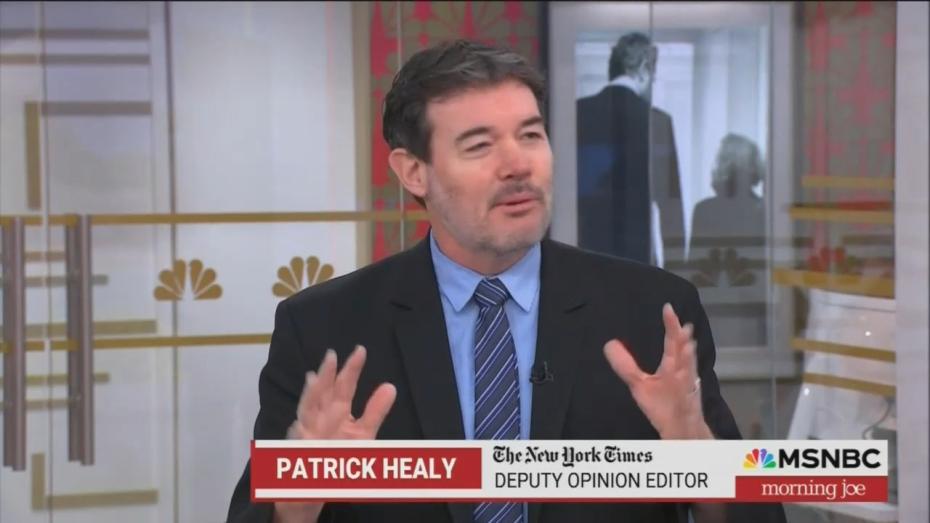
Patrick Healy, assistant managing editor for Standards and Trust at The New York Times, had a fascinating discussion (and some admissions that vindicated conservative media bias critics) in his newly launched weekly newsletter “Sound Off,” where he talks “to critics and skeptics of The Times.”
Healy, formerly a deputy opinion editor and campaign reporter, had a collegial discussion with law professor Josh Blackman, in which Healy conceded much of Blackman’s view that the Times applies a double standard in its political coverage when identifying conservatives vs. liberals. The headline was straightforward: “A Double Standard for “Conservative” and “Liberal” Labels.”
Of course, the Media Research Center has long documented The Times’s stark ideological labeling disparity, with liberals hard to find and conservatives in abundance, sometimes to embarrassing effect:
HEALY: Josh Blackman, a professor at South Texas College of Law Houston, reached out after he was described as “conservative” in two Times articles within 24 hours. He said the label was accurate, but argued that The Times applied such labels inconsistently to academics and analysts — using “conservative” far more. He did his own digging into our usage; so did we, and he had a good point. I asked him to talk it through.
The conversation opened this way:
HEALY: So, Josh, you reached out after The Times twice described you as a, quote, conservative, end quote, law professor. And you said the conservative label was accurate, but that The Times applies labels like conservative and liberal inconsistently to law professors and analysts, and that a scholar’s view should speak for itself. I’d welcome you unpacking that.
(....)
BLACKMAN: I’ll frequently talk to a reporter and they’ll say something like, “How would you identify yourself?” And they’re not asking for my pronouns. They’re trying to get at my politics….And I suspect the reason why they do this is to give their readers sort of a grounding of where I’m coming from. And if this was sort of a neutral policy that’s applied across the board, I wouldn’t have much ground to object, but I find that it’s not….
Blackman continued, “And this sort of reinforces, I think, a perception that both the academy and, frankly, the media views a liberal position as a neutral position. And the conservative position is the other, the outlier.”
Healy actually agreed: “I think there’s real truth to your critique and it’s something we need to do a better job on….It can come off like The Times treats liberals as normal and conservatives as unique and worthy of labeling.”
It's more of a warning label when it comes from The Times.
When Blackman offered an anecdote of the labeling disparity (“there have been articles where it says, “Conservative Prof. Josh Blackman and Professor So-and-So”), Healy replied, “Yeah, I can’t stand that, man. I’ve seen that happen a couple of times in drafts.”
Just a couple of times? The problem goes back decades, as documented on NewsBusters. (Healy’s own left-leaning political opinions often come through in both print and in public.)
Times reporter John Eligon’s August 2012 article on GOP infighting in Kansas was surely one of the most "conservative"- label-heavy stories ever printed in The Times, containing a staggering 33 uses of the word "conservative" in non-quoted material within a 1,367-word article, plus two labels in photo captions, plus one in the headline. By contrast, the common conjunction "and" appeared a mere 27 times under the same parameters.
And “conservative” is just the mildest flavor of description; more hostile labels abound. Ultraconservative, archconservative, and far-right were deployed for a 2023 story on the anti-spending stubbornness of the House Freedom Caucus and a 2022 front-page report on California Rep. Kevin McCarthy’s fight to become House Speaker.
While some unlikely personalities (Geraldo Rivera?) have been dubbed by The Times as “conservative,” some obvious liberal ones have not (Justice Sonia Sotomayor, who has referred to herself as liberal). Liberals have traditionally been hard to find at the paper compared to conservatives, shown side by side in this 2008 rundown of possible VP picks for Democratic nominee Barack Obama and Republican nominee John McCain.
The paper has also had a long-standing obsession with the state of Texas apparently leaning politically further and further to the “far right” (how much room is there left to run?), a trend that accelerated under Republican Governor Greg Abbott.