Is it true that President Trump’s threats to hit Iranian power plants constituted a potential war crime? According to PolitiFact’s Louis Jacobson, that depends on what day of the week it is. On April 7, Jacobson penned a piece that suggested Fox News’s Jesse Watters was probably correct in saying they would not be given historical precedents in places like Iraq, but Jacobson still refused to give Watters a “true” or “mostly true” rating. That was probably because on April 2, Jacobson co-wrote another article with Zoe Weyand giving Democratic Rep. Seth Moulton a “mostly true” rating for claiming they probably would be a war crime.
In defense of Moulton, Jacobson and Weyand wrote that the Additional Protocol I to the Geneva Conventions "would make the bombing of civilian targets, including those in Iran, 'a flagrant violation of international humanitarian law,' said Milena Sterio, a Cleveland State University law professor who specializes in international law. The bombing of a civilian target 'would give rise to a war crime,' she said," even if the U.S. has not ratified Protocol I.
The only thing keeping the duo from giving Moulton a full true rating was the acknowledgment that "there is some nuance in the rules dictating how the attacks are classified by the UN, however. Targets with both military and civilian uses are known as ‘dual use.’"
Despite the fact that Trump’s Truth Social post was about power plants, Jacobson and Weyand first discussed water desalination plants—which Iran has repeatedly hit—before coming to the actual question of power plants, “Other types of infrastructure, such as power plants, might be more legally justifiable as targets, depending on how extensive their military use is.”
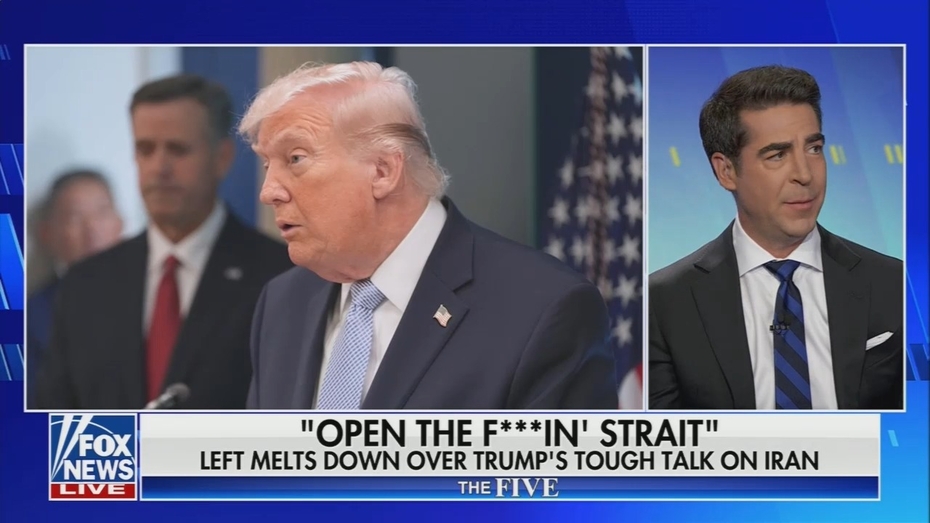
A few days later on The Five, Watters echoed this point, “Bill Clinton destroyed Serbia's entire energy infrastructure. Both Bushes took out Iraq's electricity grid. Rolling Thunder, North Vietnam — Lyndon Johnson took out the power plants. You do it under the laws of warfare. Proportionality, dual-use systems. It can be done humanely."
The aforementioned Protocol I was created after Vietnam, so it is less relevant for more recent analogies. As for Serbia, Jacobson got in the tactical weeds when providing a history lesson, “NATO didn’t reduce Yugoslavia's electrical grid to rubble during the Balkan Wars in 1999; it used projectiles carrying carbon filaments to cause short-circuits and blackouts.”
Wesley Clark, who was the NATO commander in charge of that operation and later ran for president as a Democrat, told CNN on Tuesday that bridges and power plants with military connections are fair targets.
Likewise, Jacobson continues, “In Iraq, the U.S. again attacked power plants, and did so fairly widely, but it tried to limit the destruction, including by using graphite bombs, experts said.”
Jacobson then quoted University of North Carolina Prof. Joseph Stieb as saying, "Overall, I would not say the Iraq bombing campaigns were riddled with war crimes” and “Most of the attacks on infrastructure fit within the ambiguities of what you are allowed to bomb for military purposes."
However, Jacobson still refrained from giving Watters a true rating and appeared to justify this not with a reliance on any realistic hypothetical military operation but on Trump’s social media posts, “During the wars Watters mentioned, ‘military decision-making included internal adjudication over proportionality and limiting civilian casualties,’ said Gregory A. Daddis, a Texas A&M University historian. Such care and deliberation is hardly guaranteed ‘when the commander-in-chief is threatening that ‘a whole civilization will die tonight’ if his demands are not met,’ he said.”
It would be safe to assume that if Trump decided to carry out his threat, he would not have micromanaged the operation to such a degree that he was making tactical-level decisions on what type of bombs were to be used.
One day PolitiFact is rating a Democrat’s warning of war crimes mostly true, despite acknowledging dual-use exceptions to the Geneva Conventions. On another, a conservative is not rated at all despite PolitiFact’s own expert agreeing with his historical analogies for disagreeing with the war crimes allegation. That is one reason for the great imbalance in how PolitiFact ends up rating liberals as more truthful than conservatives.