The New York Times ran an odd front-page story on Wednesday from the 1980s that came to symbolize crime and race issues: A profile of Bernie Goetz, “The Subway Vigilante We’re Still Talking About,” by business reporter David Segal, based on two upcoming books about the infamous shooting case: Five Bullets by Elliot Williams and Fear and Fury by Heather Ann Thompson. Segal interviewed both authors. Williams is particularly left-wing, as is Segal’s sympathetic take on the would-be-muggers, er, innocent “victims.”
Both authors strive to draw nuanced portraits of the shooting victims, who struggled with both physical and psychic wounds. (Two of them, Barry Allen and James Ramseur, have died, the latter possibly by suicide.) Both authors delve into Goetz’s life, too, and he emerges as a flinty eccentric, a man incensed by nearly everything about New York City….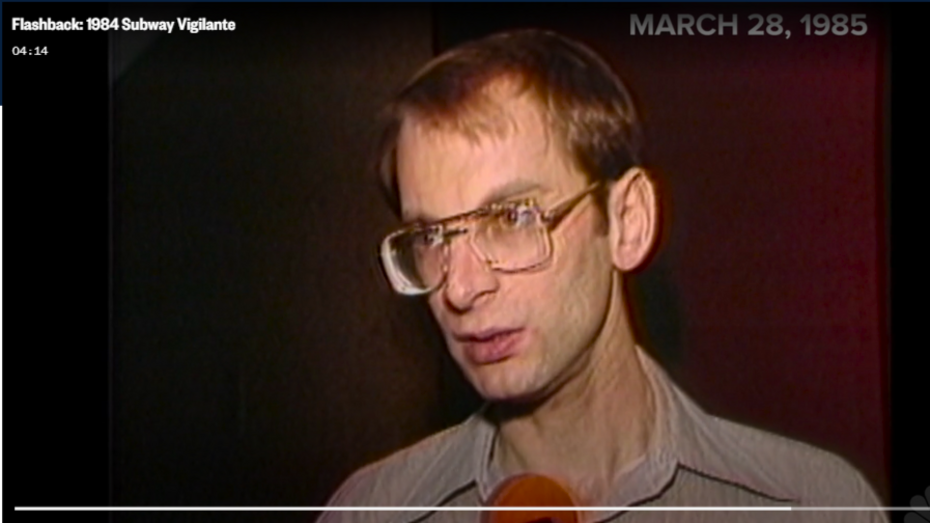
….
Goetz’s path to notoriety began with a spasm of violence that lasted less than 20 seconds, and both books unspool it in harrowing slow motion. Cabey, Allen, Ramseur and their friend Troy Canty were traveling from the Bronx to a video arcade in Lower Manhattan. Canty either asked for or demanded $5 from Goetz. Feeling threatened and cornered, Goetz, who was 37 at the time, shot and wounded all four of the teens.
Goetz spent eight months in jail for carrying an unlicensed firearm.
Note the woke capitalization of "black" throughout, and the unseemly source the Times approached for an opinion.
More than a few Black leaders denounced the verdict at the time, and still describe it as a disgrace.
“I felt it was a blatant miscarriage of justice,” said the Rev. Al Sharpton. “I did not ever say that the young men were choir boys. But do you have the right to execute people based on who they are? That was the fundamental question, as far as I was concerned, and it put all of us in danger.”
Not “choir boys” indeed. As the Times reported, back in 1985, but not in 2026:
Each of the four teen-agers shot on a subway train last month by Bernhard Hugo Goetz had been arrested or convicted at least once and each was facing a trial or a hearing on criminal charges at the time of the incident.
And race-baiting provocateur Sharpton is the last person on earth to be lecturing about putting people in danger, given his literally inflammatory history.
Appearing under the pathetic subhead “Erasing the victims,” this section was a perfect encapsulation of the elitist media mindset:
Thompson chose not to try to contact Goetz. Instead, she took an archival researcher’s approach to convey the obstacles facing young Black men in the South Bronx of the mid-80s. This includes relations with the police, who told the press that several of the young men were carrying sharpened screwdrivers, a notion repeated by the tabloids as well as by The New York Times. It made the teens sound like predators.
Actually, the screwdrivers were unaltered and were being carried to steal quarters at a video game arcade, the teens later said. The tools were also concealed, as the trial made clear, which means Goetz could not have regarded them as a threat.
So the screwdrivers weren’t for stabbing, merely for stealing? Talk about the soft bigotry of low expectations.
Segal concluded with thoughts from left-wing author Thompson smearing recent subway hero Daniel Penny.
….To her, the 2024 acquittal of Daniel Penny, a white former Marine who fatally choked Jordan Neely, a mentally ill Black man, on the New York City subway, suggests not much has changed.
Neely was a loud, threatening disruptor with a long criminal record who posed a potentially deadly threat to other passengers, but you didn't get that information from the Times.