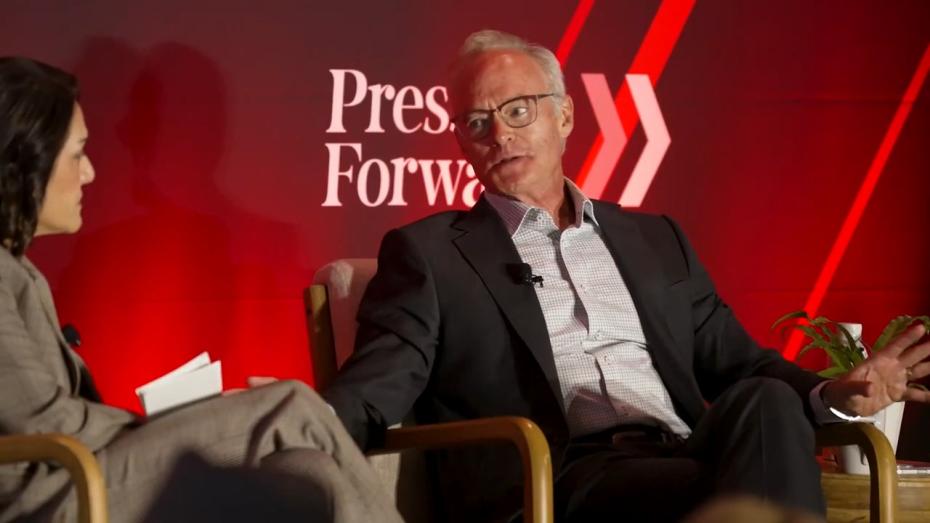
Fired longtime 60 Minutes correspondent Scott Pelley recently appeared at an event to reminisce about his time at CBS and his infamous crashout and subsequent firing from the Sunday magazine show. In an interview labeled a “fireside chat,” Pelley continued his complaints about changes to 60 Minutes, including its new executive producer, and claimed the changes were only made by someone who wanted to “destroy” the show.
Pelley was fired for cause from the show in June after accusing CBS editor-in-chief Bari Weiss of “murdering 60 Minutes” and berating new executive producer Nick Bilton in a meeting.
In the present day, Pelley seemed to want some attention at an event for “Press Forward,” a group that claims to help fund local news. Pelley was asked about the meeting, where interviewer and Knight Foundation president Maribel Perez Wadsworth said Pelley “basically called them to task.”
At a recent event, fired 60 Minutes correspondent Scott Pelley detailed the reasoning behind his crash-out and subsequent firing from CBS, and continued to complain about changes to the magazine show.
He said the appointment of Nick Bilton as executive producer of the show “was… pic.twitter.com/bNZoIPthtN— Nick (@nspin310) October 16, 2026
He began a long-winded answer and said, “Well, we were all staying within 60 Minutes. My team, the other teams, the other correspondents, because we felt throughout this period of pressure and interference that if we stayed, we could affect things for the better. And it was a mission for all of us.”
But then, Pelley complained, “But at a certain point, much to everyone's surprise, we all woke up one morning several months ago and 60 Minutes had been gutted that very morning in a matter of an hour and a half or so. The executive producer, the executive editor, the managing editor, the head of our online organization, two of our best correspondents, all fired one morning without any kind of notice or explanation.”
Pelley continued to bash Bilton, alike to his crashout:
And then they appointed a new person to be executive producer of 60 Minutes who had no experience as a journalist – Well, he was a columnist. I take that back. I reel that back in. He was a tech columnist. He wrote quite a bit about the tech industry. He had produced some television for HBO, as I recall. But in terms of running something like 60 Minutes, no obvious preparation for that at all.”
So, it was a signal to me that it was over, that the DNA of 60 Minutes was broken. Our connection with our 60-year past was over. And we were being placed in the hands, in my opinion, of people who did not know how to take it forward.
As for the DNA of 60 Minutes, the last five years of the show, which included Pelley as one of the main voices, had a five-to-one bias of liberal stories to conservative ones.
Acting as self-important as ever, Pelley said, “So, I felt like somebody had to say something.” He continued, and claimed Bilton read a statement from his phone at the meeting. Pelley then said, “Everybody in the room is thinking, Where is Bari Weiss? How did this happen? Where have all of our managers gone? And now this gentleman is reading some kind of a statement off his phone about how it's not 1968 anymore. And we all have to realize that media has changed, as if we had not.”
Pelley continued to lament, “If we had made some kind of terrible journalistic error and had a catastrophe that Hollywood tends to make a movie about, well, okay, that would be one thing. If the ratings had gone off the cliff, that would be something else. If our online presence hadn't been doubling every year, that would be - we would say, ‘Okay, we get it. We need new leadership.’ None of those things was the case. We had had one of the best years we'd ever had. And the night before, 60 Minutes won Emmy awards, the night before.”
He declared, “So, there was no reason to do this if it wasn't to destroy what 60 Minutes was.”
Pelley later disclosed that he has not watched the new season of '60 Minutes' after his firing. He said, “There is some heartbreak in all of this,” before laughing about the show’s ratings, as he said, "But the ratings are off 25%." https://t.co/qnDqs0TNsU pic.twitter.com/kSz9Sy7sG3
— Nick (@nspin310) October 17, 2026
The interviewer later asked, “So, the latest season just debuted last month. Have you watched?” Pelley slowly admitted, “No.” Then Pelley said, “You know, I was there almost 30 years. And at CBS News, almost 40 years. And there is some heartbreak involved in all of this. And so I really couldn't.”
As Perez Wadsworth moved to a different question to fearmonger about David Elliosn’s ownership of CNN, Pelley interjected, “But the ratings are off 25%.” After the audience laughed, he joked, “My wife did call that to my attention.”
Perez Wadsworth then asked Pelley for his advice for CNN employees. He responded as if he were a hero, “Stick to your ethics and hold the line. Stick to your ethics and hold the line. Oppose everything that shocks the conscience of a credible, reliable journalist.”
The transcript is below. Click "expand":
Press Forward: Journalist Scott Pelley: A Fireside Chat
Timestamp 00:11:10-00:19:40
MARIBEL PEREZ WADSWORTH: What are some of those specific instances? I mean, the final straw that had you in a staff meeting, basically called them to task?
SCOTT PELLEY: Well, we were all staying within 60 Minutes. My team, the other teams, the other correspondents, because we felt throughout this period of pressure and interference that if we stayed, we could affect things for the better. And it was a mission for all of us.
But at a certain point, much to everyone's surprise, we all woke up one morning several months ago and 60 Minutes had been gutted that very morning in a matter of an hour and a half or so. The executive producer, the executive editor, the managing editor, the head of our online organization, two of our best correspondents, all fired one morning without any kind of notice or explanation.
There was never- - no one ever came to the office and said, look, here's why we're doing this. And here's what we did, and here's why it's important, and here's what we want you to know.
Nobody said a word. They just-- we just started getting text messages. ‘I've been fired.’ ‘Me too.’ ‘They fired me in the middle of my contract.’ And we're watching these text messages go by. We couldn't imagine what was happening. A
And then they appointed a new person to be executive producer of 60 Minutes who had no experience as a journal – Well, he was a columnist. I take that back. I reel that back in. He was a tech columnist. He wrote quite a bit about the tech industry. He had produced some television for HBO, as I recall. But in terms of running something like 60 Minutes, no obvious preparation for that at all.
So, it was a signal to me that it was over, that the DNA of 60 Minutes was broken. Our connection with our 60-year past was over. And we were being placed in the hands, in my opinion, of people who did not know how to take it forward.
So I felt like somebody had to say something. They called us together in a staff meeting. The day after everyone was fired, there may have been an intervening weekend. But at any rate, immediately after everybody was fired, they called us into the staff meeting, which we thought was going to be a staff meeting with Bari Weiss, the editor-in-chief of CBS News, so that she could explain why she fired all these people and how we were going to move forward and all of that. Well, we come into the staff meeting, and there's no Bari Weiss. So, now the room is pretty unhappy about that.
And then the new gentleman comes in, his name is Nick Bilton. And he comes to the front of the room, and he starts reading a statement to the staff off of his phone without looking up at anyone. Well, that doesn't go down well. [LAUGHTER] Everybody in the room is thinking, where is Bari Weiss? How did this happen? Where have all of our managers gone? And now this gentleman is reading some kind of a statement off his phone about how it's not 1968 anymore. And we all have to realize that media has changed as if we had not.[LAUGHTER] We said a record that last season in online outreach, we had two billion online contacts for 60 Minutes alone. Growing like mad. We grew the television portion of 60 Minutes 9 percent.
PEREZ WADSWORTH: Wow.
PELLEY: Nothing in network television, nothing is growing 9 percent. So, we had a triumphant year. There was no reason.
If we had made some kind of terrible journalistic error and had a catastrophe that Hollywood tends to make a movie about, well, okay, that would be one thing. If the ratings had gone off the cliff, that would be something else. If our online presence hadn't been doubling every year, that would be - we would say, ‘Okay, we get it. We need new leadership.’ None of those things was the case. We had had one of the best years we'd ever had. And the night before, 60 Minutes won Emmy awards, the night before. So, there was no reason to do this if it wasn't to destroy what 60 Minutes was.
PEREZ WADSWORTH: So, the latest season just debuted last month. Have you watched?
PELLY: No. [LAUGHTER] I haven't. You know, I was there almost 30 years. And at CBS News, almost 40 years. And there is some heartbreak involved in all of this. And so I really couldn't - I really couldn't.
PEREZ WADSWORTH: Yeah. I understand more than you might imagine, to the CNN colleagues –
PELLEY: But the ratings are off 25%.
[LAUGHTER]
My wife did call that to my attention.
[LAUGHTER]
PEREZ WADSWORTH: So the people have spoken is what you're saying. To the journalists, I mean, obviously, you felt compelled you had to take a stand. And there's always this tension point. Do you stay and continue to try to hold a line? Do you go –
To the CNN colleagues now? You've made clear you don't think that they can take David Ellison at his word. What advice do you have for Anderson Cooper, who previously was on 60 Minutes with you, for example?
PELLEY: What advice do I have for them? Stick to your ethics and hold the line. Stick to your ethics and hold the line. Oppose everything that shocks the conscience of a credible, reliable journalist.
Now, they have left Mark Thompson in place.
PEREZ WADSWORTH: For now.
PELLEY: For now. I know Mark. He is a brilliant news manager and journalist of the highest integrity.
So that is a very good sign. I think as long as he's there to your point, he can be a firewall. So is it? They're leaving Bari Weiss in charge of CBS News. Personally, I think that's a terrible idea. She does not have the experience required to run an organization like that. She just - it's not in a fault of her, she just hasn't done it. And it's a big operation to be running.
And again, I'm just very hopeful that with the merger pressure off, with the Trump administration lacking that leverage going forward, maybe things can be better.
PEREZ WADSWORTH: Now, on that same pressure, the merger pressures off from the FCC to some degree. But President Trump has had no qualms about suing media organizations, suing networks, including CBS.
PELLEY: And we caved into that.
PEREZ WADSWORTH: And I believe you referred to that as a multimillion-dollar bribe. That settlement.
PELLEY: Well, Stephen Colbert certainly did. [Laughter] And he was canceled three days, Wigert.
PEREZ WADSWORTH: Yeah. Yeah.
PELLEY: For completely unrelated reasons.
PEREZ WADSWORTH: Yes.
[Laughter]
PELLEY: But you can do the math.
(...)