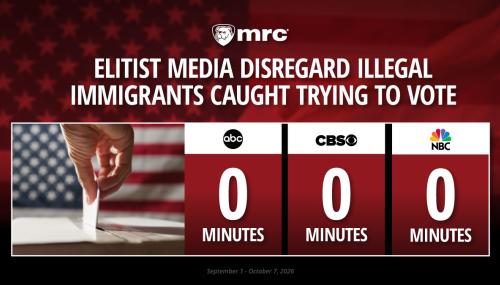
The Elitist Media continue to frame any effort at improving the nation’s election integrity as an attack against our democracy, or some variant thereof. The latest such frame comes via a notorious political operator who continues to masquerade as a “journalist.”
Watch as ABC’s George Stephanopoulos introduces an interview with two like-minded Republicans opposed to the voter integrity executive order:
ORWELLIAN: ABC's George Stephanopoulos suggests election security efforts intend to "subvert the midterms, sow doubt about the results." pic.twitter.com/ezfshlownf
— Jorge Bonilla (@BonillaJL) April 5, 2026
GEORGE STEPHANOPOULOS: President Trump signing an executive order to limit mail-in voting, his latest move to subvert the midterms, sow doubt about the results as his party faces political headwinds.
This is a recurring theme for Stephanopoulos, who set up today’s segment with a similarly-framed report on Good Morning America:
IRONY ALERT: ABC’s George Stephanopoulos and Mary Bruce argue President Trump’s executive order on voter integrity is a new chapter in “President Trump’s attempts to interfere with the midterm elections,” “sow distrust,” and “undermine confidence in the nation’s elections” pic.twitter.com/Q3bPGjOmIZ
— Curtis Houck (@CurtisHouck) April 1, 2026
This is how the media frame any attempt at securing our elections. Election reform laws in Florida, Georgia, and other states were smeared as “voter suppression acts.” These outlets gave oxygen to efforts to remove the 2021 All-Star Game from Atlanta due to the passage of such a law, for example. And they are attempting a similar play now.
The Save America Act, for example, draws scant mention on these outlets despite having broad support from the American people. The requirement of voter ID and proof of citizenship before registering to vote, much less voting, is treated as a horrendous attack on democracy. So, too, are efforts to secure mail ballots.
This is where today’s segment comes in, which serves to promote a lawsuit to be filed by a group called the “States United Democracy Center”, co-founded by MS NOW frequent flier Norm Eisen, seeking to overturn the executive order on mail ballots.
The segment featured the idea of contrast by booking two Republicans, but no real ideological balance inasmuch as they were both opposed to the executive order. So it was basically 10 minutes of bashing the EO, with no one on hand to defend it on the merits.
Thus ABC assumes the editorial position that any effort to secure our election is a subversion or an attack, or some other catastrophic undermining of our democratic principles. This begs the question: what democratic principles are upheld by curtailing election integrity, blocking commonsense voter ID, or stalling ballot transparency? After years of watching nearly EVERYTHING framed as an “attack on democracy”, it is wild to see the media obstruct efforts to defend it.
Click “expand” to view the full transcript of the aforementioned segment as aired on ABC This Week on Sunday, April 5th, 2026:
DONALD TRUMP: I’m very happy to be signing the Voter Integrity and I think it’s going to be really great. So if you don’t mind, I will take some time and I’ll make the signature absolutely perfect.
I don’t see how anybody can challenge it. I don’t see how they can challenge it. And remember, it’s about voter integrity. We want to have honest voting in our country.
(END VIDEO CLIP)
GEORGE STEPHANOPOULOS: President Trump signing an executive order to limit mail-in voting, his latest move to subvert the midterms, sow doubt about the results as his party faces political headwinds.
I’m going to speak to two Republican election experts after this report from Chief White House correspondent Mary Bruce.
(BEGIN VIDEOTAPE)
MARY BRUCE: With just seven months until this year’s midterm election, President Trump this week attempting to crack down on mail in ballots.
TRUMP: I think this will help a lot with elections.
BRUCE: The president signing an executive order directing his administration to create a list of confirmed U.S. citizens eligible to vote in each state and to ban the postal service from mailing voters ballots unless they are on a state’s official absentee voter list. That list must be given to USPS at least 60 days before an election.
TRUMP: I believe it’s foolproof, and maybe it will be tested. Maybe it won’t.
BRUCE: But it’s not clear the president has the authority to do this. The order already facing at least four legal challenges, including one filed by the Democratic Party’s campaign arm and top congressional leaders, and another filed by 22 Democrat-led states, plus D.C. Those states writing, “Neither the Constitution nor any act of Congress confers upon the President the authority to mandate sweeping changes to states’ electoral systems or procedures.”
ADRIAN FONTES: He’s trying to pick his own voters, and that’s not how we do it here in America.
BRUCE (voice-over): For months, the president has railed against mail-in voting, claiming without evidence that it leads to, quote, “cheating”. But cases of fraud involving mail-in ballots are extremely rare. And just last month, the president himself cast a ballot by mail to vote in a Florida special election, even though he was in town when early in-person voting was available.
Trump defending his decision.
TRUMP: You know what? Because I’m President of the United States, and I decided that I was going to vote by mail-in ballot because I couldn’t be there because I had a lot of different things.
BRUCE: The president has increasingly sought to sow distrust in the nation’s elections ahead of the midterms, as he’s remained fixated on his 2020 defeat. The administration actively investigating Trump’s baseless claims that he beat Joe Biden in Georgia and Arizona in that election.
Trump also recently called to nationalize elections, and the Justice Department is attempting to force at least 29 states to turn over voter data.All this as the president pushes Congress to pass the Save America Act, legislation that would require Americans to provide proof of citizenship to register to vote, and a photo ID to cast a ballot in federal elections. But the bill has no clear path forward.
(END VIDEOTAPE)
STEPHANOPOULOS: Thanks to Mary for that. We're joined now by two Republican officials who've overseen elections in battleground states. The Secretary of State of Pennsylvania, Al Schmidt, and the former Recorder in Maricopa County, Arizona, Stephen Richer. Thank you both for joining us.
Secretary Schmidt, let me start off with you. A series of lawsuits have been filed, including one from your state. Are you confident that the courts are going to strike down the president's order? And what happens if they don't?
AL SCHMIDT: I am confident of an outcome in our favor. Americans should rest assured, despite all the back and forth in the courts that we will inevitably see, despite all the back and forth in the press, that Pennsylvania, the birthplace of our republic, and Governor Shapiro are going to stand up for our voters and know that the Constitution is on our side.
STEPHANOPOULOS: And Stephen Richer, you made the point that in your state, it isn't even necessary.
STEPHEN RICHER: Well, in some ways, it's not, because we have some of the underlying features that President Trump aspires to have in all elections, which is that we have documented proof-of-citizenship requirements in Arizona. We have a mail voter list that you have to be on in order to receive a mail ballot. And of course, we, like 46 other states, have intelligent barcodes that allow voters to track their ballots and allow election officials to track those ballots, too.
So, while I agree with some of the elements in the executive order and some of the aspirations, the form does matter, and I agree with Secretary Schmidt that this is probably going to be enjoined very quickly. I think someone on the Internet said this will be enjoined faster than a cheetah on speed, or something like that.
STEPHANOPOULOS: You guys seem pretty confident of that. Mr. Schmidt, so what is your biggest worry going into November? The president has taken several steps to sow doubt about the election returns.
SCHMIDT: I would say my biggest concerns are twofold, one, that things like this cause some degree of confusion. We want voters to know that the election is going to be free, fair, safe, and secure, and that everyone knows what the rules are prior to going into this. So, confusion is never a positive thing, unless you are seeking to sow distrust in the outcome of an election.Otherwise, our election administrators in our 67 counties in Pennsylvania and our Pennsylvania Department of State prepare for every conceivable problem or issue that might occur on Election Day or leading up to Election Day. It's just that, now, we're in a slightly different realm, where the inconceivable is something that is very much on the table that we have to prepare for.
STEPHANOPOULOS: Mr. Richer, the president is still investigating the state of Arizona, trying to investigate the state of Arizona, trying to overturn the results of 2020. What are the prospects for that?
RICHER: Yes, I don't think that's going anywhere. 2020 has been investigated up the wazoo. In Arizona alone, we've had 11 different independent investigations and audits. The attorney general of Arizona previously spent over 10,000 man-hours investigating Arizona, but this seems to be a trend, and I don't know what to end other than to sow further confusion, sow further doubt in the election process, which is why I'm very disappointed with what's happening in Riverside, California, disappointed with what's happening in Fulton County, Georgia.
A number of election officials and I have a report coming out this week about Fulton County, about how the underlying allegations that serve as the basis for the warrant are completely baseless. And so, we'll be putting that out with a group called States United Democracy Center later this week.
STEPHANOPOULOS: Mr. Schmidt, are we heading towards another situation after these midterms, like we saw in 2020, where the results are going to be challenged and the doubt is going to be sown?
SCHMIDT: I certainly hope not. And I hope that we don't see or revisit any of the ugliness that we all experienced across the country in 2020, where there was an effort to undermine confidence in election results based on no facts whatsoever.
So again, it's all about us being prepared. It's not about us worrying. It's about us preparing. And that is exactly what Pennsylvania is going to do in the lead-up to this election.
STEPHANOPOULOS: And Stephen Richer, you took some heat for standing up in 2020 against the claims of fraud and against the doubt that the president seeded about the election. What's your message to Republicans today?
RICHER: That at the end of the day, the only person you have to be consistently happy with is yourself. And so, while there might be political pressures and while you might have political ambitions and while members of your precinct committee chapter might be yelling at you, you have to do what you know to be right because you have to live with it for the rest of yourself.
Fortunately, I've had some wonderful models and some wonderful companions like Secretary Schmidt, like the guys in Georgia, like Adam Kinzinger, Liz Cheney. And I hope that as more and more people do this, people will eventually see that there is no there there, because we've been saying fraud, we've been saying the time has come for about six years. And the fact remains that the president has not produced a single scintilla of evidence to suggest that the 2020 election was stolen. And so I’d suggest that this is more about ego, but that we move forward because the president is president now and he has the opportunity to do whatever he wants to do as president.
STEPHANOPOULOS: Thank you both for your time this morning.