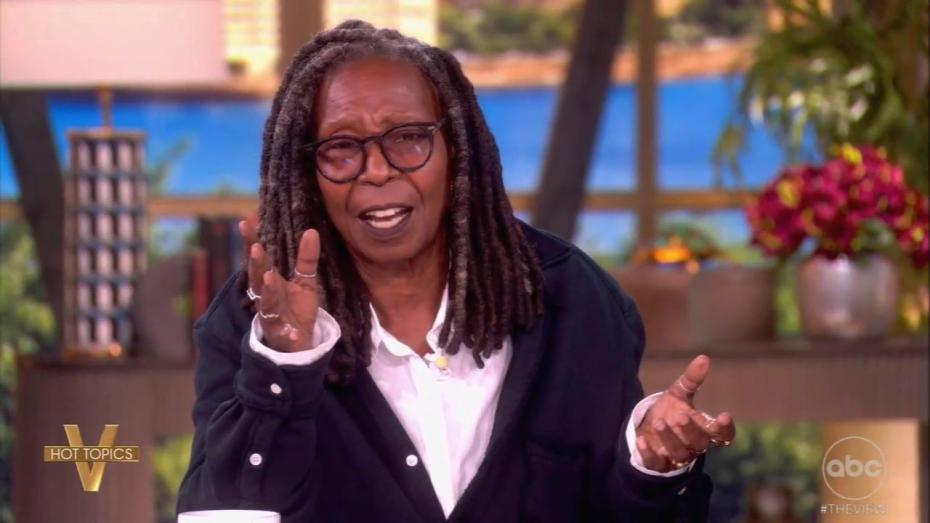
ABC’s The View found yet another way for their fans to be worried about the country’s reputation on Monday, in which the public execution of a mass murderer would make the United States look like a merciless country. In discussion of the possible public execution of convicted Fort Hood shooter Nidal Hasan, the co-hosts invoked dictatorship regimes, terrorist propaganda, and the United States’ history of racial violence to argue against the execution.
Co-host Whoopi Goldberg kicked off the discussion with how private executions “was the last bastion of humanity,” and what the implementation of this practice on Hasan would say about America. Alarmingly, she seemed more consumed with how the country would be perceived rather than the deaths of Americans caused by said terrorist.
This prompted co-host Alyssa Farah Griffin to make the claim that the United States would be in the company of terrorist regimes famous for murdering innocent people: “The only nations on earth that do this are Iran, North Korea one, Iraq ones that we don't lump ourselves in with generally from a morality perspective.”
Griffin then went on to warn that terrorists could use this footage of Hasan’s execution as propaganda for other terrorist groups: “But, most importantly, it would be giving this terrorist exactly what he wanted. It would be used in terrorist recruitment propaganda all over the world. We would be making a martyr out of him. It’s out of step with our values. I think they will have to reverse course and it absolutely should not be live streamed.”
The View says the Trump administration is destroying America's "humanity" with possible public execution of a convicted terrorist, say it's reminds them of dictatorships. pic.twitter.com/gklvriBu5b
— Nicholas Fondacaro (@NickFondacaro) October 12, 2026
Ana Navarro gave a sliver of hope with the acknowledgement that Hasan “committed a heinous crime, killed 13 people, injured – wounded 32,” until she began her comparison of the execution to Castro’s Cuba and the overall apparent connection of public executions to dictatorships (Click “expand”):
I think the idea of making it public is frankly horrific. And I grew up -- you know you talk about when you were a kid -- I grew up in Miami where there is a large Cuban-American community, and I remember the images of Castro doing firing squads against political prisoners and political dissidents in Cuba who would scream, who would go down as they were shouting [speaking Spanish], which means long live Jesus Christ, or [speaking Spanish], long live free Cuba. And those are the images that I remember. So, when I think of public executions I think of dictatorships, I think of inhumanity. I think of something that we should not stand for or project around the world.
Sunny Hostin equated the possible public execution of a convicted terrorist to public lynchings:
"I remember speaking to my grandmother and my great-grandmother from Augusta, Georgia, talking about the public lynching of black Americans with white spectators watching burning… pic.twitter.com/9OsgH6YmqM— Nicholas Fondacaro (@NickFondacaro) October 12, 2026
Then came co-host Sunny Hostin, who went on to compare the public execution of Hasan, convicted murderer and terrorist, to the history of racial injustice faced by innocent African-Americans. The fact that Hostin would even compare the history of violence on African American deserves its own reality check:
I remember speaking to my grandmother and my great-grandmother from Augusta, Georgia, talking about the public lynching of black Americans with white spectators watching burning bodies and dangling feet from trees. That is an America that people that are alive today lived through. My father being one of them. And so, for me, the notion that people would watch an execution for sport is very un-American and is disgusting. Not to mention that I don't believe in the death penalty.
The real irony of the whole segment was how the co-hosts spent the entire time arguing how the execution could make Hasan a martyr to other terrorist groups, yet failed to acknowledge the fact that they outlined exactly how his death could be weaponized and be used against the United States.
Talk about propaganda.
The transcript is below. Click "expand" to read:
ABC’s The View
October 12, 2026
11:26:18 a.m. Eastern(...)
WHOOPI GOLDBERG: When I was a kid, people always said that that was the last bastion of humanity, that we did not do that. We did not show public executions. So, I guess, you know, we also have to figure out a way to hold on to our humanity in order to get through this. Now, you know, I understand we have -- we had these discussions just a few days ago about executions and whether -- whether you're for public -- not public executions–
SARA HAINES: Death penalty.
GOLDBERG: But the death penalty. And so, I put it out to the table. What is this saying about America as a whole now?
ALYSSA FARAH GRIFFIN: They're going to have to reverse course. We haven't done a public execution since 1936 was the last time. The only nations on earth that do this are Iran, North Korea one, Iraq ones that we don't lump ourselves in with generally from a morality perspective. But, most importantly, it would be giving this terrorist exactly what he wanted. It would be used in terrorist recruitment propaganda all over the world. We would be making a martyr out of him. It’s out of step with our values. I think they will have to reverse course and it absolutely should not be live streamed.
ANA NAVARRO: Nidal Hasan committed a heinous crime, killed 13 people, injured – wounded 32. I think he should be executed. I think the idea of making it public is frankly horrific. And I grew up -- you know you talk about when you were a kid -- I grew up in Miami where there is a large Cuban-American community, and I remember the images of Castro doing firing squads against political prisoners and political dissidents in Cuba who would scream, who would go down as they were shouting [speaking Spanish], which means long live Jesus Christ, or [speaking Spanish], long live free Cuba.
And those are the images that I remember. So, when I think of public executions I think of dictatorships, I think of inhumanity. I think of something that we should not stand for or project around the world. So, you can be in agreement that this guy is a horrible criminal and terrorist who needs all sorts of punishment, but is that what America wants to project?
(...)
11:28:31 a.m. Eastern
(...)
SUNNY HOISTIN: I hope not because, you know, you have those images of Cuba. I remember speaking to my grandmother and my great-grandmother from Augusta, Georgia, talking about the public lynching of black Americans with white spectators watching burning bodies and dangling feet from trees. That is an America that people that are alive today lived through. My father being one of them. And so, for me, the notion that people would watch an execution for sport is very un-American and is disgusting. Not to mention that I don't believe in the death penalty.
(...)