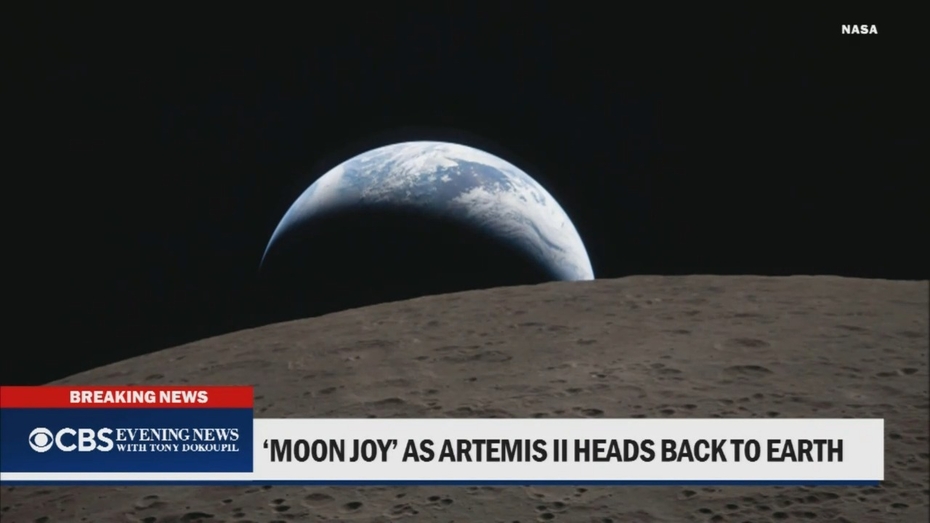
This, Kennicott argued, has “eclipsed” any “allure” of space, “the striking images” sent back, and the “bravery and telegenic decency of the astronauts.”
The print headline denoted a serious case of Trump Derangement Syndrome: “Artemis II’s view of a dark horizon; President Trump’s menacing rhetoric toward Iran eclipses the new wonders of the Space Age.” Over online, the headlines warned of “dark rhetoric eclipsing” NASA’s “new wonders.”
Kennicott started with the 1969 moon landing and even that wasn’t something he was keen on acknowledging as a monumentally positive and thrilling human achievement. The reason? He didn’t use the words jingoism or nationalism, but he called it “propaganda” as part of the Cold War between the U.S. and the Soviet Union.
Additionally, he claimed “[t]he euphoria of the first moon landing was directly connected to our ambivalence about the science that made it possible” because such early days of rocket technology also brought about the power to destroy humanity via “hurl[ing] hydrogen bombs across the planet.”
“So much of the infrastructure of America’s postwar comfort and prosperity was erected not just to serve us as citizens but to advertise our democracy and our dynamic but brutal system of untrammeled capitalism,” he further griped, sounding like an America-hating history professor conceived in a petri dish at the Babylon Bee.
But fast-forwarding to 2026, Kennicott fretted that while some on Earth “may delight in the lunar imagery, the clarity of the craters, the detail of its blasted surface, the pits and wounds of some 4.5 billion years of exposure to the vicissitudes of space,” others are consumed with crippling fear over Trump “using the language of genocide and apocalypse to threaten a country that posed no imminent danger to the United States.”
He continued to stray off-course from discussing Artemis II by blaming Trump’s saber-rattling on whatever the Iranian regime would do to its own citizens because they “are in survival mode, armed with ideological certainty, terrible powers of coercion over their own people and an unknown number of missiles”: “[W]e can be certain that the ordinary people of Iran will suffer terribly from their use, not just the country’s elite or its brutal rulers.”
Never mind that the regime has already killed tens of thousands of its own citizens this year, of course.
Kennicott returned to space and, this time, he chose to have a positive view of the original space race because “the allure of the technology, the bravery and telegenic decency of the astronauts, and the symbolic power of winning the race to the moon eventually won out” against naysayers.
The current state of the country, however, lacks “any kind of ideal at all” and the ability to tell the world “[t]rust us, we will use this power well and wisely.” Thus, he claimed, the Artemis II mission was empty even though it “carries men and women of great courage and competence.”
He finally arrived at his conclusion that, last week, the world spent the day “staring at...cellphones, wondering whether there might be nuclear bombs” used by the President against Iran and thus “damag[ed]” the ability for anyone to exhibit joy about Artemis.
“Artemis II felt like an echo of a world that has passed, an old, beloved leitmotif from a symphony we have shredded. The distant, wide-eyed wonder of unprecedented achievement of the Space Age had been eclipsed by a deferred promise to return an entire people to the Stone Age,” he insisted.