In the twilight (let’s hope), of the cancel culture era, the New York Times is reduced to going after roadside attractions. Sunday’s New York Times featured “Tacky, Rude and Beloved: Is an I-95 Landmark Worth Saving?” written by Durham, N.C.-based reporter Eduardo Medina and accompanied by 24 photos (ahem, “Visuals”) by Will Crooks of the “South of the Border” attraction in South Carolina, located on the border with North Carolina.
Maybe Medina ended up being charmed in spite of himself, because his own comments in the story’s comment section were somewhat affectionate. But in the story itself, Medina suggested the world would be better off without it:
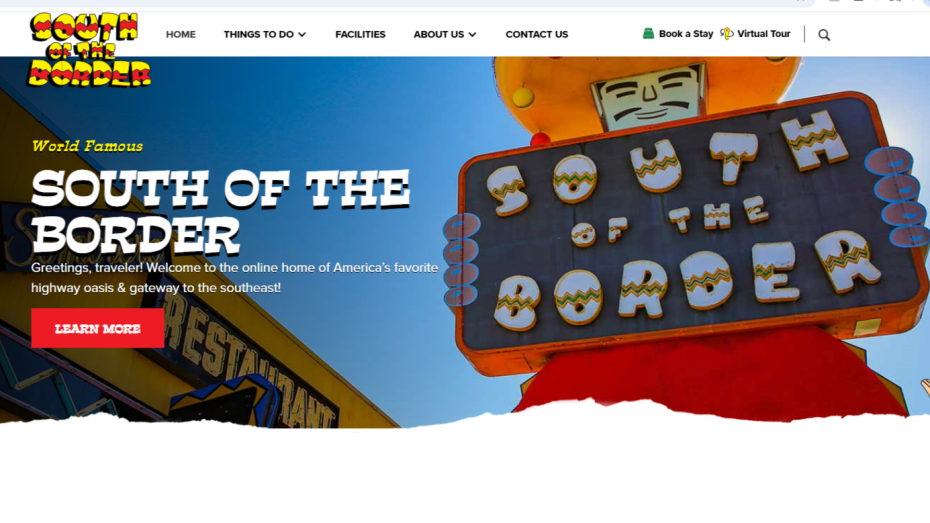 Screenshot from Website
It emerges from the horizon like a cartoonish fiesta as you cross the state line dividing the Carolinas.
For almost 80 years, the roadside attraction on Interstate 95 known as South of the Border has drawn adoration, criticism and everything in between.
But over time it has also prompted questions like: What is this place doing in the rural South?
And more recently: Should it still exist?
On a long, long highway, right where one land turns into another, a place called South of the Border has welcomed weary travelers for generations, beckoning them with a towering, neon-lit sombrero. Underneath its brim: cheap motel rooms and restaurants serving burritos, tacos and margaritas.
….
….South of the Border in Dillon, S.C., is a relic of American road travel, echoing midcentury highway oddities like Wall Drug in South Dakota and the world’s largest of just about anything across the Midwest. It harks back to a different time in the South, before the region diversified and exploded in growth.
Now, authentic Latin American spots abound, as do popular chains like Buc-ee’s and Wawa, adding to the many challenges for the aging attraction. And at a time when the country is mired in debates over immigration and identity, the kitschy, Mexican aesthetic that South of the Border embraced in its early years feels culturally fraught, and to some, offensive.
Now ask yourself: are drag queens so "kitschy" in mocking women that they are "culturally fraught" and "offensive"? Not to The New York Times.
After Medina interrogated the vital issue of “Pedro, the stereotypical, mustachioed mascot,” he turned to cultural appropriation.
Is the owner Mexican? (No.) Was the attraction built for fans of Disney World on their way to Orlando? (It predates that theme park, as well as construction of I-95.)
“It’s like a Mexican wonderland,” Vincent Toigo, 27, who is of Portuguese descent, told his family as they perused Pedro’s Mexico Shop, spotting Día de Muertos art.
….
Over the years, some have found aspects of South of the Border problematic. The mascot was named after Mexican men who worked at the attraction decades ago and whom visitors called Pedro, no matter their real names. Alan Schafer once recalled that the Mexican embassy had complained that the attraction was spreading ethnic stereotypes.
A book about consumer culture in the South captured how Alan faced criticism in the 1980s for having billboards that parodied Hispanic accents. He changed them, he said at the time, because “baby boomers do not have a sense of humor.”
Rosa Grijalva, 30, who is Mexican American, recently visited after her family was intrigued by the sight of a towering, neon Pedro statue.
“I do think it’s offensive,” she said of the theme, standing underneath the mascot’s arched legs that straddle the road. But such caricatures, she added, “don’t really bother me.”
It certainly bothered the New York Times, which is still trying to gin up 2018-style outrage in 2026, midway through the second term of Donald Trump, the living backlash to cancel culture.