On Tuesday, Washington Post local breaking news reporter Dana Hedgpeth penned an article entitled “Three words in the Declaration of Independence paint a cruel picture of Natives.” However, while Hedgpeth was eager to remind everyone this meant the Declaration’s “ideals were not extended to everyone,” the historical context she provided for the “merciless Indian savages” passage was quite thin.
Hedgpeth, whose bio refers to her as “a Native American journalist” who has “covered topics including Native Americans and their history," begins by setting up the story of “McKaylin Peters, a 24-year-old Native American graduate student at Johns Hopkins University, still recalls when she first heard the words ‘merciless Indian savages.’”
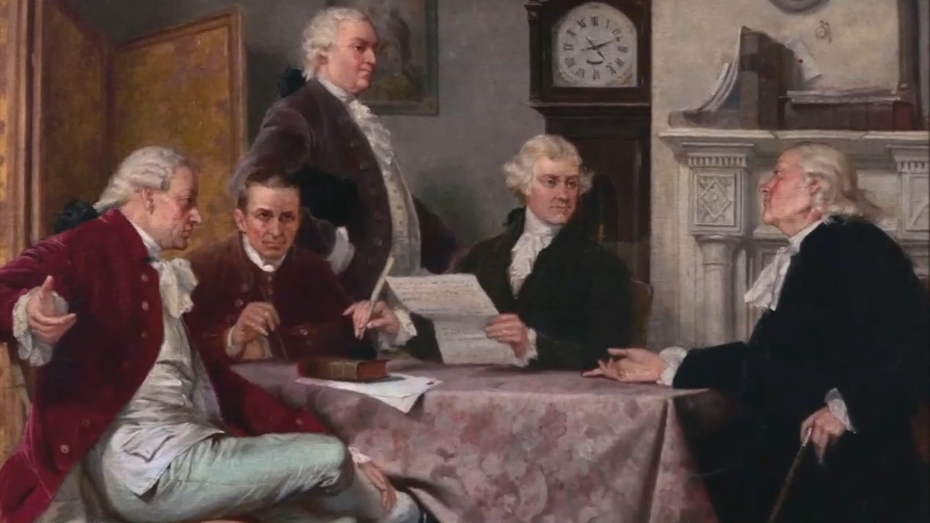
She then adds, “She cringed when the teacher read a passage deep in the Declaration of Independence: ‘He has excited domestic insurrections amongst us, and has endeavoured to bring on the inhabitants of our frontiers, the merciless Indian Savages, whose known rule of warfare, is an undistinguished destruction of all ages, sexes and conditions.’”
Ahead of America 250, she also claims, “Peters and other Native American scholars and tribal leaders are reflecting on the Founding Fathers’ use of the derogatory description for Indigenous people in 1776. Many note that while the Declaration promises that ‘all men are created equal,’ its ideals were not extended to everyone.”
Hedgpeth also claimed, “The document’s portrayal of Indigenous people helped establish a moral and legal framework that justified decades of devastating U.S. policies toward Native communities, according to historians.”
She also quoted Peters as saying, “It’s a reminder that this country was built by declaring us less than human. When the Declaration of Independence calls us that, it’s a message that Native youth sadly still hear today in classrooms, policy debates and in how society talks about us.”
Eventually, Hedgpeth got to some historical context. The first interesting tidbit she provided undermined her central argument, although she didn’t appear to realize it, “[Thomas] Jefferson described Indigenous people as just, honorable and noble — a sharp contrast to the widespread European belief that Indigenous people were inferior.”
So, where did this idea come from? While the common image of 18th century warfare is two armies standing in a field about a hundred yards apart and firing at each other, frontier warfare was something entirely different:
Repeated violence between Indigenous people and settlers also helped shape the ideology behind the description, including the French and Indian War and Dunmore’s War in 1774, when Virginia colonists fought the Shawnee and Mingo to expand into the Ohio Valley, according to historians. In the summer of 1776, as the Declaration was drafted and adopted, a lesser-known conflict unfolded when Cherokee warriors attacked frontier settlements across parts of Virginia, North Carolina, South Carolina and Georgia. Colonists responded by burning more than 50 Cherokee towns and driving Native people from their homes.
By 1776, the Founding Fathers ‘understood their need to accuse the king of what they considered the ultimate crime — partnering with Indigenous peoples and arming them,’ said Ned Blackhawk, a Native American author and Yale University historian. ‘So they created this vilification in the Declaration that, in many ways, was at odds with their experience of living alongside Natives for generations.’
Jefferson’s praise for the natives is not inconsistent with the grievance against the crown. Frontier warfare did not begin in 1774 or even the French Indian and War. Contrary to Blackhawk’s assertion, for several decades, the reality of frontier warfare with the French and their native allies saw the destruction of villages as the Declaration passage in question says. Surely, one can understand why the colonists would be angry at the king for now allying himself with such tribes. It was a trend that would continue during the Revolutionary War.
Hedgpeth closed out her article by quoting Center for Native American Youth at the Aspen Institute, Tracy L. Canard Goodluck. Underneath a picture of her wearing a shirt that said ‘“Merciless Indian Savages’ – Declaration of Independence’ she wrote:
‘Those words served the purpose back then as a way to dehumanize Native people in this country,’ said Goodluck. ‘We need to change that narrative. We’re still here. We’re doctors, lawyers, teachers and political leaders.
‘I am that merciless Indian savage who my ancestors prayed for to do great things.’
Goodluck is not “that merciless Indian savage.” She may think she is turning the table on Jefferson and the country, but she is not. They say war is hell, but frontier warfare was another level of hell. You cannot understand Jefferson’s writing without the historical knowledge of the reality of frontier warfare up through 1776. If the Washington Post wants to teach nuanced and complicated history then that should extend both ways.