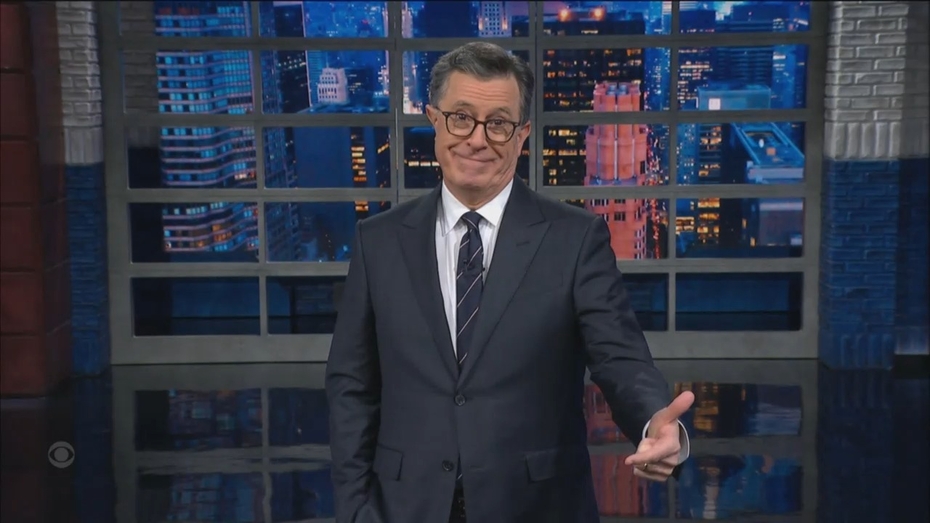
CBS’s Stephen Colbert has the week off, but he still found time to stop by The New York Times for an interview with John Koblin that was published on Tuesday to look back on his time as host of The Late Show that will come to an end on May 21. Throughout the interview, Colbert remained blind to the idea that his raging partisanship led to his downfall.
Koblin wrote, “When Mr. Colbert took over ‘The Late Show’ from David Letterman in 2015, his plan was not to have a ruthlessly topical or political show. ‘We were discouraged by the network from being topical,’ he said.”
However, he also recalled how that had changed by the 2016 conventions, which led Colbert to add, “I was like Clint Eastwood in ‘Unforgiven,’ or is it some other movie? He buried his guns. And I’m like, you know, I buried those damn guns. I was talking to Paul Dinello — he’s one of my oldest friends and one of my producers here — and he’s like, ‘You’re having fun, and people love to see that.’ And I said, ‘But that means I got to go dig up the guns.’ And he says, ‘Buddy, that’s the part the audience wants to see.’”
Over time, those audience numbers would decline and cast doubt on that assertion, but Koblin moved on to the idea that Colbert and his late night colleagues have become free speech martyrs, “Why do you think the F.C.C. and the Trump administration are so focused on you?”
Colbert then made a startling admission when he recalled how allegedly straight newspeople tell him they wish they could be more like him, “Authoritarians don’t like anybody who doesn’t give them undue dignity. Comedians are anti-authoritarian by nature. And authoritarians are never going to like anybody to laugh at them. The number of newspeople who have said to me or Jon Stewart or any of the guys who do this, ‘God, I wish I could say what you say on air.’ And we can. I think that upsets them. I think it might be upsetting that we really do not live in their world of principalities and powers.”
Koblin then wondered, “Given that you and other late-night hosts have become political targets, and given how partisan late night has become, do you have any regrets that it’s gotten to this point?”
Colbert’s response was the hardest to take seriously, “I don’t have any problem with Trump being a Republican. I have a problem with Trump being a complete narcissist who is only working for his own interest and does not appear to care if the entire world burns. That’s not a partisan position. I have eyeballs and ears, and I think calling late night partisan is just roughing the ref. And we don’t even want to be refs, but they perceive us as refs. I reject the partisan description. Partisan means you’re never, ever going to make a joke about a Democrat, and that’s just not true. There’s just no comparison of how fertile the fields are.”
Historically, Colbert tells thousands of jokes per year, so the idea that being partisan means telling literally zero jokes about Democrats is setting up an impossible standard for critics. Second of all, Colbert criticizes Trump and other Republicans all the time for their policy ideas—not just their “narcissist” tendencies, so the idea that Colbert doesn’t have a problem with Trump being a Republican is not true. Finally, Colbert’s “comparison” remarks are also hard to take seriously. The late night shows have not told a single joke about former Rep. Eric Swalwell since he was accused of being a rapist, nor have they joked about former Rep. Shelia Cherfilus-McCormick, who recently resigned before she could be expelled for corruption. For comparison, former Rep. George Santos was joked about 835 times during a strike-shortened 2023, including 262 times by Colbert.