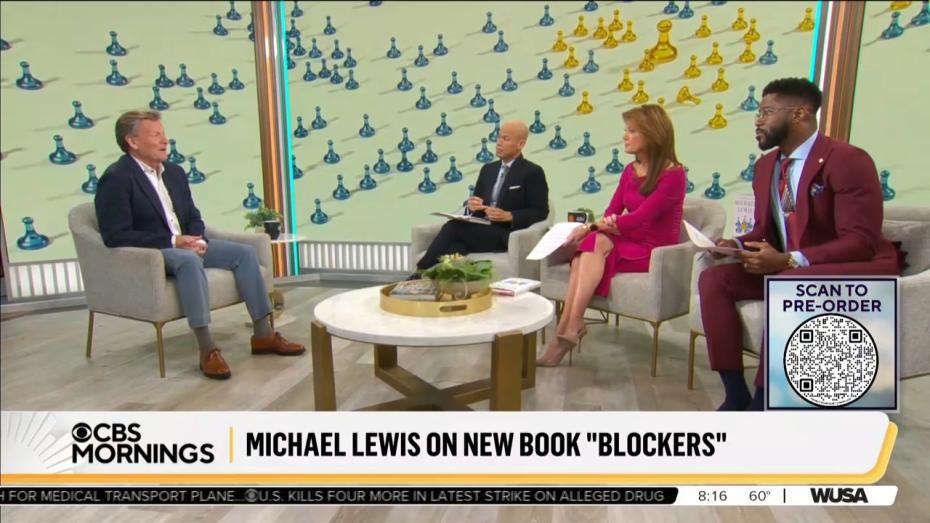
Between CBS Sunday Morning and Monday’s CBS Mornings, CBS News went out of its way to team up with liberal author Michael Lewis to come off as hot and bothered by the subject of Lewis’s new book Blockers, which acts as a shrine to federal workers who worked to undermine President Trump and Elon Musk’s Department of Government Efficiency (DOGE), heralding them as non-partisan actors whose only allegiance is to the Constitution.
Never mind, of course, that the home of the federal government — Maryland, Northern Virginia, and Washington, D.C. — is one of the bluest areas of the country.
Starting with CBS Mornings, co-host Norah O’Donnell gushed Lewis’s newest book looked at those seeking to ruin DOGE and “the mission…to eliminate what the billionaire called waste, fraud, and abuse.”

Monday’s ‘CBS Mornings’ had a whole segment gushing over Michael Lewis’s new book about “Blockers,” a fawning tribute to federal workers who have tried to sabotage President Trump’s agenda and undermine DOGE
— Curtis Houck (@CurtisHouck) October 6, 2026
Yet, Darcy, Baragona, et al. want you to think CBS News is MAGA-coded pic.twitter.com/JsW0QMtvNk
After a detour asking Lewis to weigh in on the (left-wing-driven) hysteria over AI, Lewis explained the title’s origin:
So, that’s Elon Musk’s word. He said he told his 20-somethings who went into the government to create as much destruction as possible. He said, “find the blockers,” the people who were kind of trying to stop us from doing what we want to do, and get rid of them, and I thought when I tried to meet — I met some of these people who got, like, flushed out of the government — unbelievably good at their jobs, oath to the Constitution, serving the country, doing really important things.
The notion that government workers willingly serve and carry out a president’s agenda regardless of party is, in this day and age, foolhardy.
Citing a piece by future New York Times reporter Jonathan Swan in The Hill, our friends at America First Policy Institute (AFPI) said 95 percent of presidential donations went to Hillary Clinton, with further research revealing “the average career employee gave to candidates” in the 2014 midterms “who were more liberal than President Obama’s politically appointed agency heads donated to.”
Following the 2024 election, AFPI wrote that a Napolitan Institute poll found “42 percent among federal managers” would “plan to resist” the Trump agenda, versus “29 percent of voters nationwide[.]”
But O’Donnell was smitten by this pie-in-the-sky mentality, arguing federal workers act without hesitation toward “[p]rotecting the environment, [and] taxpayers.”
“I thought — oh, he thinks blockers is an insult? We’re going to turn this into a compliment,” Lewis explained.
Featured co-host Vlad Duthiers gushed that federal workers opposed to Trump “are profiles in courage, in fact, because one of the most provocative ideas in your book is that what looks like government inefficiency to us, and to a lot of people on the outside, exists for a reason.”
In a gag-worthy question displaying the left’s penchant for a Rule of Experts world where individualism is discouraged and/or wrong, Duthiers then asked:
So, what do you believe is the reason why most Americans fundamentally misunderstand why these people are there and what they do? Because these are people that most Americans have never heard of. They don’t know who they are, and yet, they are responsible for making our lives better.
Lewis’s answer came off like something concocted by Aaron Sorkin for The West Wing, down to the claim that “civil servants” that make up the federal workforce are wholly committed to science and should never be confused with “politics” (click “expand”):
LEWIS: Yeah. No, the answer — I think the answer is pretty simple. Their stories don’t get told. And their stories don’t get told for a reason. They’re not allowed to tell their stories, but there is — I think most Americans think when they think government, they think politics because that’s what they see. They see people who are on television trying to get elected. This apparatus, this two-million-person apparatus that is actually our government, filled with civil servants, they aren’t allowed to promote themselves. There’s a layer of political people between them and the public who don’t want them to get the attention, and so, when the stories don’t get told, it creates this vacuum and, in rush, lots of false stories.
O’DONNELL: Well, people do understand healthcare, and they do understand the NIH, and they do understand that the NIH funds a lot of medical research, and one of the so-called blockers is Francis Collins —
LEWIS: Right.
O’DONNELL: — the head of the NIH who was flushed out.
LEWIS: Yeah, what I loved about it — so, what I love about writing this thing, I mean, it is awful to say, because it’s really good, I think, to tell these stories, but it’s wildly fun to tell these stories, because Francis Collins — I mean, he’s a legend, right? I mean, he found the gene that caused cystic fibrosis. He was in his lab, just trying to do science, and he gets a call right after the Trump administration rolls in and says, ‘Out of there — pack your bags. Out of there in 24 hours.’ And when I go to meet with him, he says, “I got whacked.” You know, he was — like a mob hit.
The interview ended with co-host Nate Burleson fretting, “[W]hat is the long-term impact that this Trump administration is going to have when they are getting rid of these — these seasoned experts in their fields? What impact is that going to have on us?”
Lewis argued Americans don’t know what’s good for them (click “expand”):
LEWIS: I don’t think Americans have realized that it has been a massive power grab, and what we had before was a government where The Blockers took an oath to the Constitution. They served the country. If the President asked them to do something illegal, they weren’t — they weren’t to do it. They have shifted — the Trump administration is trying to shift this to a loyalist operation, where the two million people served not the country, but a single man, a President, and that — that ripples through the government. It means all the different things the government does is going to do — it’s going to do a little differently because the incentives of the people in the government have been shifted.
BURLESON: And we feel the ripple effect.
LEWIS: You will feel the ripple effect. All of a sudden, I mean — you may not feel it now, but all of a sudden, like your tax returns are not as safe as they were, you know, two years ago.
Rewind a day to CBS Sunday Morning, where host and former Obama campaign volunteer Jane Pauley swooned Lewis penned a book on the “career civil servants who stood up to Elon Musk, DOGE and the Trump administration not all that long ago.”
Sunday Morning national correspondent Robert Costa’s piece opened with Lewis reading the oath federal workers take to uphold the Constitution, further romanticizing one of the bluest professions and stereotyping those opposed to an expansive federal government as ignorant rubes who instead need to be “thank[ing] God” for being “some of the most valuable people on the planet” (click “expand”):

Rewind a day to CBS Sunday Morning where host and former Obama campaign volunteer Jane Pauley swooned Lewis penned a book on the “career civil servants who stood up to Elon Musk, DOGE, and the Trump administration not all that long ago.”
— Curtis Houck (@CurtisHouck) October 6, 2026
Sunday Morning national correspondent… pic.twitter.com/z49ccIG8fQ
LEWIS: I will well and faithfully discharge the duties of the office on which I’m about to enter. So help me, God. Civil Service Oath of Office, U.S. Code 3331.
COSTA [TO LEWIS]: Do you believe most Americans know that civil servants in the federal government take this oath?
LEWIS: No. No. I didn’t know. I don’t think I knew even after I’d written a whole book about them. So, I assume not.
COSTA: For author Michael Lewis, pursuing knowledge is a calling...Challenging assumptions is a running theme for Lewis, including those about the occupants of Washington’s federal buildings — government workers, sometimes derided as faceless bureaucrats.
LEWIS: That’s the stereotype.
COSTA [TO LEWIS]: Many Americans think like that.
LEWIS: That’s right, faceless bureaucrats.
COSTA [TO LEWIS]: They don’t like the government.
LEWIS: Right. They don’t like the government, or they think they don’t like the government. They think they don’t trust the government, but in fact they just don’t know how much they trust the government. They take the trust for granted. Every time they drink water out of the tap, or fly on an airplane, or eat food, or put dollars in their bank account, they’re trusting the government, and I thought, who are these people? And we live in a society that is largely focused on personal ambition. It’s a — it’s a free market capitalist society and people are really interested in money and fame.
COSTA [TO LEWIS]: You’ve chronicled it more than most.
LEWIS: I’ve chronicled a lot of it. To find these people who are some of the most valuable people on the planet, who are interested in neither money nor fame, but have found some other purpose, who have a sense of public spirit, who are not — who basically not selfish — and the government is a place where you can really do stuff that makes a difference, and it attracts these people. And thank God for them.
After Lewis explained the book’s title, Costa just so happened to have found for an interview a tailor-made example of a former IRS worker who “was responsible for protecting taxpayers’ personal information,” and fought the Trump administration’s efforts to use the IRS to find illegal immigrants:

Later, Costa just so happened to have found for an interview a tailor-made example of a former IRS worker who “was responsible for protecting taxpayers’ personal information,” and fought the Trump administration’s efforts to use the IRS to find illegal immigrants pic.twitter.com/hEpDlsi8Ks
— Curtis Houck (@CurtisHouck) October 6, 2026
Costa’s example anecdote included emotional blackmail (click “expand”):
COSTA [TO WALTERS]: How tough of a choice was that for you?
WALTERS: In one respect, it was a simple choice. But simple isn’t easy always, and it was challenging, because I’d been there almost 20 years. I was 23 days shy of qualifying for early retirement. And I’m a mom to an elementary-aged child.
COSTA [TO WALTERS]: When your daughter saw her mom struggling, what did you tell her?
WALTERS: Well, she’s a smart little kid, and I told her high-level that I was asked to violate the law, and I couldn’t do it, so I left. And then later that week, I went into my bedroom, and there was a $10 bill on my shelf. And she said, “Mom, I just want to help out at home.” And she wouldn’t let me give it back, so I had to sneak it — hopefully she doesn’t see this — had to sneak it into her piggy bank again. And — and so, I know she’s proud, and she understands why I did what I did. And — and so again, I — I can sleep at night well knowing that my decision was the right one even though it was hard.
The piece concluded with Costa saying the “intense debate over its impact” has left behind the view that DOGE was “about more than numbers or budgets,” but “people.”

The piece concluded with Costa saying the “intense debate over its impact” has left behind the view that DOGE was “about more than numbers or budgets,” but “people.”
— Curtis Houck (@CurtisHouck) October 6, 2026
Asked if those “skeptical of government” should read the book, Lewis said he hoped those Americans will because,… pic.twitter.com/1AbzWxzDia
Asked if those “skeptical of government” should read the book, Lewis said he hoped those Americans will because, to again resort to the highfalutin view of the populace, “they haven’t spent the time to get to know” how government works.
“If we don’t see that these people who don’t make any money, and aren’t famous, and don’t like to talk about what they do, but are working their tails off for us have value for our society, we’re in trouble, and that’s the message that I’m trying to get across,” he concluded.
To see the relevant CBS transcripts, click here (for October 4) and here (for October 5).