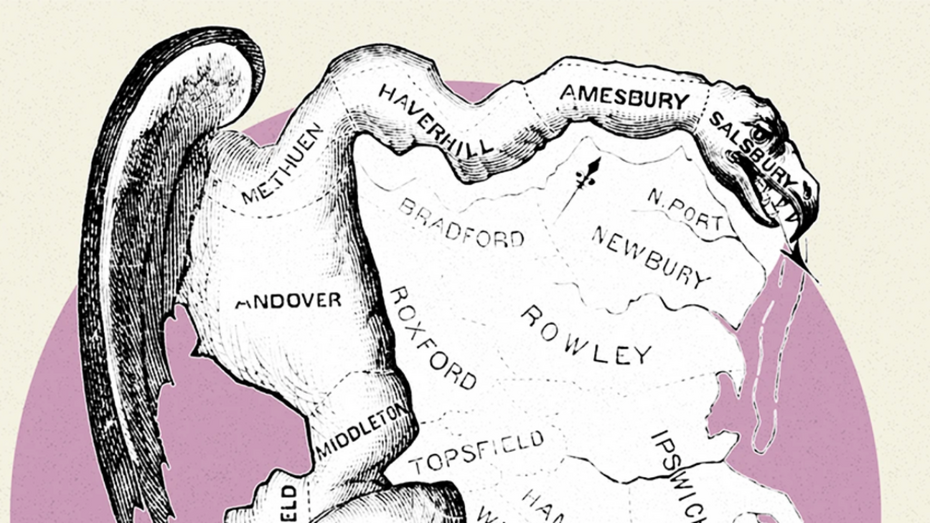
The fantasy of primarily Republican gerrymandering was presented by assistant editor Marc Novicoff on Tuesday in "The House of Representatives Is Turning Into the Electoral College."
Right away, Novicoff lets the readers know who he thinks the gerrymandering baddies are.
The very short list of constraints on partisan gerrymandering has gotten even shorter. Until last week, the Supreme Court had interpreted Section 2 of the Voting Rights Act to require states to draw some majority-minority districts. But in Louisiana v. Callais, it overturned that requirement and held that the VRA prohibits gerrymandering only if it’s done with the explicit goal of racial discrimination. If the intent behind disenfranchising minority voters appears to be merely partisan, the gerrymander is now legal. The ruling will allow Republican state legislatures in the South to erase most if not all of the region’s few blue House districts without fear of being blocked in court.
Novicoff creates the fantasy of primarily Republican abuse of drawing up congressional seats by completely ignoring recent past history of Democrats gerrymandering congressional seats to the extent that today there are no Republican congressional representatives in all of New England, only three of seventeen in the Land Of Lincoln, Illinois, and just one of the six districts in Oregon is currently represented by a Republican.
Most egregious of all is Novicoff's complete avoidance of any mention of the most over-the-top current example of partisan gerrymandering in which Virginia Democrats sought to convert a fairly bipartisan congressional representation of six Democrats and five Republicans to be manipulated into an overwhelmingly Democrat representation of ten to one.
And so the gerrymandering wars, already awful, are poised to get even worse. Democrats will respond to the Republican response to Callais; Republicans will respond to the response to the response; voters will lose in the process. In a few years, almost every seat in the House of Representatives could be safely occupied by a hyper-partisan incumbent, beholden only to primary voters. The chamber could become something like the Electoral College: Whoever wins a state gets all of its representatives, and the winners are there just to vote for or against the president.
Yet somehow it is the Republicans who get most of the gerrymandering blame while the Democrats are portrayed as merely reacting to them in Novikoff's pessimistic imagination. Last year, he wrote an article cheerfully titled "Welcoming to the Gerrymandering Apocalypse."