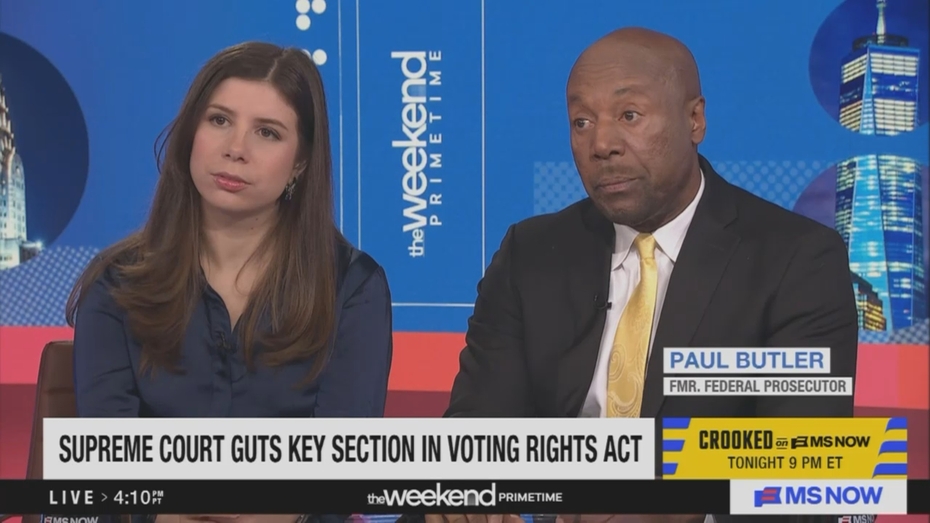
Analogizing it to the Dred Scott decision -- that garbage in heavy rotation -- Butler made the absurd claim:
“It’s like the Dred Scott decision, where the Court said that the black man has no rights that the white man is bound to respect. The Supreme Court is saying that the black voter and the brown voter has [sic] no rights that it respects.”
He also argued the ruling was worse than Plessy v. Ferguson, claiming that Plessy at least required formal equality under “separate but equal,” whereas this decision means “black and brown votes don’t have the same power as white votes.”
Co-host Ayman Mohyeldin responded by saying Democrats must make this a central part of their 2028 campaign. He listed priorities including doing away with the filibuster, Supreme Court reform [a euphemism for court packing], implementing the Voting Rights Act in a new legal framework, police reform, social justice reform, and even trying to abolish the Electoral College— something that would likely have backfired in 2024, since Trump comfortably won the popular vote.
Co-host Catherine Rampell then asked what remedies Democrats could realistically offer, explicitly suggesting court packing as one possibility, since the Supreme Court appears to be blocking tools like majority-minority districts.
WATCH:
— Mark Finkelstein (@markfinkelstein) May 3, 2026
MS NOW says SCOTUS just told black and brown voters they “have no rights that it respects.” pic.twitter.com/llR2OMSFZI
Butler replied that Congress and states can no longer create majority-minority districts. He offered little in the way of institutional solutions, instead closing on a faith-based and almost fatalistic note:
“A lot of black people are just leaning on our history, saying, we got through enslavement, we got through Jim Crow, somehow we’ll get through this.”
This closing evokes the long tradition of faith-based endurance rooted in black historical resilience—the spirit found in spirituals, civil rights-era rhetoric, and “We Shall Overcome.” The segment stands out for how quickly it moved from activist political demands to resigned historical fatalism.
We take a more positive view of the Court's decision, recalling Chief Justice John Roberts' famous words in 2007: “The way to stop discrimination on the basis of race is to stop discriminating on the basis of race.”
Here's the transcript.
MS NOW
The Weekend: Primetime
5/2/26
7:08 pm EDTAYMAN MOHYELDIN: Yeah, so where does this take the civil rights fight now, Paul? I mean, if you, when you kind of take a big picture approach and take a step back, where do you see the fight for trying to ensure the full rights of black and brown people in this country to vote—and have their votes actually weigh as they should go?
PAUL BUTLER: Ayman, that's a really difficult question. In some ways, this is one of the worst Supreme Court decisions on race ever. It's actually worse than Plessy v. Ferguson.
MOHYELDIN: Wow.
BUTLER: Plessy actually required formal equality—separate, but equal. With this case, black and vrown votes don't have the same power as white votes. It's like the Dred Scott decision, where the Court said that the black man has no rights that the white man is bound to respect. The Supreme Court is saying that the black voter and the brown voter has [sic] no rights that it respects.
MOHYELDIN: I think Democrats going forward have to make this a central part of whatever they campaign on. Whether it's doing away with the filibuster, Supreme Court reform, finding ways to implement the Voting Rights Act in a new legal framework—has to be core to what they run on.
And if you're not a Democratic candidate in 2028 who's willing to make that core to your campaign—police reform, social justice reform, voting rights reform, perhaps even trying to do -- I know it's hard -- but trying to do away with the Electoral College. I think those are the things that the base of the party wants.
CATHERINE RAMPELL: But to Paul's point, it's hard for me to even understand what the remedy is that Democrats could offer here, aside from like packing the Court.
Or is there some -- if the Supreme Court is saying that the Constitution does not allow something like the Voting Rights Act to protect the recognition of vlack and brown votes, where do Democrats even go? What do they offer?
BUTLER: So that part—the creation of majority-minority districts—the Supreme Court has said that can no longer be done. Congress can't change that, states can't change that.
So, Ayman, I mean, you ask where do we go from here? A lot of black people are just leaning on our history, saying, we got through enslavement, we got through Jim Crow, somehow we'll get through this.