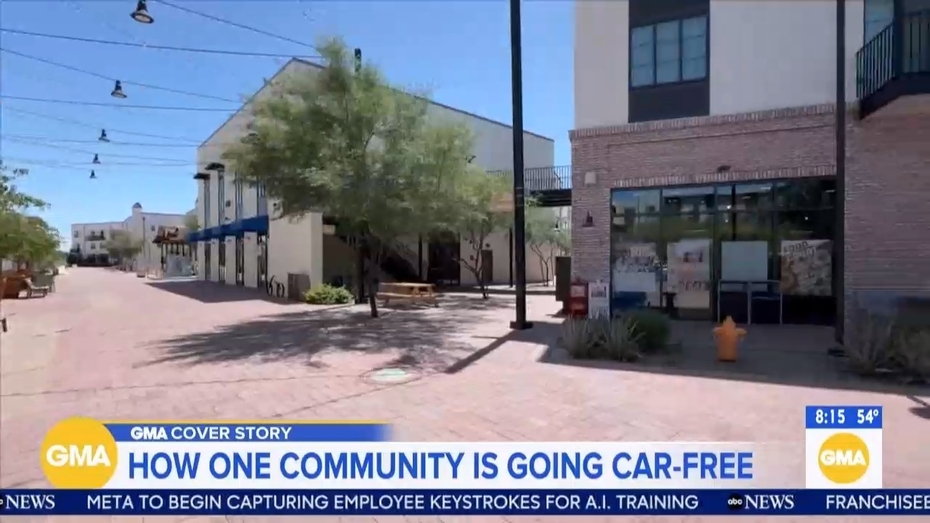
“Celebrating Earth Day with a visit to one car-free community relying on walking and biking. The benefits from saving money on gas to saving the planet, and how other suburbs can take inspiration,” gushed co-host and former Clinton official George Stephanopoulos in a tease.
Chief meteorologist Ginger Zee visited Culdasac (all one word) and invited viewers to “imagine living that life, but when you go there, it’s the silence, the biggest difference, that quiet calm that comes from a community that is car-free.”
ABC’s ‘Good Morning America’ marks Earth Day by touting a Tempe, Arizona neighborhood where cars are *banned* and expresses hope more places in America follow suit pic.twitter.com/C8xzzaktfc
— Curtis Houck (@CurtisHouck) April 22, 2026
Zee added “[i]t’s kind of hard to imagine, especially with that loud home of traffic that likely awaits you in your city or town this morning, but it is possible to have life without cars” even though the country has “a car culture...from our cities to our suburban and rural neighborhoods.”
She spoke with two residents who, of course, love it. One of the interviewees has a particular stake in banning cars as she’s blind (click “expand”):
RESIDENT JACOB STEINKAMP: I’m starting to realize that being car-free doesn’t necessarily mean you can’t use cars. [SCREEN WIPE] It just means that you’re not owning one, it’s not being stored 90 percent of the time in a parking spot. I would say there’s more options than you realize out there.
ZEE: Culdesac not only encourages walking and biking, it’s built around it. Everything is meant to be walkable, boutiques, a restaurant, farmer’s markets, even a plant shop all close to where people live.
RESIDENT ELECTRA HUG: I love this print on the black. [SCREEN WIPE] I don’t think we need a car as much as we think. Honestly, it’s so fun to just be able to walk to a local coffee shop or go to our neighbor’s house.
ZEE: It saves money on gas, insurance, car payments, and is, of course, better for the planet.
STEINKAMP: I would say that going car-free for my wife and I have saved us money.
ZEE: For Jacob Steinkamp, using a bike or electric scooter rather than driving offers other benefits.
STEINKAMP: I do the same route every day and you start to recognize familiar faces, and it’s a little bit more friendly than a car. If you wage someone in a car, they’re like, “what’s that guy doing?” But on a bike or walking, it’s just more natural.
(....)
ZEE: For 26-year-old Electra Hug, there’s one more benefit. She’s been blind since she was 16, so spending most of her time away from traffic is a real game changer.
Along with the convenience and disability angles, Zee had to introduce the climate change argument: “In 2022, transportation was responsible for a whopping 28 percent of greenhouse gas emissions, and a majority of that comes from our cars and trucks.”
She also foresaw viewers being skeptical about this in Arizona, one of the hottest states in the country: “Tempe has one of the most extreme climates in the country, with temperatures regularly reaching 100-plus degrees. They say this community was designed to keep things cooler.”
Of course, she also spoke to the community’s CEO and co-founder, who set her up to lament such communities are “actually illegal” in parts of America. And then, back live, she gushed that residents also have a free bus and light rail pass (click “expand”):
CEO & CO-FOUNDER RYAN JOHNSON: We have 55 percent landscape space, and it feels 15 degrees cooler than the project across the street, and that’s because there’s not a drop of asphalt. There’s lots of trees and shade, and also the white reflects heat.
ZEE: But communities like Culdesac aren’t possible everywhere since, in some areas, they’re actually illegal.
JOHNSON: Through zoning and parking minimums and other rules, we’ve effectively made it so that you’re not allowed to build walkable neighborhoods.And as a result, there’s fewer than 10 percent of Americans that get to live in a walkable neighborhood.
ROBERTS: Mmmm!
ZEE: Another perk for people who live in Culdesac? They get a free, unlimited light rail and bus pass —
ROBERTS: Okay!
ZEE: — and they live right on a train route, so you don’t have to live in Culdesac to have all of these things.
“You can consider shopping local today or every day. Whenever possible, walk or bike, just get in the and out of the car whenever you possibly can,” she said to the approval of the co-hosts.
When she said “we hope to see more like Culdesac,” Roberts agreed and admitted “I’m just surprised that in some places it’s not actually legal.”
“Because of permitting and rules that have been set in place for a very long,” Zee replied, to which Stephanopoulos said “that’s gotta change.”
To see the relevant ABC transcript from April 22, click here.