New York Times reporter Kellen Browning is a superfan of Rep. Alexandria Ocasio-Cortez (D-NY) – in April 2025 he celebrated the “monster crowds” the younger leftist generated on her “Fighting Oligarchy” with older leftist Sen. Bernie Sanders.
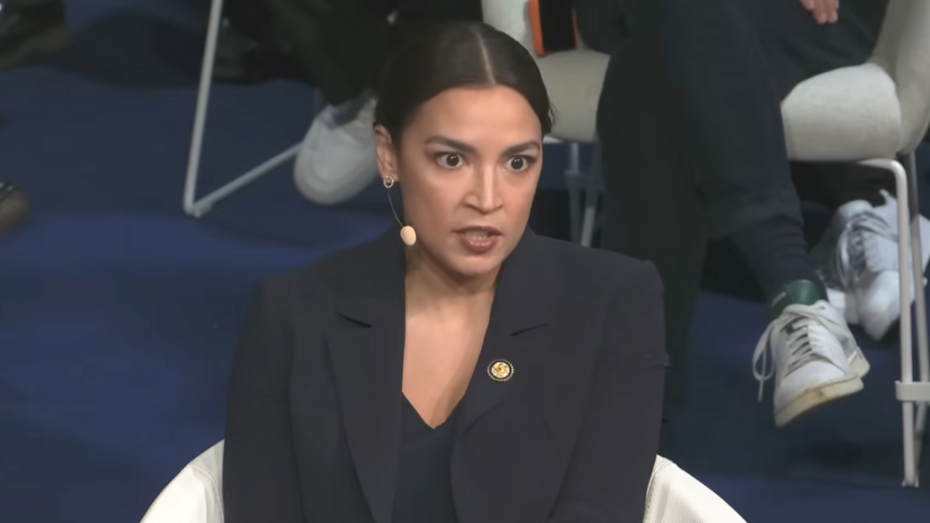
AOC came to Munich to warn about the far-right. Coverage focused on 2028 & verbal missteps. She gave me a call. "Everyone’s got this story wrong, that this is about me running for president," she said….
The story’s headline deck made it clear Ocasio-Cortez was in charge of the story’s framing: “After First Big Overseas Trip, Ocasio-Cortez Expresses Frustrations -- The congresswoman argued in an interview that presidential speculation, which included scrutiny of her slip-ups, had overshadowed her anti-authoritarian message at the Munich Security Conference.”
But rather than the substance of her arguments, it was her on-camera stumbles when answering questions about specific world affairs that rocketed around conservative social media and drove plenty of the discussion about her visit, as political observers speculated whether they would make a dent in a potential presidential run in 2028.
....
The way her performance was microscopically dissected through the lens of what it meant for a hypothetical White House campaign frustrated Ms. Ocasio-Cortez, 36. She said she worried that her message — warning that wealthy world leaders must better provide for their working classes or risk their countries sliding toward authoritarianism — was being lost in all the commotion.
So on Monday night, while still in Berlin, Ms. Ocasio-Cortez spoke to The New York Times by phone and tried to underscore that message.
….
Ms. Ocasio-Cortez argued that efforts to make clips of “any five-to-10-second thing” from her remarks go viral online, especially in the conservative ecosystem, had been done to “distract from the substance of what I am saying.”
What substance?
At least Browning remembered the ideological labeling sometimes, even if it was employed more in praise than as a warning label, which is standard procedure for conservative figures.
Mary Robinson, a former president of Ireland and the former head of a group of world leaders known as the Elders, said that Ms. Ocasio-Cortez offered a generational freshness and that her left-wing ideals appealed to Europeans.
“I’m not sure America’s ready for that yet,” she said. “But maybe it is.”
Still, Ms. Ocasio-Cortez’s missteps were striking for a politician who is usually quick on her feet and is considered one of the best communicators in politics. In addition to the answer on Taiwan, critics highlighted comments referring to the “Trans-Pacific Partnership” (she clarified online that she meant Atlantic) and suggesting that Venezuela was below the Equator (the country lies just to the north).
The journalist commiserated with AOC against political enemies rude enough to notice her painful performance.
Ms. Ocasio-Cortez’s frustration, she said, was that she felt there had been an effort “to shadow and obscure this all through the idea of a horse race….
Online reaction to Browning's clean-up op was scathing. Independent journalist Glenn Greenwald sarcastically parroted Browning on X:
So anyway, last night I was sitting around, and a politician called me. She told me to get a pen and write down what she wants me to put in the NYT about her, in response to widespread criticism. So I wrote it down and put it in the paper, while adding my own defenses of her.
In the words of National Review’s inimitable Charles Cooke:
One could dissect her words for the next ten years straight, with the best of intentions, and still one would not glean anything coherent or useful from them. This wasn’t the fault of “conservative social media” or “rocketing” or “speculation”; it was the fault of Ocasio-Cortez herself, who went to a security conference, was asked questions about security, and fell flat on her face at the first hurdle.