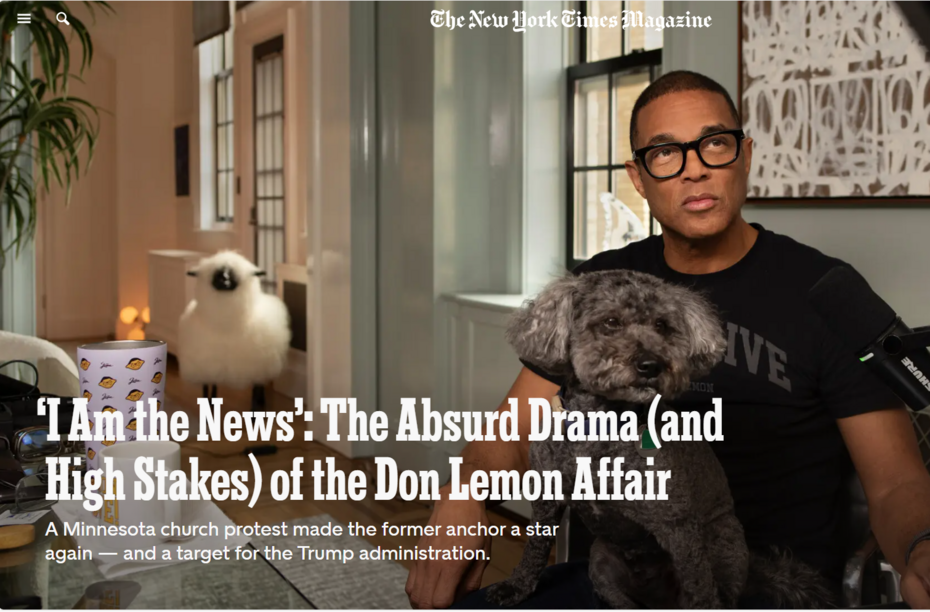
Times writer Matt Flegenheimer implies that Lemon isn’t exactly the best example of journalism and that he’s remarkably stuck on himself. The absurd drama seems to be how both sides of the Trump wars have made Lemon’s post-CNN career:
It could feel as if Lemon and Trump had a common goal: to make Don Lemon the face of American journalism — unmistakable proof that today’s press is either hopelessly timid and compromised (except Don Lemon) or stocked with bad-faith lefties cosplaying as proper newspeople (like Don Lemon).
Let's focus first on the overwhelming egotism of Lemon put on display:
Lemon has largely avoided discussing details that might factor in his defense, citing the ramifications for all journalists “if this goes the wrong way.” But he did volunteer something his therapist had shared recently. “He said, ‘You are Black history,’” Lemon told me. He wept, he said, but he did not disagree.
Then we come to the historical glue-sniffing portion with Lemon's pal and comedian D.L. Hughley, who wasn't trying to be hilarious:
Hughley joined the stage and compared himself and Lemon, “on a much lower scale,” to James Baldwin and William F. Buckley, pining for a future “progressive Trump” to take the White House and countergovern with equivalent force.
“So,” Lemon replied, “should I run?”
The Lemon Heads roared. It had struck him in Los Angeles, he continued, while he was detained “in that holding room,” that maybe he had “been playing at too small a level.” Soon enough, Hughley was comparing Lemon to Rosa Parks, too.
I did not have "Don Lemon is Bill Buckley and Rosa Parks" on my NewsBusters bingo card for this one.
Flegenheimer did allow a little dissent later on in the piece, from Christopher Rufo:
Some who think little of Lemon nonetheless regard this chapter as more sincere. “An irony now is that Lemon is more honest,” Christopher Rufo, a conservative activist, told me. “When he was at CNN, he was smuggling left-wing opinion between the perception of the Walter Cronkite straight-news television personality.”
I don't think anyone thought Lemon was either "straight news" or Cronkite. CNN might have claimed it was just "news," but the man was kissing up to his Chicago pals the Obamas before he was dropping rhetorical bombs on Trump.
Geraldo Rivera was also quoted, making the obvious point about Lemon's participation in a church invasion.
“I say to any journalist, or certainly any street reporter, ‘Stay away from churches,’” Rivera, an acquaintance of Lemon’s from their time on cable, told me. “There’s nothing but problems.”
As much as liberal outlets like the Times want this to be a pure "freedom to report" situation, Lemon was clearly a co-conspirator in disrupting (and ending) a church service. Lemon was not "more honest" in this ruckus.
“I’m just here photographing, I’m not part of the group,” Lemon said, still offscreen. “I’m a journalist.” He stood to the side, mostly observing aloud. A young man in the corner, he noticed, was unsettled and crying.
But the protest, Lemon intimated, was a natural consequence of recent events. Minnesotans’ due process had been violated, he said. People were being brutalized. “You have to be willing to go into places and disrupt and make people uncomfortable,” Lemon said, as demonstrators (many also recording) and worshipers circled one another in the confusion. “That is what this country is about.”
Let's guess that if a rowdy group of conservative protesters interrupted a New York Times newsroom meeting and shouted it down, they wouldn't feel like that was a great place for an angry protest. The First Amendment isn't just about newspapers. It's also about the freedom to worship, which the Times doesn't see as an important freedom at all.
PS: This is the puffy passage that Brian Stelter liked on X:
"The danger is the credibility. He is the news." https://t.co/ueqFD4ioFe pic.twitter.com/4gxqs6RKeE
— Brian Stelter (@brianstelter) March 22, 2026