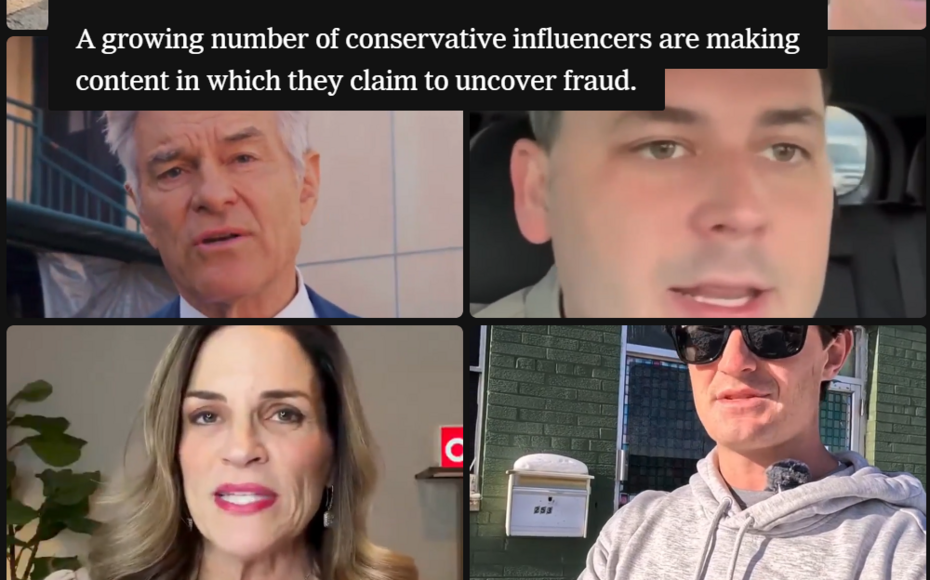
The New York Times is forever looking down its snobby nose at uncredentialed conservative journalists exposing inconvenient stories they don’t want to touch, like the Somali fraud ring in Minnesota. There's no Pulitzer Prize bait in that! Nick Shirley & Co. come under assault in a story by social-media reporter Nathan Taylor Pemberton.
He argued conservative creators are increasingly posting "slopulism," low-quality political content that prioritizes populist rage, aiming to provoke policy action. Exhibit A was Nick Shirley probing fraud in Minneapolis, inspiring new videos investigating fraud in San Diego by Amy Reichert.
Ms. Reichert is one among many conservative content creators who have become the internet’s busiest sleuths in recent weeks. They create videos that are light on evidence and traditional journalistic techniques but are filled with sinister-sounding claims that neatly align with the Trump administration’s priorities.
It’s a novel form of political behavior that has left many political commentators and researchers struggling to articulate what it is. Though many are quick to say what it’s not: investigative journalism. It is also, experts say, more than misinformation or disinformation, terms that fail to capture the nature of these misleading posts and how they are filtering up into the highest echelons of government.
Curt Mills, the executive director of The American Conservative magazine, called it “MAGA-muzak.”
Kate Starbird, a researcher at the University of Washington who studies online spaces and extreme politics, has called it “participatory propaganda.”
“Try ‘entrepreneurial opportunism,’” said A.J. Bauer, an assistant professor of journalism at the University of Alabama with a focus on right-wing groups.
Now contrast this with The Times, whose work on Russian collusion was "light on evidence, but filled with sinister-sounding claims that neatly align with Democratic Party priorities." Their "high-quality investigative journalism" fell apart like a sloppy Jenga tower.
It's mildly amusing at how Pemberton tries to say both right and left make slop, but one is about cruelty and sadism, while the other is for justice!
On the right, this can look like gleeful cruelty, sadistic memes, posts that “own the libs” or sensationalized claims about fraud and conspiracy. On the left, it could be social justice messaging, online identity politics or populist economic proposals to, say, tax the rich.
Pemberton penned a piece for The Nation last year on "Why the Right Fantasizes About Death and Destruction," complaining about growing up with "my family's lunatic fringe" that talked about Benghazi and all that. The Times piece sounds similar:
The new wave of fraud-themed content, made by creators like Mr. Shirley, invokes familiar themes of populist rage and elite resentment. It seems to be the latest evolution in a culture where posting is a primary method of practicing politics — except these posts appear to be made not only to get in on a trending wave, but also to provoke policy action.
“Slopulism works by harnessing the excitement and vibe of a moment,” said Neema Parvini, a senior fellow at the University of Buckingham in England who is considered to have popularized the term. He believes it’s a way for populist leaders, like Mr. Trump, to keep their bases content.
“It convinces supporters to invest their emotions in story lines rather than the substantive politics or structure behind it,” he said. “It doesn’t lead anywhere, it’s just entertainment.”
When conservatives who didn't attend Columbia Journalism School probe progressive sacred cows, there can't be any "public interest" in it. No, Pemberton argued this "slopulism" is just "a political tendency that offers followers emotional gratification through mindless, performative gestures online."
Perhaps we should redefine "slopulism" to define all the leftist celebrities and influencers shouting "F--k ICE!" That's emotionally gratifying and mindlessly performative.