Ever since Sophie Cunningham of the WNBA's Indiana Fever told ESPN, last month, that she does not favor biological men playing in woman's sports, the league has been involved in multiple controversies, almost all of them self inflicted. Tuesday on CNN's The Situation Room, host Pamela Brown brought on CNN Contributor Cari Champion, formerly of ESPN, to discuss some of what was going on, in what was a one sided session that also left out many relevant facts.
Brown began by asking Champion about Cunningham's comments, claiming the remarks have pulled the league into a culture war, and Champion downplayed the whole situation.
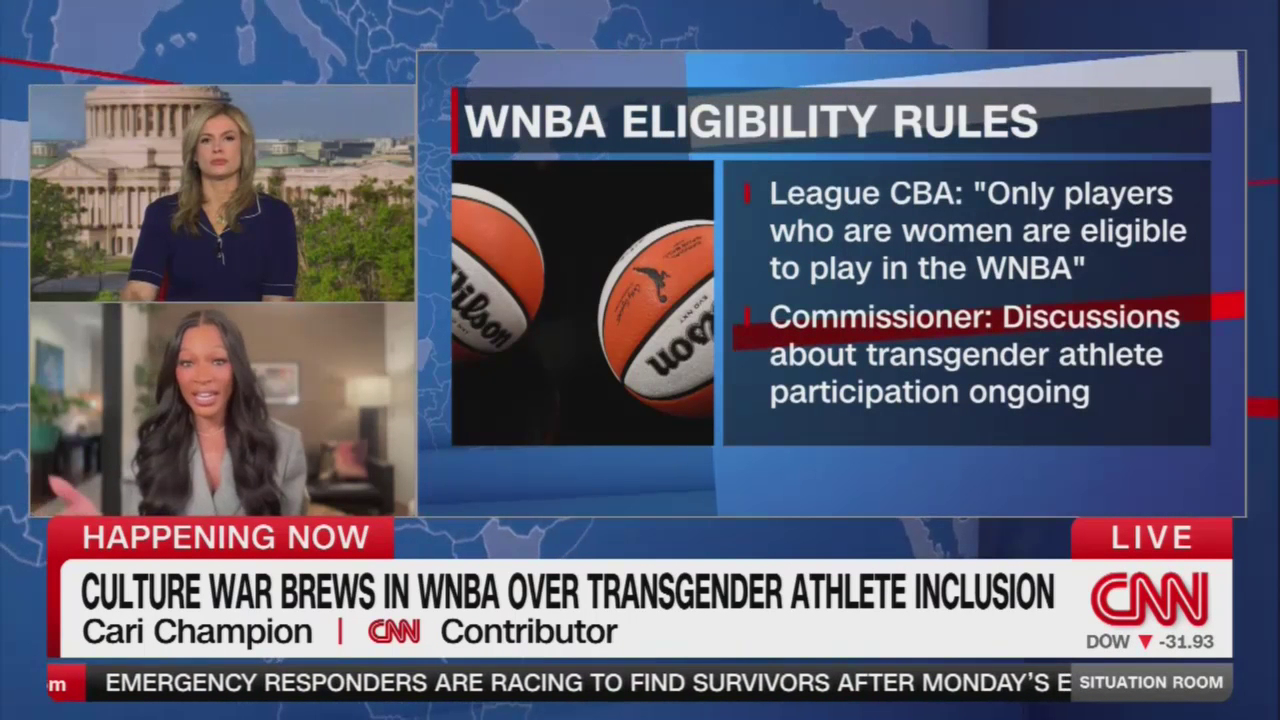
CHAMPION: It's really not an issue. There are no biological men attempting to really, truly try to play in the WNBA....not on the NCAA level, not on the Olympian level. So, if you can't play college sports, you definitely won't make it to the pros.
Whoa! First, no mention that NCAA President Charlie Baker told a Senate panel in December of 2024, that there were less than 10 transgender athletes in college sports, although he did not say if that includes transgender men. No mention that in March of this year, that the IOC issued a new policy on the protection of the women's category for Olympic sports. And no mention of injuries suffered by girls in High School sports, at the hands of biological boys playing against them.
Champion continued to throw cold water on the legitimacy of the whole subject, before Brown brought up that there are indeed two biological men who are planning on entering the WNBA Draft.
CHAMPION: I think this is a conversation that has been brought up by certain people.... and more importantly, political folks who want to use this league as their avatar to get their opinions off, to push narratives they want to talk about. And unfortunately, we're all falling for it because we're talking about it.
BROWN: You do have two former NBA players, Enes Kanter Freedom and Royce White, who are declaring for the 2027 WNBA, draft, claiming they now identify as women. This appears to be performance, publicity stunt, whatever you want to call it.
Brown then asked how the league will handle this, and Champion got out the violin.
CHAMPION: I think that the Players Association, as well as the League will probably be a little more clear about what they mean by women playing in the WNBA. Unfortunately, those two retired players were looking for some attention and trying to prove a point....And they (WNBA) have just gotten to the point where they finally have the attention that they deserve, that they've worked so hard for all of these years. And people are co-opting this message.
Champion continued to present the WNBA as the victim in all of this, which was fine with Brown.
CHAMPION: When this league started, these women, it was sweat equity....There's some excellent basketball being played by these ladies, and they will continue to keep the main thing the main thing, and try to quiet this narrative of what is a woman playing in sports. I think we shouldn't even answer those questions.
These issues are not being pursued by just league outsiders. It wasn't mentioned that last month the co-owner of the league's Seattle Storm was suspended for verbally harassing young girls, who were displaying signs in favor of Sophie Cunningham's stance. Earlier this month, Minnesota Lynx Coach Cheryl Reeve wore a "Trans Kids Belong" shirt.
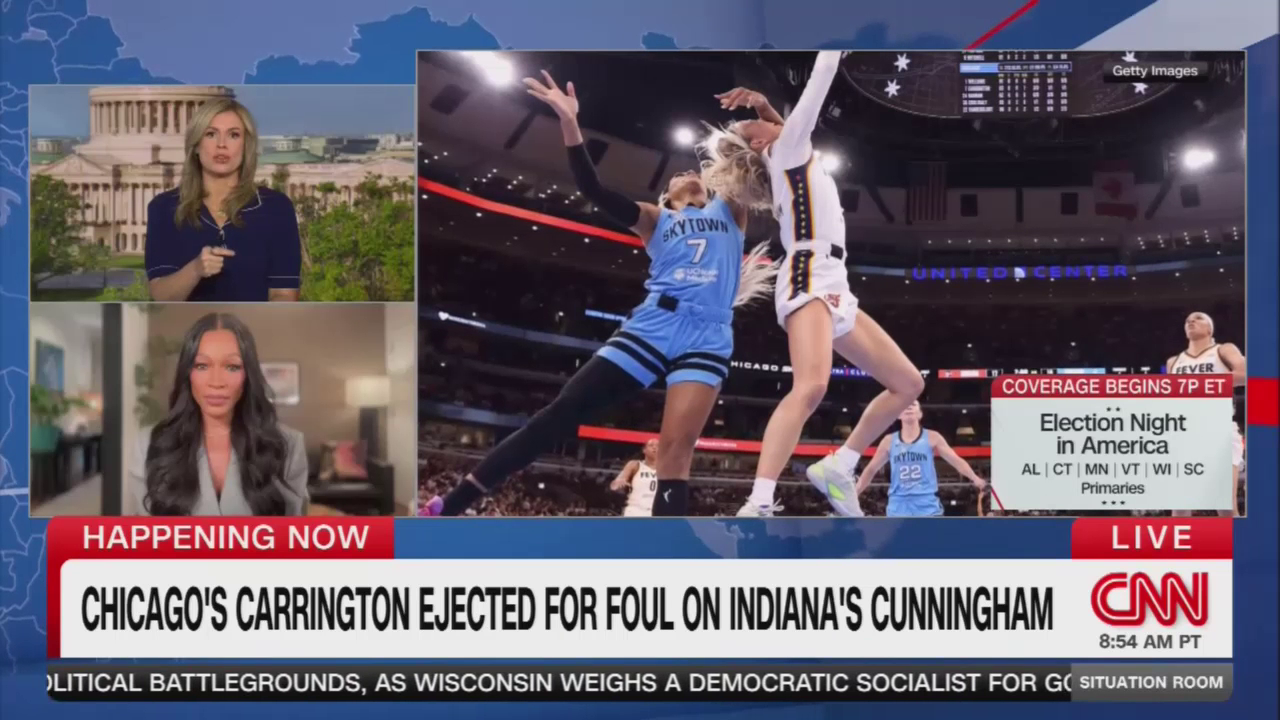
Brown then brought up the ejection last week of Chicago Sky's DiJonai Carrington, who is black, for a flagrant foul against Cunningham, and Carrington's post game post of "white privilege". Champion then seemed to blame white and straight WNBA players, and those in the general population, for the league's current problems.
CHAMPION: There's a race problem in the WNBA as much as there is a race problem in this country. It is now black versus white, a league that is 68 percent black, has players that are LGBTQ-plus. They are very well aware of what's going on in the world and culturally we are fighting these wars.
Champion went on uninterrupted, for another 80 seconds, making an excuse for Carrington's white privilege post, before admitting, "I got to be honest, I can't say I know what she meant by that."
Another key issue left out by Brown and Champion, Cunningham's coach Stephanie White's original defense of the foul on her own player, saying she didn't oppose the hard foul, before telling her critics to "go to hell", although that happened Tuesday night, well after the interview was conducted.
All in all, a segment with some outrageous claims, devoid of inconvenient facts, with no pushback. This is CNN!