"(I should note here that it is possible to acknowledge two things at once: that Musk is an omnidirectional boor, and also that he builds awesome rockets.)"
Atlantic magazine executive editor Adrienne LaFrance was in absolute AWE of the SpaceX accomplishment on Saturday of their historic soft landing via "chopstick" arms for the first time of one of their starships. She waxed poetic on Sunday about this event in the appropriately titled, "Awesome."
Of course, in order to provide such high praise for this SpaceX event means you also have to mention its CEO, Elon Musk, and that could provide a rather problematic situation on the pages of the Atlantic with its very liberal readership. So what to do? What to do?
Well, as it turned out in this case it was to provide a rather awkward "boor" caveat, as you saw above. But first let us read some of the glowing praise by LaFrance for the amazing scientific achievement that happened on Saturday.
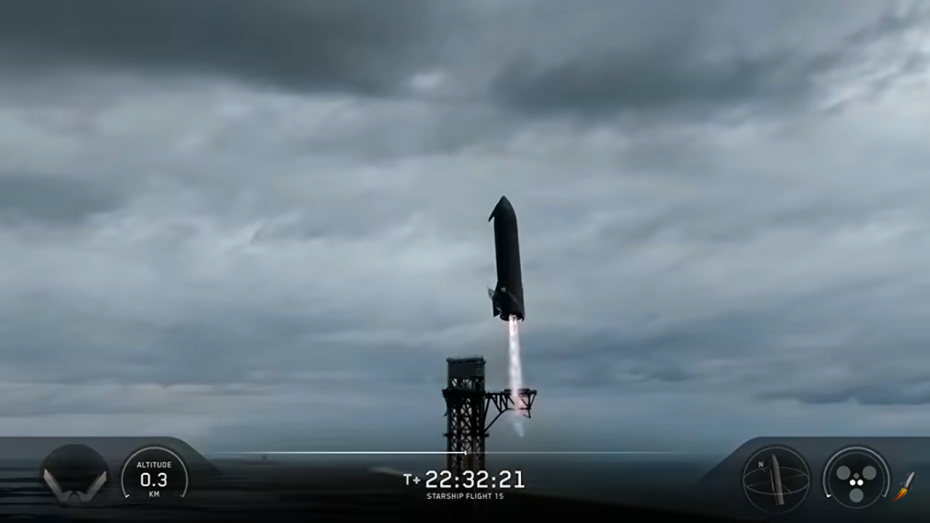
Yesterday, for the first time ever, engineers successfully pulled off a midair landing—using the company’s Mechazilla tower’s “chopstick” arms to snatch a starship the size of a skyscraper out of the sky after it had spent the past 22 hours in Earth’s orbit. Up until this point, Mechazilla’s chopsticks had caught boosters after launch—that is, the part of the rocket that detaches—but never ships themselves.
You really do have to watch the video for yourself, and when you do, try to remember this: Starship 42—the largest and most powerful rocket in the world—just successfully launched, went into orbit, took 14 victory laps around the Earth at some 17,000 miles per hour, deploying more than two dozen Starlink satellites as it went, before careening into our atmosphere then swiveling upright so it could glide gently into a pair of robot arms waiting below.
Every aspect of what took place is unbelievably hard to achieve, but let’s begin with the absolute violence of re-entry. A rocket in orbit goes fast, so fast it is difficult to visualize, something like 20 times faster than the speed of sound, and certainly faster than a bullet (or, for that matter, a cannonball). When the starship approaches the Earth’s atmosphere, traveling five miles a second, several things happen in quick succession: Engineers fire a single engine against the direction of travel, in order to steer it back toward Earth belly-first. This move is less about slowing the ship down—it barely does—and more about achieving the right orientation so that the heat shield coating the belly of the starship can double as, essentially, a giant brake against the air of the atmosphere.
So far so good, but now we are about to enter the sticky territory where the name-that-can't-be-avoided is involved:
It is not an exaggeration to say that almost no one believed this was possible. Even SpaceX’s most devoted engineers had their doubts. The aerospace engineer Tom Mueller, whom Musk hired as SpaceX’s first employee in 2002, recently appeared on a podcast where he described the meeting, several years ago, where Musk first presented the idea of plucking a rocket out of midair as it landed. The idea was, “we’re going to catch it in the air on chopsticks, like catching a fly with chopsticks,” Mueller recalled, “and we all just rolled our eyes like, this is crazy. There’s just no way.” He went on: “Some of us did not believe it could be done.”
They were wrong, and beautifully so. (Musk, who teased the idea of the chopstick landing by tweeting a GIF of Mr. Miyagi five years ago, reported yesterday that he hugged Starship 42 upon its return.) The lesson for Mueller—and this was something he said even before yesterday’s triumph—was this: “It’s not hype. He’s going to build it. I believe if it’s possible, it will be solved. And it might take longer than Elon thinks, but he will solve it.” (I should note here that it is possible to acknowledge two things at once: that Musk is an omnidirectional boor, and also that he builds awesome rockets.)
Ah! And there we have it in parenthesis at the end. The caveat for the benefit of the liberal Atlantic readers who can't handle any type of praise for Elon Musk. Yeah, it was probably too much for them to tolerate since many of those same readers even if they didn't actually participate of the keying of Teslas last year probably approved of it because of... Musk.
The only question is whether LaFrance was the one who decided to put the caveat shot in or was it another editor who was shocked by her previous high praise for the genius who came up with the idea of the "chopsticks" method of plucking rockets out thin air and demanded that the disapproving caveat must be inserted despite looking awkwardly out of place.