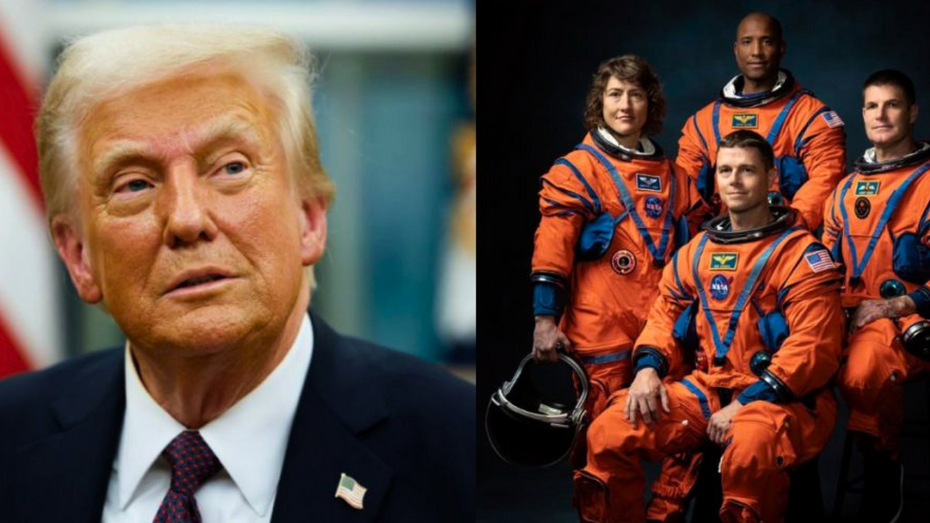
The first four paragraphs, containing praise for the Artemis II mission sound normal although the subtitle does give a hint as to where Warzel's derangement is headed: "The world witnessed the best and worst of humanity in a single week."
And you can guess what, or rather WHO, Warzel considers to be the "worst of humanity." But first some of the tribute to the Artemis II mission and the joy of seeing Earth from space:
“You don’t see borders, you don’t see religious lines, you don’t see political boundaries. All you see is Earth, and you see that we are way more alike than we are different,” Christina Koch, one of the four astronauts on the Artemis II mission, told NASA recently. Jim Lovell, describing the view on Apollo 8 from the dark side of the moon back in the late 1960s, told Chicago magazine that he could put his thumb up to the window, and in that moment, “everything I ever knew was behind it. Billions of people. Oceans. Mountains. Deserts. And I began to wonder, where do I fit into what I see?”
Where some see immeasurable beauty, others see fragility. Marina Koren previously reported in this magazine that, upon seeing the Earth from space, one astronaut “became absolutely convinced we would kill ourselves off between 500 and 1,000 years from now.” Famously, the actor William Shatner has written that his brief experience looking at the Earth produced a profound sadness. “What I was feeling was grief, and the grief was for the Earth,” he told Koren in 2022.
Unfortunately, by the fifth paragraph Warzel could no longer contain himself and he began about how thse images were compromised by "reports of the U.S. president threatening the civilizational destruction of Iran."
And from this point on, the floodgates opened on Warzel's rage. Gone was the moving tribute to the Artemis II mission and what it means for humanity only to be replaced by the base politics of hurling insults at President Donald Trump:
Trump’s threats triggered denouncements from Democratic lawmakers as well as the podcasters Tucker Carlson and Alex Jones, and incited no small amount of panic from people who have interpreted Trump’s post as a suggestion of nuclear warfare. Then, this evening, an hour before the deadline, Trump announced a two-week cease-fire deal, which Pakistan helped broker.
Trump’s bluster, no matter how serious, has always been impossible to parse. (He’s famous for chickening out, backpedaling, or pretending like he never said what he said.) Yet one way to view our current age is as a series of existential reminders, be they nuclear proliferation, climate change, or pandemics. In Silicon Valley over the past half decade, civilizational extinction at the hands of hypothetical technological advances has moved from the realm of pure science fiction to a marketing tactic to an immediate concern for a subset of true believers. Humans may not want to die, but as a species we seem eager to invent and tout new ways to threaten our existence.
And yet at the very same moment, four flesh-and-blood human beings are hundreds of thousands of miles away taking pictures of our delicate little world. Their mission and their photos remind us of something else entirely—of a yearning to learn, to explore, and to band together to become something greater than the sum of our parts. If Trump’s claims of mass destruction represent humanity at its smallest, weakest, and most cowardly, then those who are gazing upon our planet right now from afar represent the best of what we have to offer.
...There is something disorienting, horrible, and somehow fitting in the timing of all of this. That one man with the means to do it would threaten destruction of a part of our planet at the same moment its beauty and fragility are on full display. We are, in this tense moment, living with our own overview effect. Four are watching from afar. But the rest of us are watching too—left to reckon with our own place on the pale blue dot, reminded of all the ways we might die, and all the reasons for which to live.
There is "something disorienting" in reading a tribute to a noble space mission only to see it hijacked into an angry tirade of partisan politics.