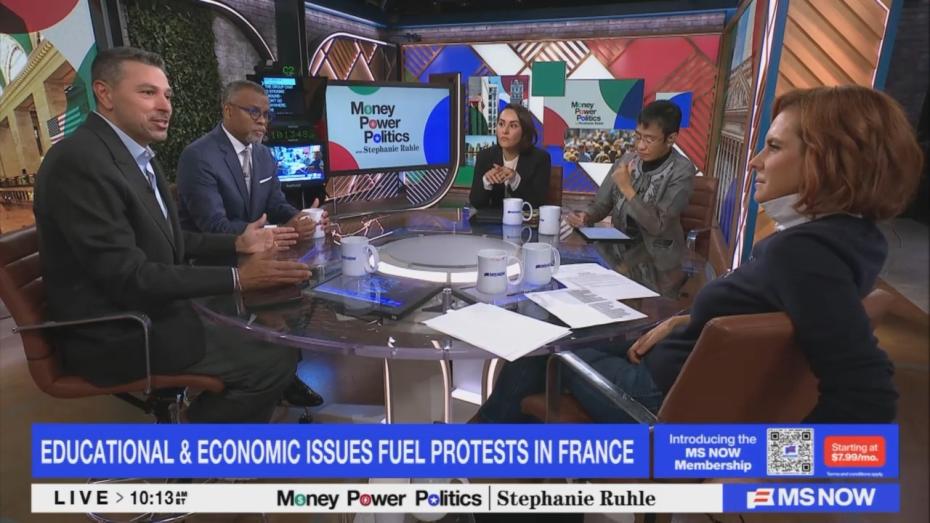
On Thursday, MS NOW’s Money, Power, Politics with Stephanie Ruhle actually discussed the “student protests” in France that have turned violent and made it about the state of the economy around the world. MS NOW analyst Ayman Mohyeldin, who no longer has a show on the network, took the discussion of the French protests to implore Americans to protest like the French, which he said they have “unfortunately” not done.
Ruhle was the first to connect French protests to economic problems, as she said, “Like, you can tie all of this together. Enormous economic frustrations that people are feeling.” She added, “We are seeing country after country start to say, this system just don't work anymore.”
Ruhle tied to the thought to frequent panelist Eddie Glaude: “And it's actually Eddie who's been saying to me for years, ‘No, people want to break the system’. And I'm like, ‘No, Eddie, everything is fine.’ And I'm saying that from a very privileged seat. As we're watching, scores of voters say no to the system, to both parties.”
Thursday's ‘Money, Power, Politics’ on MS NOW actually discussed the “protests” in France and framed them as being about economic issues, as Ayman Mohyeldin seemed to implore more Americans to protest over the economy, like the violent “protests” in France. pic.twitter.com/XyrrdUvsDd
— Nick (@nspin310) October 15, 2026
Mohyeldin then came to place blame on AI, and said, “I think that there is a fundamental problem in the governance of both AI and our politics.”
He later invoked “oligarchs”: “And our political class is more interested in trying to support the technology and the AI and the oligarchs than it is for the ordinary people.”
Ruhle, to her credit, responded, “Which, by the way, Ayman, came before Trump was in office.” Mohyeldin then said, “Of course.” Ruhle later said, “So, it's BS to say that like, well, it just happened a couple years ago with Trump. They've both been in cahoots.”
Mohyeldin then turned to compare the French protests to the “Arab Spring” that was “motivated by the inequality and the authoritarianism that has permeated throughout the Middle East for such a long time.”
Furthermore, he said, “When you are in a democracy, and you want to feel that you have governing structures and accountability structures that are to keep an eye on all these industries,” and “those systems are failing us,” then “you take to the streets.
“The point that I'm trying to say is that when you are in a democracy, and you want to feel that you have governing structures and accountability structures that are to keep an eye on all these industries and say, ‘How do these industries work to the greater good of humanity,’ and those systems are failing us, then you take to the streets,” he added.
Mohyeldin ultimately made his connection to America:
Unfortunately, in this country, that tipping point of when Americans take to the streets for socioeconomic reasons is a very different calculation than most parts of the world.
He then continued to imply the American people should protest like the French, and said, “We can spend hours trying to dissect that as to why Americans don't take more to the streets as a result of socioeconomic pressures that they're facing.”
The “student protests” in France have turned violent, and Reuters reports the French Prime Minister has warned of more violence over the coming weekend. Hopefully, Mohyeldin was not calling for the echoes of the scenes of violence across France, as he essentially begged Americans to protest against the economic system.
The transcript is below. Click "expand":
MS NOW’s Money, Power, Politics
October 15, 2026
10:11:49 AM Eastern
(...)
STEPHANIE RUHLE: Okay, but then look at the protests happening in France right now, right? Like, you can tie all of this together. Enormous economic frustrations that people are feeling, whether it's old people who say they cannot retire, whether it's young people who can't start their lives, or people in the middle saying, I thought I was going to be okay.
We are seeing country after country start to say, this system just don't work anymore. And it's actually Eddie who's been saying to me for years, ‘No, people want to break the system’. And I'm like, ‘No, Eddie, everything is fine.’ And I'm saying that from a very privileged seat. As we're watching, scores of voters say no to the system, to both parties.
AYMAN MOHYELDIN: I think that there is a fundamental problem in the governance of both AI and our politics. And part of the problem is that ordinary people, whether they are in France or here in the United States, are watching the rise of big tech, the rise of AI, and the convergence with our political class. And our political class is more interested in trying to support the technology and the AI and the oligarchs than it is for the ordinary people.
RUHLE: Which, by the way, Ayman, came before Trump was in office.
MOHYELDIN: No, no. Of course.
RUHLE: Okay. We can go back to President Obama being in office.
EDDIE GLAUDE: Absolutely.
RUHLE: And there was basically a revolving door for Sheryl Sandberg, Mark Zuckerberg, and that whole posse.
GLAUDE: Absolutely.
RUHLE: And so, we could see all of those CEOs come and get grilled on the Hill. And when they get on their G5's and go home that night, all of the lobbyists that work for those companies take the staffers for people on the Hill, from both sides out at night. So it's BS to say that like, well, it just happened a couple years ago with Trump. They've both been in cahoots.
MOHYELDIN: By the way, it's not only an American phenomenon, as you were just saying as well. In France it's happened. And part of the Arab Spring was motivated by the inequality and the authoritarianism that has permeated throughout the Middle East for such a long time. And that was 15 years ago as well.
The point that I'm trying to say is that when you are in a democracy, and you want to feel that you have governing structures and accountability structures that are to keep an eye on all these industries and say, ‘How do these industries work to the greater good of humanity,’ and those systems are failing us, then you take to the streets. And that's what we're seeing with the anger and the protests that is playing out in France at the moment.
RUHLE: But we -
MOHYELDIN: But unfortunately, in this country, I was just gonna say real quickly. Unfortunately, in this country, that tipping point of when Americans take to the streets for socioeconomic reasons is a very different calculation than most parts of the world. And I think there's a lot of reasons for that. We can spend hours trying to dissect that as to why Americans don't take more to the streets as a result of socioeconomic pressures that they're facing.
(...)