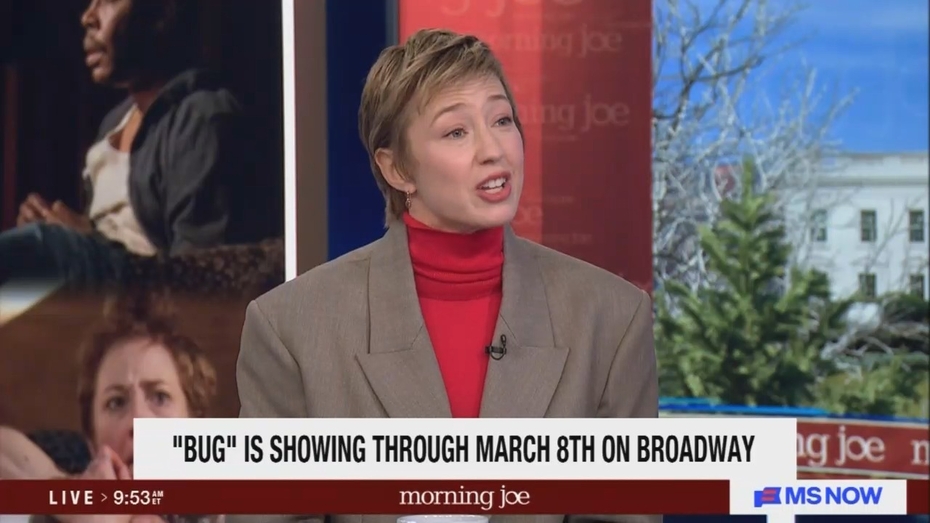
Co-host Jonathan Lemire introduced the play, written by Coon’s husband, as centered “around a poor and lonely waitress” who “meets a secretive war veteran who convinces her that he is the victim of a government experiment.”
Coon said her husband wrote the play in the face of the Oklahoma City bombing and the creation of the internet. “And here we are. I think I don't have to say why that kind of thinking is relevant today,” she added.
After a leading question from New York Times writer Molly Jong-Fast, Coon went into a bit of a rant making comparisons of the play to the political side she doesn't like:
We are experiencing a moment where, for some reason, part of our population believes that one percent of immigrants are inflicting financial pain on them, or one percent of transgender people are the source of their troubles, when in fact one percent of the population are billionaires who are controlling everything. And yet we have a segment of our population that seems entirely focused on these groups.
It seems Coon followed the same liberal media playbook to downplay illegal immigrant crimes and transgender shootings as the rest of the media.
On MS NOW, actress Carrie Coon touts that art and artists are "ris[ing] up" against President Trump and audiences are "hungry for this kind of darkness" and "blood. They want to see it. And we are feeling that in the house." pic.twitter.com/qcjwMVWORP
— Nicholas Fondacaro (@NickFondacaro) February 24, 2026
Lemire then asked how the idea of conspiracy theories affect art (a way that could be asked twofold):
LEMIRE: The idea of how the rise of conspiracy theories, we can't even agree on the same set of facts. How does that spill over into art? How is it sometimes tough to tell the message you want to because people simply don't want to believe?”
COON: (...) I think what people understand is that art has a responsibility in times like these. And when you start to experience the repression of autocracy, art rises up and starts to get more irreverent and more gross and more in-your-face. And I think that's the moment we're seeing in art in this country right now.
Coon then stated “we all know that where art goes, there goes democracy” before she shared a claim of what the audience would want from art right now:
And we're finding the audience responding in that way. They are hungry for this kind of darkness, for irreverence, for nudity, for blood. They want to see it. And we are feeling that in the house.
In the very last little segment of the show, Coon got the last word and used it to defend artist’s public display of leftist opinions (Click “expand”):
Wow. I guess I'll say - you know, I hear often on social media, people tell me that artists shouldn't speak about politics, that we should just be there to entertain. But art has always been political. And I would say what artists understand is the power of language.
And one of the ways this regime has excelled is in using language to, for example, dehumanize immigrants. We wouldn't be in the situation we're in right now had Donald Trump not come down the escalator talking about Mexicans as rapists. It started from the jump. And we know the power - how that language accumulates over time. And we would do well to pay attention to the way that we're speaking about these issues.
It is ironic that the actress went on Morning Joe to showcase a play that is focused on the consequences of conspiracy theories given that MS NOW (formerly MSNBC) has spread a good amount of conspiracies, especially after the first Trump assassination attempt.
And as we saw with some political activism from "artists" in the first Trump term, some depicted images of a bloody Trump, like Kathy Griffin’s infamous Trump image.
Maybe Carrie Coon should listen to those against artists' heavy political activism because it seems like she might need a break.
The transcript is below. Click "expand":
MS NOW’s Morning Joe
February 24, 2026
9:49:38 AM Eastern
JONATHAN LEMIRE: Welcome back. An intense thriller with themes relevant for today's heavy times, now showing on Broadway. The play Bug stars Tony award nominated actress Carrie Coon, and it centers around a poor and lonely waitress who is staying in a rundown motel. There, she meets a secretive war veteran who convinces her that he is the victim of a government experiment. Over time, his delusions become hers, and the audience watches as the pair descend into madness. The play's run has been extended twice., And Carrie Coon joins us now, chuckling along as she hears the phrase “descends into madness”.
CARRIE COON: Yes.
LEMIRE: Great to see you again. Welcome back.
COON: Thank you for having me back, I appreciate it.
LEMIRE; So, let's just start this. Tell us why this production? Why now?
COON: Well, you know, Tracy wrote the play in 1996, the year after the Oklahoma City bombing. It's his most well researched play. And when he looked into the, you know, the circumstances, he discovered that the internet was going to be this place for conspiracy thinking. And so whereas people used to have their tinfoil hats alone in their room, now they would be able to proliferate these ideas in a new way. And so he wrote this play.
And here we are. I think I don't have to say why that kind of thinking is relevant today. But, you know, what I love about the play is that it's also a love story because Tracy, where he couldn't necessarily understand why somebody would embrace these ideas, he did understand what people give up or embrace for love. And so he couched it in the form of a love story. And so it's this kind of zany, funny, gross, terrifying play that doesn't normally show on Broadway, frankly, this kind of thing.
MOLLY JONG-FAST: When I was reading the review, the New York Times review, it is - it could not be more delighted by your performance -
COON: Oh thank you.
JONG-FAST: - in the play. So I'm just curious, like, there's so much, you know, you're married to the playwright. The play was written a long time ago. The themes matter a lot right now. Talk us through all the feelings. And you're also just amazing in it. So talk us through the feelings you have about that.
COON: Well, of course I'm delighted, for Tracy's sake. It's a play he never thought would necessarily be on Broadway. This is probably the biggest house that's ever been in, frankly, in the history of the play. The fact that we're getting a lot of young people in the theater is really thrilling. I mean, I certainly adore our subscribers. We wouldn't have theater without them. But I'm seeing a lot of young people coming who are television fans, who've never been to a play before, and that's really exciting. There are no cell phones in the house, and I'm finding that at halftime you hear people talking to each other. That's actually thrilling. People are really focused in on the storytelling.
And I think we all understand, we're in a moment where we have lost sight of the truth. We thought the internet would make the truth rise to the top, but in fact it sinks to the bottom. We are experiencing a moment where, for some reason, part of our population believes that one percent of immigrants are inflicting financial pain on them, or one percent of transgender people are the source of their troubles, when in fact one percent of the population are billionaires who are controlling everything. And yet we have a segment of our population that seems entirely focused on these groups.
LEMIRE: So let's talk about that. The idea of how the rise of conspiracy theories, we can't even agree on the same set of facts. How does that spill over into art? How is it sometimes tough to tell the message you want to because people simply don't want to believe?
COON: Right. I mean - I think what's - I think that's what's interesting about this play right now, to return to that original question, I think what people understand is that art has a responsibility in times like these. And when you start to experience the repression of autocracy, art rises up and starts to get more irreverent and more gross and more in-your-face. And I think that's the moment we're seeing in art in this country right now.
A necessary correction for art in this country right now. I mean, artists have never been more persecuted here than they are. We have seen our funding cut not only for visual art and theater, but also for our museums. What's happened to the Kennedy Center? We are in an unprecedented time in America, and we all know that where art goes, there goes democracy.
So I think we have a responsibility to, kind of, tell these sorts of stories right now. And we're finding the audience responding in that way. They are hungry for this kind of darkness, for irreverence, for nudity, for blood. They want to see it. And we are feeling that in the house. And I hope people will come out in our last two weeks and really experience this in a group with other people.
LEMIRE: Bug, extremely important and timely. (...)
(...)
9:56:43 AM
LEMIRE: So Carrie Coon ended up sitting here through the commercial break, so we will simply give her the final thought of the morning.
COON: Wow. I guess I'll say - you know, I hear often on social media, people tell me that artists shouldn't speak about politics, that we should just be there to entertain. But art has always been political. And I would say what artists understand is the power of language.
And one of the ways this regime has excelled is in using language to, for example, dehumanize immigrants. We wouldn't be in the situation we're in right now had Donald Trump not come down the escalator talking about Mexicans as rapists. It started from the jump. And we know the power - how that language accumulates over time. And we would do well to pay attention to the way that we're speaking about these issues.
LEMIRE: Carrie Coon, with our morning's final words. Thank you again for joining us.