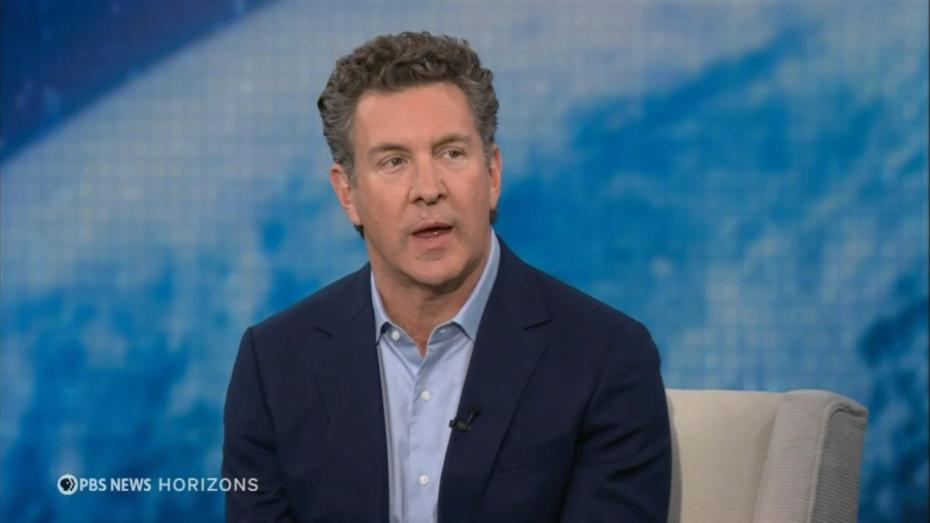
On Saturday's Horizons on PBS, host William Brangham gave environmental alarmist and University of Pennsylvania Professor Michael Mann a forum to promote more regulations to limit carbon dioxide emissions during a discussion of the U.N. conference in Turkey. Brangham opened the show:
Eleven years ago, nearly 200 nations reached a historic agreement to do everything possible to slow down the dangerous warming of our planet. It was in Paris at the same annual U.N. conference that's wrapping up in Turkey right now. Negotiators settled on trying to limit additional global warming to 1.5 degrees Celsius. That's just under three degrees Fahrenheit in order to stave off the worst impacts of climate change.
The media elitists really believe an international order can politically manage the weather, and the failure of everyone to agree with their dictates are guilty of endangering everyone on the planet. Brangham continued:
Without that tangible target, they argued, greenhouse gas pollution would continue to fill our atmosphere. The earth would see increasing droughts and heat waves stressing our ability to grow food and making many parts of the planet uninhabitable. A warming planet would also create dangerous, destructive floods and storms, driving people from their homes and costing billions of dollars in damages. By almost all measures, we're going to overshoot that 1.5-degree target and warm the planet even more.
The PBS host then blamed climate change for recent disasters:
And the tragedies, as predictable as they are, continue to pile up. Just one recent example, three months ago, in Nepal, a mountain glacier weakened by warming temperatures and other factors collapsed. It sent a deadly torrent of water, ice and debris through a valley and killed over 1,300 people.
After bringing aboard Mann and Kate Marvel of Project Drawdown as guests, Brangham joined Mann in admitting that the drive to limit global warming to just 1.5 degrees Celsius was just too "political" with Mann then pushing to just set a more extreme target. A bit later, the PBS host fretted about the failure to achieve goals set in previous such conferences. Here's Brangham:
PBS's Brangham Lets Michael Mann Promote the Left's Climate Agenda pic.twitter.com/EfgvPPWJ6P
— Brad Wilmouth (@bradwilmouth) November 23, 2026
How do we not see this, though, as a colossal failure of international negotiations? I mean, 200 nations said, "We're going to do everything we can to do this," but, in the ensuing decade, emissions have continued to go up, temperatures have continued to go up. I want to read the opening sentence of a paper you recently were an author on. You wrote, quote, "We are witnessing the rapid destabilization of the earth's climate system. This is no longer a warning for the future -- it is a diagnosis of the present." How do we not see this as an enormous failure?
Could there be a softer softball? Here again, PBS is just like MS NOW in rolling on the fiery red carpet for Mann, who responded:
MANN: Well, it is an enormous failure as Kate (Marvel) said, and we have locked in far more damage -- far more suffering because of the relative inability that we've demonstrated to increase carbon emissions fast enough. Five years ago at COP26, there was reason for optimism. The countries of the world had all agreed to fairly stringent decreases in fossil fuel burning that had the potential to hold planetary temperatures well below two degrees Celsius. It was substantial progress. Since then, we haven't seen much additional progress. And we need to see more progress. Two degrees Celsius is still too much warming of the planet -- 1.5 Celsius warming, which we are already nearly at -- look, we don't have to speculate as to what sort of harm we will see. We're seeing it.
Mann went on to try to tie the war in Iran to the environment, claiming that the purpose of the war was to protect the oil supply, in spite of the concerns about Iran trying to build nuclear weapons. Everything from inflation to data centers is part of the climate crisis. He also claimed that the Donald Trump administration is making the environmental situation worse by refusing to adopt more regulations.
Transcript follows:

PBS's Horizons
November 19, 2026
WILLIAM BRANGHAM: Eleven years ago, nearly 200 nations reached a historic agreement to do everything possible to slow down the dangerous warming of our planet. It was in Paris at the same annual U.N. conference that's wrapping up in Turkey right now. Negotiators settled on trying to limit additional global warming to 1.5 degrees Celsius. That's just under three degrees Fahrenheit in order to stave off the worst impacts of climate change.
Without that tangible target, they argued, greenhouse gas pollution would continue to fill our atmosphere. The earth would see increasing droughts and heat waves stressing our ability to grow food and making many parts of the planet uninhabitable. A warming planet would also create dangerous, destructive floods and storms, driving people from their homes and costing billions of dollars in damages. By almost all measures, we're going to overshoot that 1.5-degree target and warm the planet even more.
And the tragedies, as predictable as they are, continue to pile up. Just one recent example, three months ago, in Nepal, a mountain glacier weakened by warming temperatures and other factors collapsed. It sent a deadly torrent of water, ice and debris through a valley and killed over 1,300 people.
Given the dangerous nature of climate change, and the seeming inability of global talks to address this crisis, we wanted to turn today to two research scientists who have long wrestled with this issue. Kate Marvel is the senior climate scientist at Project Drawdown, which is a research group that focuses on climate solutions. For over 10 years, she was a research physicist at NASA's Goddard Institute for Space Studies, and, last year, she published the book Human Nature: Nine Ways to Feel About Our Changing Planet.
Michael Mann is one of the country's preeminent scientists. Trained as a climatologist and geophysicist, he is the Presidential Distinguished Professor at the University of Pennsylvania where he also directs the Penn Center for Science, Sustainability, and the Media. His most recent book, co-authored with Dr. Peter Hotez, is Science Under Siege.
Kate and Michael, so good to have you on the program. Thank you for being here. Michael, to you first. As I mentioned, we are most likely going to blow past this 1.5-degree Celsius target that was set out in the Paris agreements. This was admittedly a political target. It's not a meaningful scientific target. So does it matter that we're going to blow past that?
MANN: Yeah, thanks, William, it's good to be with you. It's, you know, we sometimes put too much emphasis on these specific numbers. We make it sound like 1.5 Celsius -- as you said, roughly three degrees Fahrenheit -- is some sort of climate cliff that we go off and all hope is lost if we exceed it. And that's just not the way it is. It's much more like a dangerous highway that we are going down. And the further we go down the highway, the more danger we will encounter. And we may miss, it now looks, the 1.5 Celsius exit. That doesn't mean that we drive all the way to Toledo. We get off at the next exit, and right now there's a lot of discussion about what that is. How much warming can we realistically hold the planet to and still avoid much of the harm and danger and mortality we will encounter if we continue down this dangerous highway?
(...)
BRANGHAM: How do we not see this, though, as a colossal failure of international negotiations? I mean, 200 nations said, "We're going to do everything we can to do this," but, in the ensuing decade, emissions have continued to go up, temperatures have continued to go up. I want to read the opening sentence of a paper you recently were an author on. You wrote, quote, "We are witnessing the rapid destabilization of the earth's climate system. This is no longer a warning for the future -- it is a diagnosis of the present." How do we not see this as an enormous failure?
MANN: Well, it is an enormous failure as Kate (Marvel) said, and we have locked in far more damage -- far more suffering because of the relative inability that we've demonstrated to increase carbon emissions fast enough. Five years ago at COP26, there was reason for optimism. The countries of the world had all agreed to fairly stringent decreases in fossil fuel burning that had the potential to hold planetary temperatures well below two degrees Celsius. It was substantial progress. Since then, we haven't seen much additional progress. And we need to see more progress. Two degrees Celsius is still too much warming of the planet -- 1.5 Celsius warming, which we are already nearly at -- look, we don't have to speculate as to what sort of harm we will see. We're seeing it.
(...)
We are seeing catastrophic climate impacts now -- every summer with the heat domes and the wildfires and the floods and the super storms that we experience here in the United States. We all witnessed the horror of what transpired in Europe this past summer, and, of course, the Nepal collapse which was an example of more than 1,000 people who died because of climate change. We clearly can connect the dots there and with many of these catastrophic events. So, look, we've already warmed the planet too much, and now it's about decarbonizing -- moving away from fossil fuel burning as quickly as possible. We're not seeing the progress we need to see at these conferences. And we can talk about, you know, how the rules might have to be revised so that a single bad actor -- say, Saudi Arabia or Russia can't essentially block any meaningful agreement for the rest of the world.
(...)
It's clear that we are making tremendous progress. The irony is that we are not making enough progress. Both of those things can be true at the same time. We are still relying heavily upon legacy fossil fuel sources for power -- for transportation, as Kate was saying, and there are existing solutions. The irony here is that we have the technology to decarbonize our world. Obstacles that we face are not physical -- they're not the physical climate system. We know that if we stop emitting carbon, we can bring the warming of the planet to a halt. It's not physical -- it's not technological -- we've got the solutions to decarbonize our world. The obstacles are entirely political, and that's where individuals, once again, are important in the sense that we can engage in collective action.
We can use our voices and our votes, and we saw in the midterm elections that people turned out in force -- people who care about, you know, sort of the long-term sustainability of our world and our environment and our issues like climate change turned out in force, and that had a dramatic impact on our sort of the policy environment that we now find ourselves where there's an opportunity for meaningful policy progress on climate. So, yes, the individual action is critical, but, in my view, the most important individual action is participating in collective action that puts pressure on our policy makers to take the actions that we can't take ourselves -- to help move us away, to provide incentives to move us away from fossil fuels towards renewable energy and other climate-friendly practices.
(...)
There's a sense of pessimism that arises from sort of an understandable cynicism with the political process given everything that we've witnessed over the past two years, and I think that to some extent that's sort of that pervasive gloomy thinking is a product of, you know, of a very challenging political environment that we have found ourselves in for two years. It's understandable that people have sort of lost their sense of agency. It just feels like all the problems that we face are too big to do anything about and those who are in power are not only uninterested in solving the problems -- in the current case, they're actually creating these problems. So it's understandable.
At the same time, it's also important to understand that we do have agency, and this election was a good example of that. And I'll just pick up on some points Kate made with which I agree very much although I put a sort of a fine point on it. If you look at the issues that voters cared most about -- as Kate said, affordability -- but affordability -- prices, transportation prices are being driven up because of a foreign war of choice by the President. That was really about maintaining access to fossil fuels. And we are seeing the disruption of supply chains and distribution systems by extreme weather events that's driving inflation as well.
And so when people talk about affordability, when they talk about inflation, there's a clear climate impact there. There are the policies of the current administration that have canceled clean energy projects at the last minute when they were nearly finalized. The administration has provided incentives to energy producers to scrap renewable energy projects and instead double down on fossil fuels. And that is driving up energy prices as well because fossil fuels on a levelized basis are the least expensive form of energy. You take that out of the mix, and you're going to drive up energy prices.
So one of the things that I've been advising some political candidates is to try to connect the dots here. Yes, it's about affordability, it's about inflation, it's about an unpopular war of choice, it's about data centers which ultimately we just learned in a report the other day have a larger carbon footprint than we realized. All of these things are about energy and climate. And it's time for politicians to connect the dots because some of the solutions -- some of the actions that we might take to combat any one of these things are not the same as the solutions that we would pursue if we recognized that there is one underlying problem -- crisis that is creating all of these problems. And that's the climate crisis.