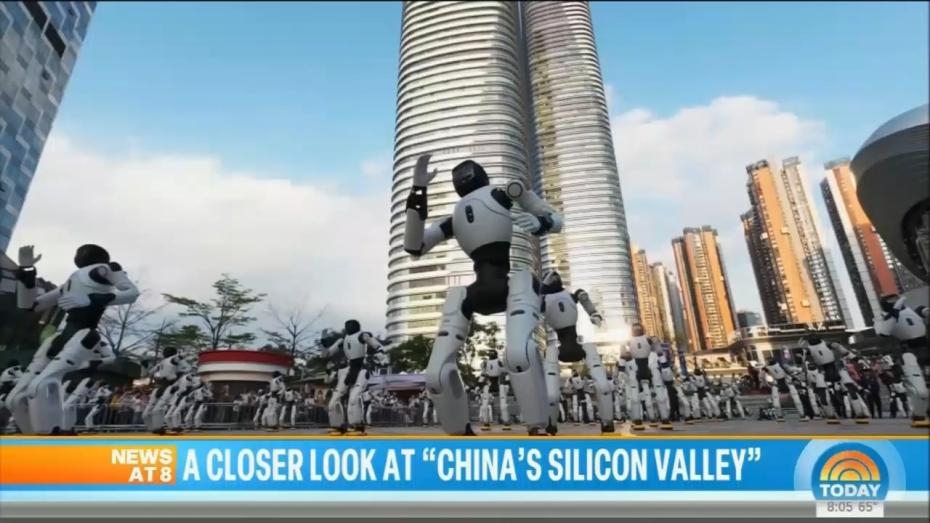
With President Trump in China this week for yet another visit, the major broadcast networks have sent a plethora of resources to Shenzhen, so it wasn’t surprising on Wednesday when CBS Mornings and NBC’s Today eagerly promoted propaganda for the murderous authoritarian thugs who run the Chinese Communist Party (CCP), with puff pieces gushing over the rapid growth of full-sized robots who increasingly take part in everyday life for everything from deliveries to laundry.
But at no point in either story did CBS or NBC point out personal liberties being compromised with footage being captured by said robots and shared with the CCP to ensure complete and total compliance with and loyalty to the regime’s aims. None of it was surprising since they (along with ABC) spent over 18 minutes in August giggling about a Chinese robot convention (or drooling over Chinese military parades).
“And sci-fi city. We go inside one of the world’s most modern metropolises. How this city in China that was nothing but farmland a few decades ago is now leading a tech revolution,” gushed Today co-host Savannah Guthrie in a tease.
Sounding like a CCP tourism board official, Guthrie cued up the piece by Beijing-based correspondent Janis Mackey Frayer: “We wanna look closer at Shenzhen, China, the city that is hosting this historic trilateral meeting. It was once a quiet farming and fishing village, and now it is one of the world’s most powerful technology hubs. It’s frequently referred to as China’s Silicon Valley.”
WATCH: NBC’s ‘Today’ ran a piece of CCP propaganda on Wednesday disguised as journalism, gushing over the rapid growth of full-sized robots that increasingly take part in everyday life
— Curtis Houck (@CurtisHouck) November 18, 2026
Sounding like a CCP tourism board official, co-host Savannah Guthrie cued up the piece by… pic.twitter.com/i0gETye7eP
Mackey Frayer swooned that the city’s “skyline alone tells you this is center stage,” and that “[u]nder the skyscrapers, flyovers, and urban sprawl, Shenzhen is wired to move at a different speed — a sci-fi metropolis of 18 million people, where your takeout takes off, robots are part of the scenery, and getting a taxi doesn’t always mean getting a driver.”
She visited one such company developing personal robots, bragging “modern China” is “a showcase of technological ambition, with AI at the center” to create machines that “move, see, and behave” like humans.
To anyone who’d argue Mackey Frayer’s life would be threatened if she were to have done a story critical of privacy concerns about robots or suggest they could be military tools, the response is simply that she shouldn’t have done the story if it was going to result in a wet kiss.

Speaking of censorship, she made China’s agrarian past seem quaint instead of the tens of millions murdered during the Chinese civil war and subsequent Great Leap Forward, often through killing fields and forced starvation. Notice she naturally found an American tech worker willing to extol China’s supposed greatness (click “expand”):
MACKEY FRAYER: Yet for all the tech wizardry, it wasn’t so long ago that much of this was farmland until the 1980s, when China opened up to foreign business, igniting opportunity —
UNIDENTIFIED NBC NEWS REPORTER: 150,000 construction workers have been brought in from all over the country
MACKEY FRAYER: — remaking a backwater on Hong Kong’s doorstep into one of China’s wealthiest cities. Tech giants like BYD, Tencent, and Huawei helping put Shenzhen on the map, but beneath the shiny surface, there are cracks in the economy, fewer secure jobs, and a technology standoff with the U.S. over the advanced chips powering the AI race. What China does control is a huge manufacturing base and the supply chains that go with it. The Huachengbei mega market alone is a maze of stalls stocked with everything from sensors to circuit boards, shortening the distance between an idea and full-scale production; access to that pipeline is what Joey Gutral (sp?) is chasing.
GUTRAL (SP?): It’s immensely cost-efficient and time-efficient, both.
MACKEY FRAYER: His San Francisco-based startup Voyage is making a brain-reading device and splits its time between Silicon Valley and China’s version of it.
GUTRAL (SP?): There’s more silicon here than there is in San Francisco, if I’m being honest. Like actual silicon, it’s everywhere.
Mackey Frayer concluded with an embarrassing-yet-predictable parting thought about how terrific Chinese society is:
There is Shenzhen speed, but with world leaders now in town, it has slowed to apex speed, with traffic, road closures, and not a single protest here, as well as a temporary ban on those drone deliveries and robo taxis until the summit wraps up
Question for NBC: Why are protests in China banned?
The supposedly “MAGA-coded” and unabashedly pro-American CBS News was similarly disappointing.
In various teases, co-host Gayle King and featured co-host Vladimir Duthiers declared that “China is racing ahead” of the U.S. with “very impressive” examples of “new technology.”
CBS Evening News anchor Tony Dokoupil came the closest to offering another view about the robots, saying that while “Shenzhen is a city of drone deliveries, robot taxis, and electronic vehicles that are basically your smartphone on wheels” to prove China has “a defining role” in the world’s future, “the rest of the world does not always agree with that.”
At another point, he warned before pointing out U.S. sales of chips to China are “banned...on national security grounds”: “China tries to tell the world that its rise as a dominant force in technology is nothing to worry about, but the world is not so sure[.]”

Hong Kong-based correspondent Anna Coren — who bragged last week that China doesn’t have the same data center concerns and protests as the U.S. does — was ebullient at what she experienced:
The supposedly pro-America and ‘MAGA-coded’ ‘CBS Mornings’ also served as a tool for the murderous Chinese regime by marveling at the advancement of robots to participate in seemingly every aspect of life, with nary a mention of privacy concerns pic.twitter.com/TRpiov82sA
— Curtis Houck (@CurtisHouck) November 18, 2026
[W]hen we arrived at this training center in Wuhan, we were greeted by dancing and singing robots, but what we found most interesting were the humans training the humanoids. A computer science graduate in Wuhan, China, patiently puts cutlery and chopsticks into a container, a tedious job he will do over and over again. But this is all about collecting valuable data using motion sensors, cameras, and AI to help train what some believe will ultimately replace us: humanoid robots.
Also ignoring the reality these robots are surveillance tools for the regime, Coren insisted robots will “help humans rather than replace them,” and spoke to two sympathetic robotic engineers (click “expand”):
Professor Jiyin Ciao runs the Hubei Humanoid Robotics Innovation Center, where over 100 graduates train humanoids. [TO YINATO] What are you training these robots to do? “Our main goal is for these robots to serve humans in household and industrial settings,” he tells me. “We’re training them to integrate better into human life.”
And China is under enormous pressure to make this happen. The country is facing an aging and shrinking population, a demographic change that’s one of the fastest in the world. There is an urgency to get these humanoid robots into labor-intensive industries, but this training all takes time. [TO ROBOTICS ENGINEER] And how many times do you need to do this? “We need to run this hundreds or thousands of times. We’ve only completed 500 iterations so far,” he says.
A longtime Hong Kong resident, Coren likely made whatever CCP minders are tasked with monitoring her proud, down to emphasizing “more and more women are wanting to get into AI” in China and the country produces far more computer science degrees than Americans (click “expand”):
COREN: While it’s questionable as to when these humanoid robots will be in our homes doing these types of menial tasks, China is working at breakneck speed and scale to make this a reality. Whether it’s pouring water, stacking dishes, making beds, or folding clothes, every single motion needs to be captured and perfected, as witnessed by visiting students and tourists. [TO WESTERN TOURIST] Could you see one of these in your home?
UNIDENTIFIED MALE WESTERN TOURIST: My home? Not sure. But in the local supermarket, yes.
COREN: Some experts believe it will take tens of millions of hours of data before humanoids reach their breakthrough moment, which could be years away. Now, China produces more than a million computer science graduates every single year. Compare that to the U.S., which has, on average, about 130,000. Now, this is a concerted effort by the Chinese government to make AI and technology a national priority. And Tony, I think what really struck me the most were the number of female graduates that were there. More and more women are wanting to get into AI and have a future career.
Dokoupil asked a soft follow-up: “It’s an amazing piece. You know, Anna, many young Americans are not excited about a robot future. Are they excited here in China?”
Coren gave a predictable answer that “they are” and there’s been “a definitive no” from the Chinese people when it comes to being “concerned about being replaced, or at least their jobs being replaced by robots.”
“You know, they are there to help us. They are there to make our lives easier. And as I said, China, as much of Asia, is facing an aging and shrinking population, so they need that industrial, you know, resource to — to boost up the economy,” she concluded.
To see the relevant transcripts from November 18, click here (for CBS) and here (for NBC).