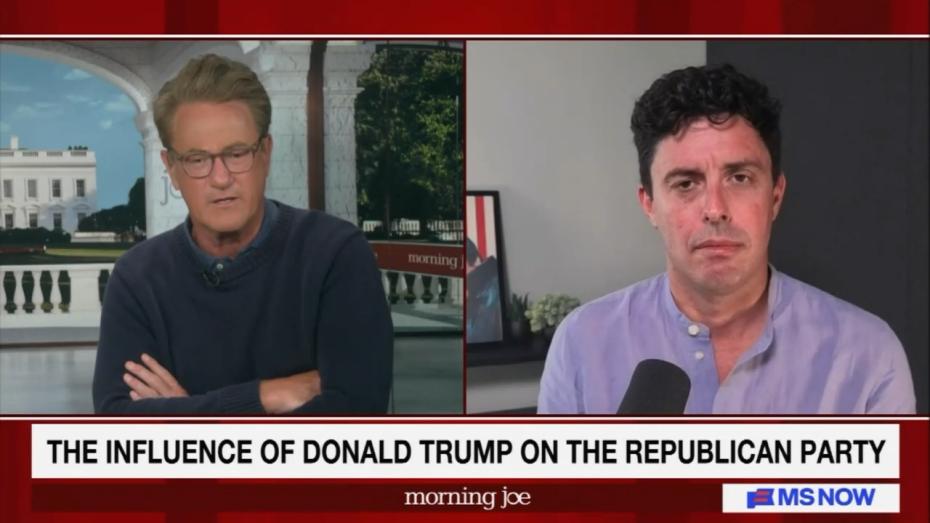
On Monday’s Morning Joe, the show’s 8 AM hour was heavily filled with a pre-recorded conversation with The Bulwark podcaster Tim Miller. In the interview, Miller took the opportunity to essentially go after Republican voters as he stated, “I’m not saying that every Republican voter is a bad person, but” -- before he used a Nazi slogan, “Blood and Soil,” to describe what he felt they wanted.
Host Joe Scarborough asked Miller, “Let's talk about our former party. What happened to Republicans? When did it happen?” and wondered whether he and Miller, who worked as a Republican operative for figures like former Florida governor and presidential candidate Jeb Bush, held any responsibility for the current Republican Party.
Miller responded, “Look, I think there's plenty of blame to go around. I mean, I raised my hand. I certainly went along with stuff that I knew was not right in order to kind of appeal to the Republican base voters. I think that there was a lot of, you know, culture war, red-meat stuff that was firing up the base from Republican candidates going back to your class of '94.”
Monday’s Morning Joe featured a long, nearly 20-minute interview with The Bulwark’s Tim Miller.
In the interview, Miller used a Nazi slogan to describe Republican voters as he stated, “I'm not saying every Republican voter is a bad person, but I think that, on balance, a… pic.twitter.com/RCWCLIdR1U— Nick (@nspin310) August 17, 2026
Then Miller used a former Nazi slogan to describe what the “Republican base voter” wanted:
And I think that Donald Trump has spoken to the issue of the Republican base voter. I'm not saying that every Republican voter is a bad person, but I think that, on balance, a majority of Republican voters want, or they resonate with the idea of, like, a blood and soil nationalist party.
The Holocaust Memorial Museum defined “Blood and Soil” as “an early Nazi slogan used in Germany to evoke the idea of a pure ‘Aryan’ race and the territory it wanted to conquer.”
Miller did not stop with his use of the term for the Republican Party and expanded it to “right-wing parties” everywhere “except the anglosphere”: “Everywhere else, the right-wing party is a blood and soil religious party that is anti-immigration, you know, very culturally conservative.”
He expanded and called it “human nature” before he said, “Like that's the strain of like an average conservative voter in Louisiana where I live.”
Miller continued, “The majority of Republican voters didn't care about balancing budgets and didn't really care about the rule of law and didn't care about all these, some of these other fundamental classical liberal values. But what they cared about was going after their foes. And whether that be elites on the coasts, or immigrants, or Muslims, you know, Muslim terrorists, etc.”
Miller closed, “That rhetoric is what appealed to those voters. And I think now the party is representative of it.”
Later, Miller said that if there were only two future governing routes, he preferred to “become a Scandinavian Democratic socialist country” under the DSA rather than becoming a “Viktor Orban authoritarian country.” pic.twitter.com/xkNBcs3yP6
— Nick (@nspin310) August 17, 2026
Later in the show, after the use of Nazi terms, Scarborough and Miller discussed the Democratic civil war between the “moderate” wing and the Democratic Socialists of America (DSA).
Miller’s response: “And, you know, but at this point, like, look, my advice for people always is if you told me, Hey, the two parties in our country, these are the only two routes, we're either going to become a Scandinavian democratic socialist country, or we're going to become a Viktor Orban authoritarian country. Like, that's not a hard choice for me....it's obviously much preferable, you know, that we go down a democratic path where I have some policy disagreements." The DSA folks somehow aren't fans of authoritarians?
Miller described his podcast as getting popular in 2024 for people trying to find "center-left information." Don't buy that label. Centrists would not defend far-left streamer Hasan Piker and use a Nazi slogan to describe the views of their opponent’s voter base.
The transcript is below. Click "expand":
MS NOW’s Morning Joe
August 17, 2026
8:24:37 AM Eastern
(...)
JOE SCARBOROUGH: Let's talk about our former party. What happened to Republicans? When did it happen? How much responsibility - you know, a lot of people look back to my class in ‘94, the Gingrich revolution and all this other stuff, or George W. Bush's presidency. I don't think it's quite that simple.
But I turn around, and I look at all the things I fought for politically my most of my adult life. I look at, you know, evangelicals who were my natural allies all the way through, you know, probably got 80, 90 percent of the evangelical vote. And so many of these people now are the very people that are holding up Donald Trump, a guy who again tried, tried to overthrow a presidential election in 2001, and a guy who is doing everything he can to stand in the way of a fair and free election in 2026.
TIM MILLER: Look, I think there's plenty of blame to go around. I mean, I raised my hand, I certainly went along with stuff that I knew was not right in order to kind of appeal to the Republican base voters, I think that there was a lot of, you know, culture war, red meat stuff that was firing up the base from Republican candidates going back to your class of 94, even maybe before that, but certainly was supercharged and kind of the Fox News and internet era on the right. I think basically how I would sum up what happened is that leadership does actually matter.
And I think that Donald Trump has spoken to the issue of the Republican base voter. I'm not saying that every Republican voter is a bad person, but I think that, on balance, a majority of Republican voters want, or they resonate with the idea of, like, a blood and soil nationalist party.
And if you just look around the world, the right-wing parties, everywhere around the world – except for in the anglosphere, basically, except for England, the US, Canada, Australia – everywhere else, the right-wing party is a blood and soil religious party that is anti-immigration, you know, very culturally conservative.
I think that - that is in human nature. Like that's the strain of like an average conservative voter in Louisiana where I live. And I think that there were a lot of Republican leaders that push people away from some of their dark impulses for a while, maybe they didn't do as well as didn't do so as consistently or as well as as we would have liked. And there were certainly times where everybody fell down.
But Donald Trump comes through Kool-Aid, man, through the door. And he's like,’ I'm going to let you get everything you want.’ Like, I'm gonna appeal to your most base instincts. And then, everything, kind of, the house of cards kind of collapsed.
And it turned out that, you know, there are some obviously, again, we're painting with a broad brush, but the majority of Republican voters didn't care about balancing budgets and didn't really care about the rule of law and didn't care about all these, some of these other fundamental classical liberal values. But what they cared about was going after their foes. And whether that be elites on the coasts or immigrants or muslims, you know, Muslim terrorists, etc.
Like that - that is what the rhetoric - that rhetoric is what appealed to those voters. And I think now the party is representative of it.
(...)
8:36:09 AM Eastern
MILLER:. My complaints about the party are mostly like tactical.
SCARBOROUGH: Right!
MILLER: I mean, it's just the amount of cutting off their nose, despite their face that they do is extremely frustrating to me. And I think that the, you know, kind of demands for, you know, making sure everybody falls in line on every issue is really frustrating and turns a lot of people off.
And, you know, but at this point, like, look, my advice for people always is if you told me, Hey, the two parties in our country, these are the only two routes, we're either going to become a Scandinavian democratic socialist country, or we're going to become a Viktor Orban authoritarian country. Like, that's not a hard choice for me.
SCARBOROUGH: No.
MILLER: Like that's neither of those are my ideal option, but it's obviously much preferable, you know, that we go down a democratic path where I have some policy disagreements.
SCARBOROUGH: It seems to me - and again, I'm not being critical of the Democrats. I'm simply trying to offer some guidance. I have found now that I want Democrats to win races against people who are anti-democratic, I found that a lot of times they seem more interested in being right or feeling right, like they're right, than doing the things they need to do to win elections.
(...)