A job, we would learn, is on par with American soldiers and perhaps even more important. And, as we also saw, a profession that is inconceivable to him, no one would have grounds to distrust.
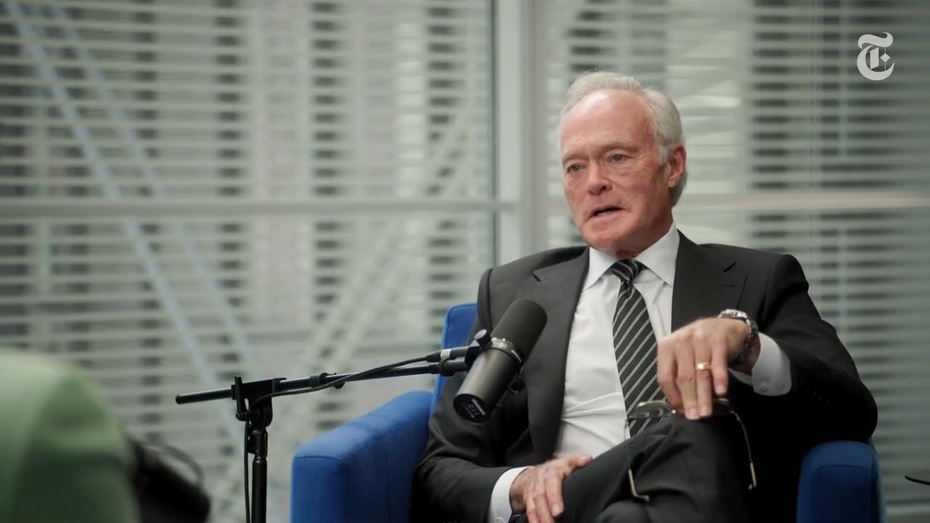
The interview began on an insensitive and jarring note as Pelley said the upheaval at CBS News was “like your spouse was murdered” and, through misty eyes, asserted this isn’t “about me” and “I’m fine,” but “these people that I left behind…who are still trapped.” This, he insisted, was “the depth of my devotion.”
Scott Pelley INSISTS “I’m fine” and this is “not about me,” but gets misty-eyed when saying being fired at CBS News is “like your spouse was murdered” and many times he “frankly fall[s] apart” because being married to someone is the same “depth” of “devotion” he gave to CBS….… pic.twitter.com/srOqyUZn6g
— Curtis Houck (@CurtisHouck) June 7, 2026
Pelley explained “no one saw the Black Thursday massacre coming” in which executive producer Tanya Simon, her deputy, other staff members, and correspondents Sharyn Alfonsi and Cecilia Vega were fired.
He said it triggered “dismay” and “shock” to see colleagues he went to war with were laid off. Pelley actually compared it to “when somebody wipes out, murders a large number of your family members, people are hurt and shocked in disbelief and just desperate for some explanation.”
CBS’s Scott Pelley breaks down in tears over how colleagues he went “into liberal combat together” with overseas were all fired, giving off feelings of “shock, dismay, impossible to believe”…
— Curtis Houck (@CurtisHouck) June 7, 2026
“Shock, dismay, impossible to believe, searching desperately for an explanation,… pic.twitter.com/RhpiD6ARy0
Again, how insensitive to those who’ve actually experienced that heartbreaking scenario. At least Pelley’s colleagues are still alive, and he has his sailboat.
To Garcia-Navarro’s credit, she asked him to explain why he ignored previous overtures from Bilton to talk instead of blow himself up in front of the entire staff:
WATCH: Scott Pelley explains away his decision to reject any and all overtures from Nick Bilton and Bari Weiss's team about the '60 Minutes' changes, waiting until the all-hands meeting to attack...
— Curtis Houck (@CurtisHouck) June 7, 2026
“I’m almost 69 years old. And if I’ve learned one thing in life, it is not to… pic.twitter.com/np9GObrkmT
As for why he unleashed such anger at his bosses, he called it “fate” and broke down in tears when saying “newsrooms are sort of like the military” and have “life-threatening job[s]” with “very strong bonds” that demand “people…go to war zones when…pregnant.”
He added Bari Weiss, Nick Bilton, and their lieutenants “have never felt that” in their lives (click “expand”):
EYE ROLL: Scott Pelley says “it was fate” that he chose to tear into his new bosses to their faces and cries AGAIN when saying “newsrooms are sort of like the military” and have “life-threatening job[s]” with “very strong bonds” that demand “people…go to war zones… pic.twitter.com/pYD27PaKFd
— Curtis Houck (@CurtisHouck) June 7, 2026
It was fate. First of all, our entire senior staff had been wiped out there and out there. I looked around the room, I’m the only correspondent there, which surprised me very much. I learned that my colleagues were out shooting stories as they should be in the month of June. But I’m the only correspondent there, which surprised me. And I looked around at my friends and colleagues in the room and realized I was the senior person. Only I could do it. None of them could be asked to take that risk. So, when I saw Nick Bilton’s email and then saw him reading to my broken-hearted people off his phone, I felt that somebody had to stand up for the broadcast, not just the broadcast, but the people. There are people in that room who go to war zones when they are pregnant. [SOBBING] Newsrooms are sort of like the military or the police or the beautiful people at the FDNY down the street. It is a life-threatening job in many instances. And very strong bonds, very emotional bonds are found or are developed in that kind of setting. And to have people running CBS News who don’t know that, have never felt that, and don’t understand it, is a tragedy I never expected to see.
Another embarrassing moment came when she twice wondered how Pelley couldn’t have realized attacking management in such a way wouldn’t have led to consequences.
Pelley said it was the “furthest thing from my mind” and “it hadn’t occurred to me.” Thus, he said, he “just didn’t connect the dots,” but said his indignation was appropriate because the series of meetings last week were “about whether 60 Minutes was even going to survive”:
Lulu Garcia-Navarro: “But it really didn’t occur to you that you could be fired after so many of your colleagues had been let go after you’d had this, you know, very contentious interaction with your new boss?”
— Curtis Houck (@CurtisHouck) June 7, 2026
Scott Pelley: “You know, some reporter, I turned out to be. I just… pic.twitter.com/rDtKTzJMgY
Once he unspooled his recollections of his meeting with Cibrowski and Weiss before his firing, Garcia-Navarro made another attempt to have Pelley consider he went too far:
The arrogance of this guy...
— Curtis Houck (@CurtisHouck) June 7, 2026
Lulu Garcia-Navarro: “But, Scott, in a meeting, you accused Bari Weiss, the head of the network of wanting to murder the show, of coming into 60 Minutes with the agenda to dismantle the institution. And you did not think that that was going to have… pic.twitter.com/ZCiPXY1cyW
Zooming past his initial recollections of David Ellison’s Skydance purchasing CBS’s parent company Paramount, and the end of the Redstone family’s ownership, Pelley again showed his thick walls of bias by conceding he had never heard of Bari Weiss prior to her hiring:
Scott Pelley says he had never even heard of Bari Weiss before she was hired as CBS News editor-in-chief pic.twitter.com/18W475MC23
— Curtis Houck (@CurtisHouck) June 7, 2026
Pelley quickly came to loathe Weiss. Why? Because she stated something Pelley found meritless, which was that increasing numbers of Americans distrust the media due to their bias:
WATCH: Here’s the full exchange of Scott Pelley saying he was “shocked” to hear @BariWeiss or anyone say there’s a bias at CBS News and the country doesn’t trust the news media, insisting “we certainly didn’t believe that….”
— Curtis Houck (@CurtisHouck) June 7, 2026
Garcia-Navarro: “So, when Bari comes in, she has a… pic.twitter.com/c88dPEfWhc
Pelley disclosed one claim of interference from Weiss, which allegedly came in a piece he did on the Minneapolis unrest with immigration enforcement. He claimed Weiss tried to tell 60 Minutes that Renee Good tried to hit the officer with her car, which Pelley refused to include because he believes the facts showed otherwise:
Scott Pelley says, contrary to what President Trump, Bari Weiss, and others claim, there's no evidence Renee Good tried to hit ICE officer Jonathan Ross with her car, but he shot her anyway pic.twitter.com/mSJyYT9idr
— Curtis Houck (@CurtisHouck) June 7, 2026
Pelley wept again when declaring Weiss and CBS News President Tom Cibrowski showed “breathtaking, complete lack of empathy,” “callousness,” and “inhumanity” by letting go Tanya Simon because her “family is legendary at CBS News.”
He reiterated the tears are not “about me...but the people I leave behind treated in this way, that breaks my heart. And it’s going to take me a long time to get over it.”
Scott Pelley cries again when declaring CBS’s Bari Weiss and Tom Cibrowski showed “breathtaking, completely lack of empathy,” “callousness,” and “inhumanity” by letting go Tanya Simon because her “family is legendary at CBS News.”
— Curtis Houck (@CurtisHouck) June 7, 2026
He again insists the tears are not “about me,”… pic.twitter.com/5WSjQDJjmF
A few minutes after he called on the Ellison family to fire Bari Weiss because “[s]he brings an ideology into CBS News where that is just anathema,” Pelley cried yet again because President Trump said liberals like Pelley “don’t care about” America.
This gave Pelley the chance to compare himself to soldiers and claim journalists like him are actually more important. Why? Because while both have “been in combat,” “[t]here is no democracy without journalism” (click “expand”):
Scott Pelley sobs when he argues he’s just like U.S. troops because both go to war to serve the country and might even be more important because “there is no democracy without journalism”…
— Curtis Houck (@CurtisHouck) June 7, 2026
“Don’t care about the country? [CRYING] I’ve never worn the uniform, but I’ve been in… pic.twitter.com/omB9uteXFq
GARCIA-NAVARRO: He went on a podcast and called you a stiff…He also said you were part of this gang of stupid crooked people that don’t care about your country.
PELLEY: Stupid. I can take that. Stiff, yeah, probably. Don’t care about the country? [CRYING] I’ve never worn the uniform, but I’ve been in combat for this country in Afghanistan, Iraq, Kuwait, been shot at. Spent nights in foxholes filling up with water in the desert. I’m not aware that the President of the United States has ever done any of those things for his country. Please correct me if I’m wrong. You become a journalist because you love the First Amendment. You become a journalist because you love the country. And while all the other descriptions that the President used about me might be applicable, not that one. [CRYING] There is no democracy without journalism. It can’t be done. And that is why I am a journalist.
Pelley closed with what he hopes Paramount Skydance executives do in the future to end this Weiss tenure in which “there is a thumb on the scale for” Donald Trump’s GOP and “there’s a subtle political bias that I’ve never seen” before at the network.
The pomposity of this guy…
— Curtis Houck (@CurtisHouck) June 7, 2026
“[T]hey don’t know what they’re doing, and there’s a subtle political bias that I’ve never seen at 60 Minutes before, and so – or at CBS News before. And so, that is my hope. A return to sanity, a return to honor, a return to courage. We used to have… pic.twitter.com/XwOrOMcFr0
“[T]hat is my hope. A return to sanity, a return to honor, a return to courage. We used to have all of those things in abundance. And now, we don’t. We can save this. It’s possible to land this plane. But right now, CBS News, in my view, is on fire,” he concluded.
To see the transcript of the Pelley interview from June 7 (taped June 5), click here.