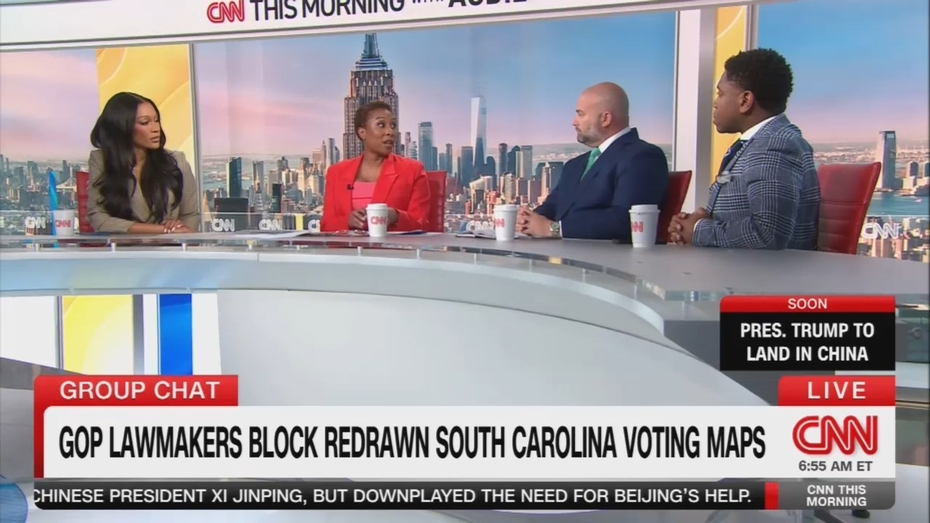
After a show that was already dominated by Cornish and panelists against Borelli, the final segment of the show discussed redistricting after South Carolina did not pass a new map, which kept the powerful House Democrat Jim Clyburn in his seat. Seawright said Republicans respected Clyburn’s power.
After Seawright, Borelli mockingly pointed out how “noble” Democrats gerrymandered in their states for a Democratic House seats advantage:
But where are these noble Democrats in the New England states, where there are significant Republican pockets. There are significant Republican pockets in all of the New England states, and yet not one single seat in an entire region is represented by a Republican. That is due to gerrymandering. That is due to consistent gerrymandering, not just of this decade cycle, but the cycle before and the cycle before that.
On CNN This Morning, panelist Joe Borelli pointed out how Democrats have little "moral high ground" as some blue-state congressional maps have little Republican representation, as host Audie Cornish and her panel essentially ignored his points.
— Nick (@nspin310) May 13, 2026
Antjuan Seawright claimed it was… pic.twitter.com/EUCKHdhTa0
Seawright responded and said the discussion was all about “black political power and black political representation.” He also said, “nobody cares about a 74 or 75 percent white district.”
Borelli began to interject and pointed out that Republicans ran black candidates against Jim Clyburn and one South Carolina Senator was a black Republican, Tim Scott.
Seawright got back in to make his point and went back to the period after the Civil War, and stated: “We're seeing the fastest rollback of black political power in the south. Perhaps since Hayes ended Reconstruction in 1877. That's not a joke.”
Borelli also pointed out that the representative of Tennessee’s Democratic stronghold seat of Memphis was a white Democratic man.
Champion then started her response to Borelli and claimed a “dilution” of black voters: “There's a specific - it's a dilution. They're trying to get rid of black voters and black representation. And you know that. And you can point out whatever you want to point out. You can give me any example.”
Borelli’s own response to Champion was a case of a New York gerrymander, where, Borelli said, “the Democratic Party wanted to redistrict the seat (...) where they would remove a Hispanic Republican and replace it with a white man.” None of the panelists or Cornish wanted to discuss this.
He also said, “I disagree with the Democratic moral high ground on this.”
Cornish took a dig at Borelli as she said, “This is not a show where we care about what the lobbyists are saying. Part of this is public perception.”
Cornish then asked, "Can the Republican Party go into the midterms with a growing perception within this community that there's a problem?"
— Nick (@nspin310) May 13, 2026
Seawright later said, "This is intentional to eliminate black political representation." pic.twitter.com/fCOv9qpFu2
Cornish repeated a line about a possible black American boycott of SEC schools and asked, “Can the Republican Party go into the midterms with a growing perception within this community that there's a problem?” Borelli responded with the same answer about the gerrymandering in blue states.
For the last word of the segment, Seawright exemplified some Democrat disarray as he called on progressives “who challenge African-American Democrats” to step up.
As Borelli pointed out, there was little moral high ground for democrats who gerrymander their states, like an old Illinois’s current map and California's newly enacted “fair map,” with little pushback and breaking news segments in the media.
The transcript is below. Click "expand":
CNN This Morning
May 13, 2026
6:53:27 AM Eastern
(...)
AUDIE CORNISH: So, I wanted to know, Antjuan, you, of course, know Clyburn. You're close to Clyburn. He's so powerful in that state. Is this because they like him, he's powerful, or is this because there was actually some frustration with Republicans in this state?
ANTJUAN SEAWRIGHT: All politics is local. Jim Clyburn, by far, is the most consequential elected official to ever serve our state. Definitely - perhaps our country. And Republicans may not agree with Jim Clyburn, but they respect Jim Clyburn in his cachet and what he has done for our state. And so, I think that's a large part of the equation. And I think that South Carolina does not always fold to pressure from outsiders.
CORNISH: Well, we saw that in Indiana and then Trump primaried those Republicans.
SEAWRIGHT: But can I say this? We have a six-one map in South Carolina. Any redistricting would make those seats more competitive and give democrats an advantage. I don't think that's smart politics.
CORNISH: Oh, yes, I think they call that a dummy-mander, actually.
JOE BORELLI: But stay on that six-one idea, right. In a state that even has some Republicans or some Democrats, there should be one person representing. And that state senator sounded lovely.
But where are these noble Democrats in the New England states where there are significant Republican pockets. There are significant Republican pockets in all of the New England states, and yet not one single seat in an entire region is represented by a Republican. That is due to gerrymandering. That is due to consistent gerrymandering, not just of this decade cycle, but the cycle before and the cycle before that.
SEAWRIGHT: Can I just make one point about this moment we're in? This is not about gerrymandering. This is about literally exterminating black political power and black political representation. Nobody cares about a 74 or 75 percent white district.
What we're seeing across the south is the fastest rollback of black political power -
BORELLI: But Republicans ran -
SEAWRIGHT: But let me finish, Joe. Joe, let me finish.
BORELLI: Republicans ran a black candidate against Joe Clyburn twice.
SEAWRIGHT: Joe, Joe, Joe, let me finish.
BORELLI: They ran Tim Scott. He has something to say about this.
SEAWRIGHT: We're seeing - we're seeing - we're seeing a - we're seeing the fastest rollback of black political power in the south. Perhaps since Hayes ended Reconstruction in 1877. That's not a joke.
CORNISH: Can I bring this up, to his point, because with the Supreme Court jumping in, specifically taking away race, despite the history of the South and saying, look, the partisanship is fine, are Republicans now in a position where they are going to be saying, yes, district after district should be Republican. And if that means they're completely white and those black voters aren't going to get their representation -
BORELLI: But that's not the history, right?
CORNISH: No, but it's going to look -
BORELLI: We're talking about Jim Clyburn's district. Republicans ran black candidates twice against Jim Clyburn.
CORNISH: No, no, no.. We could show you the map of Alabama and all the other places where those districts will go away.
CARI CHAMPION: It's a very concerted effort. And I think -
CORNISH: Well, I think it's more like, what do you tell the voter.
BORELLI: What about the map of Tennessee, where you have the most African American - one of the most African American cities currently represented by a white man who Republicans ran black candidates -
CHAMPION: You can pick - you can pick and choose all you want.
CORNISH: Yeah. I mean that district will also be gone.
BORELLI: And Republicans have ran consistently Black candidates in that race.
CORNISH: Well, I think that there is a world -
BORELLI: Or I'll give you another - I've got another one for you.
CORNISH: Hold on, Joe. There's a world where black voters will come off the sidelines if they perceive, not politics, if the public perceives -
BORELLI: This year -
CORNISH: That they're being taken advantage of.
CHAMPION: Advantage of. And that's exactly what you were trying to get at, to your point.
CHAMPION: There's a specific - it's a dilution. They're trying to get rid of black voters and black representation. And you know that. And you can point out whatever you want to point out. You can give me any example.
BORELLI: I'm pointing out facts. Yeah.
CHAMPION: That's fine. That's what you do for a living. You're going to debate this issue. But we're talking about a core where people know that there's a significant history of what happens in the South and how they are making an effort to get rid of -
BORELLI: This year I was an expert witness in a case, New York 11 here -
CHAMPION: Jim, Jim -
BORELLI: Where the Democratic Party wanted to redistrict the seat -
CHAMPION: You're not - but you're not talking about that issue.
BORELLI: Where they would remove a Hispanic Republican and replace it with a white man.
CHAMPION: And you know that this is an attack specifically on the black -
BORELLI: So, I just - I disagree with the Democratic moral high ground on this.
CORNISH: Let me jump in for a second.
SEAWRIGHT: Can I make one point on this? Yesterday, the Trump -
CORNISH: No. Hold on one second. I just need to say this. This is not a show where we care about what the lobbyists are saying. Part of this is public perception.
BORELLI: I'm talking about what the courts are saying.
CORNISH: Yes, what the - no, I'm talking about public perception. And we just saw someone like D.L. Hughley say, maybe these black athletes shouldn't run and go to SEC schools.
CHAMPION: Go to SEC schools anymore. We should take back the power/
CORNISH: So, what I'm talking about is perception.
CHAMPION: Yeah.
CORNISH: Can the Republican Party go into the midterms with a growing perception within this community that there's a problem?
SEAWRIGHT: And when yesterday, when the president -
BORELLI: I just gave you an example here in New York where the Democratic Party's position, through lawsuits, was to remove a Hispanic candidate because she was Republican and replace her with most likely Dan Goldman, a white man.
CORNISH: Well -
BORELLI: So, this is not a one-sided race-based issue.
SEAWRIGHT: Joe, Joe -
BORELLI: You have the Democratic Party doing the same things.
SEAWRIGHT: Joe, Joe, Joe, hear this. When the president was asked specifically yesterday whether or not he is concerned about black representation being eliminated, his response was, “it's going great.” This is intentional to eliminate black political representation.
They're starting in the south. It does not mean they're not going to continue to grow this, because the Supreme Court has given Republicans and Donald Trump a pass to literally eliminate black political - and why? Because every time we show up in elections, the tectonic plates in this country shift to where people, white men who traditionally have had power, that no longer exists.
CORNISH: Well, Antjuan, this is going to have some implications for Democrats, especially those, the Bernie Sanders of the world, these people who have not really -
SEAWRIGHT: Well, they should be saying more in this moment.
CORNISH: Ok.
SEAWRIGHT: Progressives who challenge African American Democrats, CBC members in primaries, they should be stepping up and saying more in this moment because this is an all hands on deck moment. Whatever differences we may appear to have amongst each other -
CHAMPION: Everybody needs to get involved. Everybody.
SEAWRIGHT: - they do not compare to the differences we have with the people who are trying to eliminate and exterminate black political power.
CHAMPION: Antjuan, good point.
(...)