Cornish, who earlier in the opening lead of the show said the result would “even the score in the redistricting fight,” asked NPR correspondent Tamara Keith about redistricting: “Was the juice worth the squeeze here for Republicans?”
Keith responded as if the fight was a wash when taking multiple states into account, and then Cornish made a point about Democrat Hypocrisy on redistricting: “And Democrats kind of have to go back on all the campaigning and philosophizing about redistricting and how they feel about it.”
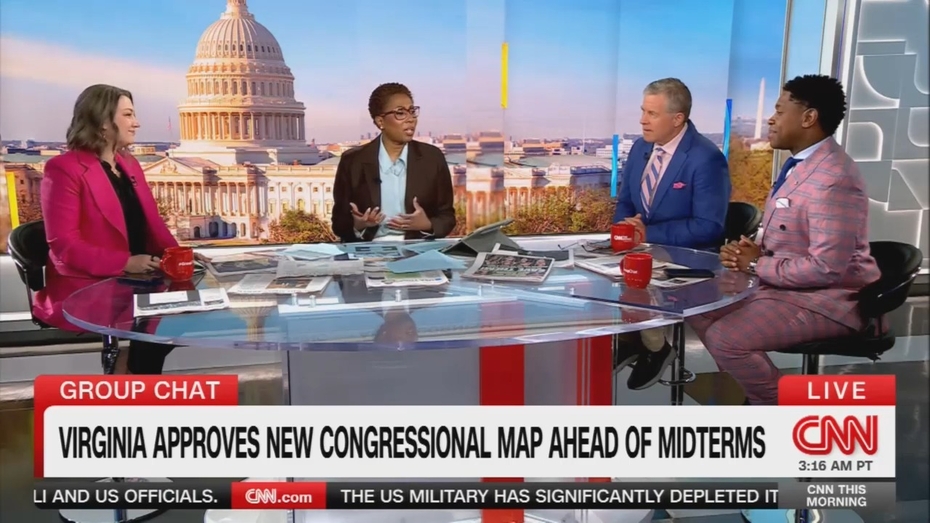
CNN This Morning talked about Virginia Redistricting on Wednesday, as host Audie Cornish joked about the "lobster claw" district. In fairness, she also pointed out recent redistricting hypocrisy from Dems.
— Nick (@nspin310) April 22, 2026
Would Cornish ever joke about Democrat voter disenfranchisement? pic.twitter.com/9H1zNgSWuk
But after she made that good point, she went into laughter and jokes about Republican disenfranchisement with a showcase of the maps, especially the so-called “lobster claw”:
Because there is this one section they call the lobster claw. Alright. So, if you're looking on your TV on the left, there's a lot of red there right now. You look over onto the other side and there's that little - little lobster tail jutting out into the sea of red. Never mind all the blue.
Cornish joked about the gerrymander, Democratic strategist Antjuan Seawright labeled Democratic House Leader Hakeen Jeffries as the “Brooklyn Brawler” and started his talking points of “this started in Texas. A redistricting war led by Donald Trump. Responded in California with Prop 50.”
The CNN host called the Democratic reaction a “victory dance” and pointed out how Democrats felt their gerrymandering was better since they got it through voter referenda:
I mean, what I hear in this victory dance, because I like the rhyme, is the fact that Democrats feel like the fact that it was voters, in particular, who agreed with them somehow gives them sort of the edge in saying, look, you guys invited this fight, and then the voters confirmed their rejection of it.
Seawright ended the conversation while he said exactly what Conrish had stated was a Democrat victory dance: “It was OK for Texas to not ask the people what their will was and simply redraw the seats. But somehow or another, it was cheating or doing something wrong for Virginia voters to suggest what they want their maps to be.”
Cornish ended her segment, again, with some laughter and this close about the blame game: “Well, in the meantime, I think all of these Republicans in Virginia are texting each other this morning, trying to figure out whose fault this was.”
The fault may lie in the new, allegedly moderate Governor of Virginia, who pledged not to redistrict in 2025. The key difference in media coverage was the coverage of the disenfranchisement of Republican voters compared to alleged cases of Republican gerrymandering as the media coverage from Cornish was slight laughter.
In Republican redistricting plans, there were accusations of a revival of Jim Crow and disenfranchisement of black voters. The difference was in coverage clear and showcased the media’s little care for the hurt of Republican voters in the recent fights in California and now Virginia.
The transcript is below. Click "expand":
CNN This Morning
April 22, 2026
6:01:04 AM Eastern
(...)
AUDIE CORNISH: So Virginia voters helped Democrats even the score in the redistricting fight. Could Florida now be the tiebreaker?
(...)
6:15:28 AM Eastern
AUDIE CORNISH Alright. Bringing in my friends in the group chat: Tamara Keith, senior political correspondent for NPR and host of NPR's politics podcast. Charlie Dent, former Republican congressman from Pennsylvania, and Antjuan Seawright, Democratic strategist.
I want to just play for you the response from the Republican in Virginia who's head of the campaign arm there, just for a moment, so you can understand, like, sort of how they're taking it.
REP. RICHARD HUDSON (R-NC): You know, it hurts when you've got an illegal gerrymander that violates the state constitution, draws a divided purple state 10 to 1. That makes it harder. [jumpcut] But there's no one who can look you in the eye and tell you the Virginia map is a fair and legal map.
CORNISH: Was the juice worth the squeeze here for Republicans?
TAMARA KEITH: If you take this on net, if you take Texas and California and Virginia and Indiana, which ultimately didn't end up redistricting, you almost get a wash.
CORNISH: Yeah.
KEITH: All of this money, all of this effort, all of this pain, members of Congress inevitably losing their seats, incumbents losing their seats. And for what ultimately just kind of - kind of a wash in a year where Republicans are in trouble.
CORNISH: Yeah. And Democrats kind of have to go back on all the campaigning and philosophizing about redistricting and how they feel about it.
I just want to give people a sense of what the old district looked like, or the current district, and what the new district looks like, what these changes will mean. Let me see if I can get it up on the screen there.
Because there is this one section they call the lobster claw. Alright. So, if you're looking on your TV on the left, there's a lot of red there right now. You look over onto the other side and there's that little - little lobster tail jutting out into the sea of red. Never mind all the blue. It feels like we're right back to the problems that Democrats wanted out of.
ANTJUAN SEAWRIGHT: Well, I think Jeffries, in particular, sent a strong message, who I refer to sometimes as the Brooklyn Brawler. Don't come for me unless I send for you, as we say in the African-American community. Charlie, that's a proverb you should use sometime.
But this started in Texas. Redistricting war led by Donald Trump. Responded in California with Prop 50 -
CORNISH: That wasn't easy. I mean, Hakeem Jeffries tried to go to Maryland and get this done -
SEAWRIGHT: However -
CORNISH: - and it did not work.
SEAWRIGHT: So, we had started in Texas. California, Prop 50. We framed them in Ohio, New Hampshire, Nebraska. We tamed them in Utah, picking up a seat. And now in Virginia. And now we're daring them to put a ballot initiative in Florida. Because when the people have a chance to express themselves about Republicans trying to steal the midterm election, the people responded properly.
CORNISH: I mean, what I hear in this victory dance, because I like the rhyme, is the fact that Democrats feel like the fact that it was voters, in particular, who agreed with them somehow gives them sort of the edge in saying, look, you guys invited this fight, and then the voters confirmed their rejection of it.
CHARLIE DENT: Well, look, Congress, after this whole ordeal is finished, is it going to need to pass a law to ban mid-decade redistricting. This is terrible for democracy, because what's happening now is we're creating more very safe seats for both parties. The middle of this country is shrinking as a consequence. But I get it. But I -
CORNISH: The only other person who said that to me this week was also retiring, and you're out of Congress.
DENT: No, no. But I'm saying -
CORNISH: I feel like when you're in Congress, they don't want to do anything about it.
DENT: Well, look, I was - I've been involved with redistricting three different times in my life. This is an arduous process. It is painful. Once every ten years is enough. Now, look, Republicans made a strategic blunder entering into this. The juice was most certainly not worth the squeeze. In fact, they're probably going to lose more seats now because of this.
These seats in Texas that they think they're going to win, five. They're not going to win all five of those seats. The mood is so bad. They were assuming -- they were assuming a bunch of Latinos are going to stay with the Republican Party. Well, that's a big assumption right now. So, it's a mistake.
CORNISH: It occurs to me both of you have said something interesting, which is that it's the voters who have been the wild card here.
KEITH: Certainly, there were ballot measures in those two states, in California and Virginia. Voters now -
CORNISH: But even those thinking about Texas, you're assuming.
KEITH: Oh, yes.
CORNISH: - that those Latinos, we've won. You. It's locked.
KEITH: And this is why there's talk of Florida being, potentially, a dummy-mander instead of a gerrymander. Because in the - in this year where Democrats are expected to do far better than Trump did against Harris, if you're drawing lines based on 2024, you're potentially making a terrible mistake.
DENT: It's the next election.
SEAWRIGHT: But can we -
KEITH: Yes.
SEAWRIGHT: Can we say this, because I think it's a piss-poor choice of words by the person who ran the campaign in Virginia, in his response.
It was OK for Texas to not ask the people what their will was and simply redraw the seats. But somehow or another, it was cheating or doing something wrong for Virginia voters to suggest what they want their maps to be.
People could have voted no. They could have voted no in California. Yet, they made a strategic decision.
One of the undermining factors of last night is that voters had a chance to express their disappointment with the president and those in charge, because Virginia, just like Maryland, more so than any other state in the country, has been impacted by the government layoffs.
CORNISH: Well, in the meantime, I think all of these Republicans in Virginia are texting each other this morning, trying to figure out whose fault this was.
(...)