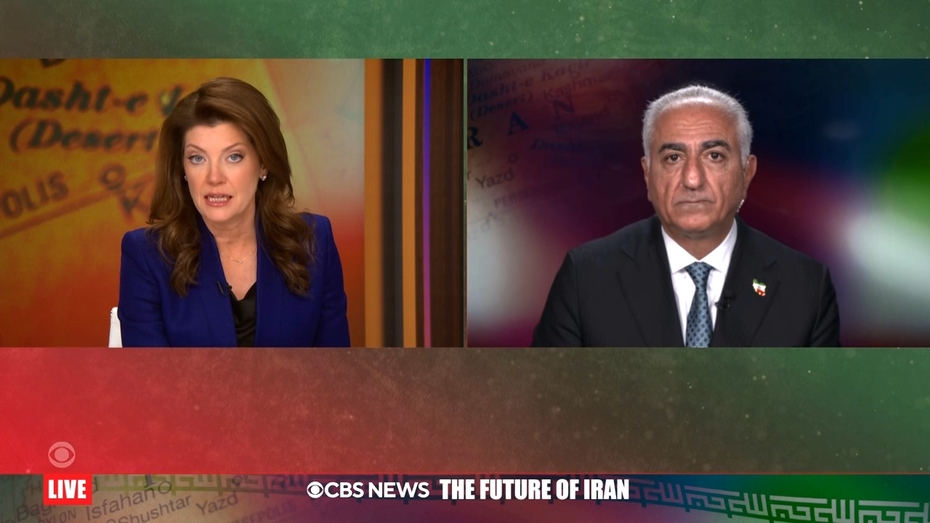
The interview started cordial enough with questions about the internet black out and talks with President Trump. But after Pahlavi talked about stabilizing relations with Iran’s regional neighbors and America, O’Donnell pivoted to being hostile.
O’Donnell attacked Pahlavi by accusing him of being responsible for getting Iranian civilians killed with his calls for protests and uprisings, not the radical Islamists who were actually doing the killing:
And as you are urging people to protest and go to the streets, the death toll is rising in Iran. This violent crackdown continues just as it has in past attempted revolutions. I mean, is it responsible to be sending citizens in Iran to their deaths? Do you bear some responsibility?
CBS's Norah O'Donnell asks Iranian Crown Prince Reza Pahlavi is he bears responsibility for getting Iranian civilians murdered by the Islamic regime of Iran with his calls to protest:
— Nicholas Fondacaro (@NickFondacaro) January 12, 2026
"And as you are urging people to protest and go to the streets, the death toll is rising in… pic.twitter.com/QedMX4kHVy
Pahlavi noted that every war had casualties and their fight for liberation would be no different, and that their fight would be the last one where the government would turn on its citizens. He might have struck a nerve when he argued that President Trump was set to do more for the Iranians that Democratic Presidents Obama and Biden, who threw them under the bus:
I think President Trump is responding to the call that the Iranian people have. The Iranian people have heard his words. They are naming streets after him in Iran. There's a difference. They know he's no Barack Obama or Joe Biden. And that's why they do have a higher expectation.
O’Donnell followed up by rhetorically scoffing at the Iranians who were chanting Pahlavi’s name in the streets. Citing an article from the Wall Street Journal, she sniped: “Few analysts think Pahlavi has a real path to the throne or leadership in Iran. His improved reputation in recent years says more about the mounting discontent with the Islamic Republic than it does about a genuine desire by Iranians for a return of the monarchy, analysts said.”
O'Donnell rhetorically scoffs at the Iranians in the streets chanting for Pahlavi to be their leader. Reading from the WSJ, O'Donnell says: ""'Few analysts think Pahlavi has a real path to the throne or leadership in Iran. His improved reputation in recent years says more about… pic.twitter.com/qhmO6L97HH
— Nicholas Fondacaro (@NickFondacaro) January 12, 2026
“Well, it is interesting the way you characterize it,” he quipped, “because if the people did not actually believe that I can be the person doing that for them or the person to be trusted, there wouldn't be in the millions on the streets of Iran, in the four corners of Iran, chanting my name and asking my return. They do.”
Pahlavi went on to explain that his vision was to have the Iranian people choose everything about how they would be governed and who would govern them (Click “expand”):
And in terms of the political alternative, it's a constitutional process. The interim government would be able to organize free elections so the people can send their representative in a constituent assembly to ultimately debate what ought to be and the final form that the future democratic secular system in Iran should take.
I'm not here to advocate for a republic or a monarchy. I'm here to be the honest broker above the fray in complete neutrality, making sure, however, that we have a fully transparent democratic transition. But the expectation of Iranians is to be able to have a smooth transition, to be able to have a stable transition.
Proving that patriotism and love-of-country was a foreign concept to her, O’Donnell claimed not to understand what Pahlavi meant when he proclaimed over the weekend that he was willing to die for Iran. He had to educate her (Click "expand"):
O’DONNELL: Forgive me, Reza, I heard you say over the weekend that you are willing to die for this cause. What does that mean?
PAHLAVI: Yes! But look, the first time I was ready to die for a cause. When I volunteered to join the Iranian Air Force during the Iraqi attack on Iran and the breaking of the Iran-Iraq war, when the revolutionary government of Khomeini was already in place. My patriotic duty was asking me to, as a pilot, to go and fight alongside my military brethren. In that war, I was prepared to die then. I'm prepared to die now. There is no greater cause than the liberty.
O'Donnell doesn't understand what Pahlavi means when he says he's willing to die for his country and in bringing down the Islamic regime: "Forgive me, Reza, I heard you say over the weekend that you are willing to die for this cause. What does that mean?" pic.twitter.com/1Ep3lKykqn
— Nicholas Fondacaro (@NickFondacaro) January 12, 2026
Increasingly sounding like a puppet for the Islamic regime, O’Donnell insisted that trying to overthrow the government was pointless because the Islamic regime was as strong as ever:
Reza, when I have talked to my sources in the region about what is happening in Iran, they point out that there has been this cycle that we talked about starting with the Green Revolution in 2009, and every year, and what occurs is people rise up in Iran wanting change. And then there is this violent crackdown with hundreds, thousands killed, and then it fizzles out because there are not cracks in the regime. There is not a crack and fissure within the elite. What can you say today that makes this any different? There's no sign yet that there have been any cracks in the regime.
Pahlavi told her that her anonymous sources were wrong. “Well, that's not accurate. There has been cracks in the regime. Defections are beginning to occur,” he said. “In fact, as I said, there have been an outreach of elements that have already said that are prepared to do that. There are significant levels of authority both in the armed forces side, as well as the civilians. They know that this regime is on the verge of collapse.”
O'Donnell suggests that this new attempt to overthrow the Islamic regime is pointless:
— Nicholas Fondacaro (@NickFondacaro) January 12, 2026
O'DONNELL: Reza, when I have talked to my sources in the region about what is happening in Iran, they point out that there has been this cycle that we talked about starting with the Green… pic.twitter.com/1DhO9mEq7p
O’Donnell tried to further discredit Pahlavi as the opposition leader by citing a TIME magazine gripe that he was too close with the world leaders he wanted Iran to normalize relations with:
I want to allow you to respond to this. He wrote this, quote, ‘the Islamic Republic couldn't ask for a better foil than Pahlavi. His visibility allows the regime to portray protesters as tools of foreign powers, and the discredited monarchy. Every photo-op in Washington, every meeting with Israeli officials, every call for international intervention reinforces the regime's narrative and undermines the legitimacy of the protests.’
“So again, what legitimacy do you have as the as the opposition and a potential leader of the transition?” she pressed. “Well, again, I refer you to what the people are asking for on the streets. Whose name are they writing on the walls? Whose name are they chanting in the streets?” he shot back.
O'Donnell tries to discredit Pahlavi for being the voice of the Iranian people outside the country and encouraging them to rise up:
— Nicholas Fondacaro (@NickFondacaro) January 12, 2026
O'DONNELL: And with you publicly calling for these protests and saying that you will be the leader of this transition, you have made yourself the… pic.twitter.com/fnjFrcd5JG
Pahlavi went on to call out “the apologists for the regime” and their narrative trying to discredit him (Click “expand”):
That's the reality on the ground. And I don't think that the regime, in any kind of trickery or the apologists for the regime – and we know who they are – who have for long, tried to lobby against Iranians who tried to liberate their country and tried to justify why this regime has to continue to be in place, won't be able to have a true case to offer.
My case is made by the people in Iran themselves, and I'm just there to help them. And I know we will succeed, despite the regime's attempts to try to discredit me or the movement in whatever ambitions that they have in creating a false narrative of the reality.
Seems like we could now include Norah O’Donnell in that category.
The transcript is below. Click "expand" to read:
CBS News 24/7
January 12, 2026
2:40:35 p.m. Eastern(…)
NORAH O’DONNELL: And as you are urging people to protest and go to the streets, the death toll is rising in Iran. This violent crackdown continues just as it has in past attempted revolutions. I mean, is it responsible to be sending citizens in Iran to their deaths? Do you bear some responsibility?
REZA PAHLAVI (Iranian Crown Prince): As I said, as I said, as I said, this is a war, and war has casualties. In fact, in order to preserve and protect and minimize the death toll, minimize innocent victims yet again be killed by this regime, action is needed.
The regime is going to try and brutalize its citizenry as it has always done. But we are in a fight for liberation. I didn't ask the people to come to the streets to fight for or against the regime, because I want it so. They asked me to step in to help them and to be their voice on the outside world, to do everything that we can so we make this uprising successful this time. And I think we have some serious leaders that understand what is necessary, that understand the ask of the Iranian people and are responding to that.
I think President Trump is responding to the call that the Iranian people have. The Iranian people have heard his words. They are naming streets after him in Iran. There's a difference. They know he's no Barack Obama or Joe Biden. And that's why they do have a higher expectation.
(…)
2:44:09 p.m. Eastern
O’DONNELL: Reza, one thing we have talked about is what is different about this particular revolution or this uprising? And one thing is that now many of the protests are rallying behind you, chanting slogans with your name in it.
And I know you have talked about wanting to lead a transition, but I want to ask you about that, because here is what the Wall Street Journal wrote over the weekend. They said this: ‘The 65-year-old Pahlavi’s prominence is a departure from previous bouts of protest, when the heir to the controversial dynasty was rarely referenced. His father, who ruled Iran from the 1940s, was widely despised in Iran for his autocratic rule, his political repression, and what critics saw as his subservience to the U.S. Few analysts think Pahlavi has a real path to the throne or leadership in Iran. His improved reputation in recent years says more about the mounting discontent with the Islamic Republic than it does about a genuine desire by Iranians for a return of the monarchy, analysts said.”
So, I want to allow you to respond to that. Reza. Why would you be the right person to lead such a transition? And why should people trust you to return the country of 90 million people and bring them towards a democracy?
PAHLAVI: Well, it is interesting the way you characterize it, because if the people did not actually believe that I can be the person doing that for them or the person to be trusted, there wouldn't be in the millions on the streets of Iran, in the four corners of Iran, chanting my name and asking my return. They do. And that should be indicative of the reality on the ground.
(…)
2:46:12 p.m. Eastern
PAHLAVI: And in terms of the political alternative, it's a constitutional process. The interim government would be able to organize free elections so the people can send their representative in a constituent assembly to ultimately debate what ought to be and the final form that the future democratic secular system in Iran should take.
I'm not here to advocate for a republic or a monarchy. I'm here to be the honest broker above the fray in complete neutrality, making sure, however, that we have a fully transparent democratic transition. But the expectation of Iranians is to be able to have a smooth transition, to be able to have a stable transition.
(…)
2:50:14 p.m. Eastern
O’DONNELL: Forgive me, Reza, I heard you say over the weekend that you are willing to die for this cause. What does that mean?
PAHLAVI: Yes! But look, the first time I was ready to die for a cause. When I volunteered to join the Iranian Air Force during the Iraqi attack on Iran and the breaking of the Iran-Iraq war, when the revolutionary government of Khomeini was already in place. My patriotic duty was asking me to, as a pilot, to go and fight alongside my military brethren. in that war.
I was prepared to die then. I'm prepared to die now. There is no greater cause than the liberty. And what is my life when I'm thinking of millions of young Iranians who today call my name? This young girl who a doctor in Tehran was operating on because she was shot in the face with bullets that had broken her jaw. The doctor said, ‘where are you going?’ She said, ‘I'm going back to the street. I'm going back and I'm going to the streets. So that and I wait until Reza, my leader, comes back and saves us.’
That's the degree of commitment they have. How could I not possibly be unprepared to die for them, to die for liberty, to die for saving our nation? I am prepared to do that. I've trained for it all my life. I prepared for it all my life. And maybe this is the time that I can be there alongside them to fight the final battle.
O’DONNELL: Reza, when I have talked to my sources in the region about what is happening in Iran, they point out that there has been this cycle that we talked about starting with the Green Revolution in 2009, and every year, and what occurs is people rise up in Iran wanting change. And then there is this violent crackdown with hundreds, thousands killed, and then it fizzles out because there are not cracks in the regime. There is not a crack and fissure within the elite. What can you say today that makes this any different? There's no sign yet that there have been any cracks in the regime.
PAHLAVI: Well, that's not accurate. There has been cracks in the regime. Defections are beginning to occur. In fact, as I said, there have been an outreach of elements that have already said that are prepared to do that. There are significant levels of authority both in the armed forces side, as well as the civilians. They know that this regime is on the verge of collapse. They need to be ensured that they can really have a place in the transition, a place beyond this regime. And that's exactly the kind of dialog we have with those elements.
Khamenei the first thing that happened during the 12-Day War, he was hidden underground in a bunker. They are gearing up to escape from the country. They are loading up planes to take off and maybe end up in exiling themselves. That's how close it is. This is -- When we get Intel from inside the secret meetings within – We call it beta rahbari, which is the supreme leader's sort of inner circle of decision making. There's a lot of demoralized people sitting right there, including Khamenei himself.
As I said, they are just using brutality just to hope that they can yet again intimidate the country and in total obscurity, go ahead and do whatever they want to do. But what's different this time is people have had it. They are committed to liberate themselves.
And I think Iranians know that unlike the past, that they were thrown under the bus at least under two different administrations. The first time in 2009, and Barack Obama was in charge. And lately, under the Biden administration, which basically gave the regime in a mode of appeasement, an opportunity to gather second steam. It's not going to happen this time. It's too much at stake to let this regime survive. It's not just us knowing it. I think many serious leaders in the world know that. And that's the difference between what happened before and the way it can happen this time.
O’DONNELL: And with you publicly calling for these protests and saying that you will be the leader of this transition, you have made yourself the face of this opposition in many ways. And I want to ask you, because Bobby Ghosh of TIME magazine calls you a Pahlavi. Pretenders and says that you lack any meaningful organization with Iran.
I want to allow you to respond to this. He wrote this, quote, ‘the Islamic Republic couldn't ask for a better foil than Pahlavi. His visibility allows the regime to portray protesters as tools of foreign powers, and the discredited monarchy. Every photo-op in Washington, every meeting with Israeli officials, every call for international intervention reinforces the regime's narrative and undermines the legitimacy of the protests.’
So again, what legitimacy do you have as the as the opposition and a potential leader of the transition?
PAHLAVI: Well, again, I refer you to what the people are asking for on the streets. Whose name are they writing on the walls? Whose name are they chanting in the streets? I mean, I'm sure you have monitored the footages that came up in Iran in the last few weeks.
Of course, the regime is going to try to build a narrative that will discredit me or attack me. In fact, they’ve committed agents to do exactly that. And for mainstream media to then again buy into that false narrative.
But I refer you to the people on the streets in Iran, in the four corners. There are very clear in what they're asking and identifying with who they want them to lead in the process. And yours truly. His name is the only name that appears. I'm not saying this because I'm trying to cash in anything. I'm just telling you this is why I respond to their call and I accept their ask for me to play my role in helping them in that process.
That's the reality on the ground. And I don't think that the regime, in any kind of trickery or the apologists for the regime – and we know who they are – who have for long, tried to lobby against Iranians who tried to liberate their country and tried to justify why this regime has to continue to be in place, won't be able to have a true case to offer.
My case is made by the people in Iran themselves, and I'm just there to help them. And I know we will succeed, despite the regime's attempts to try to discredit me or the movement in whatever ambitions that they have in creating a false narrative of the reality.
(…)