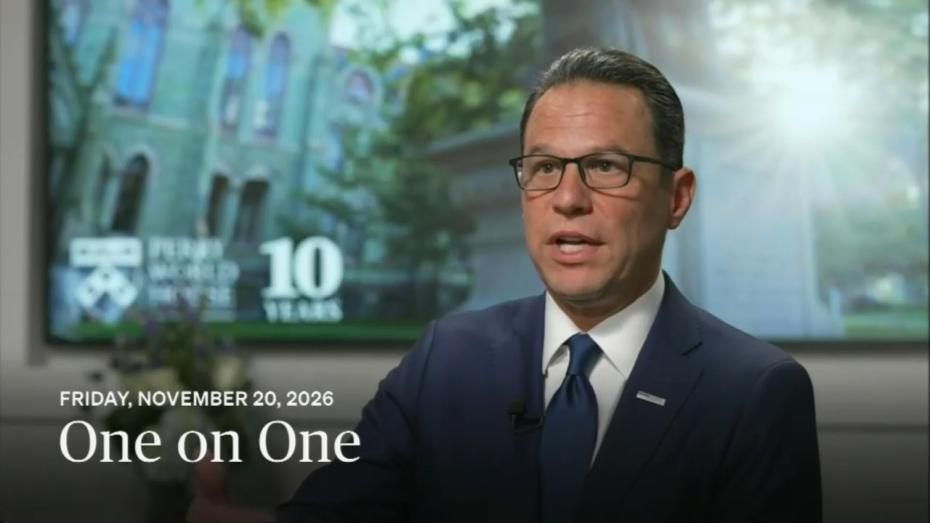
The PBS News Hour loves interviewing Democrats. We found earlier this year that they are more than five times as likely to interview a liberal rather than a conservative. On Friday, PBS anchor Amna Nawaz brought on Gov. Josh Shapiro (D-Penn.) to kick off speculation about whether Shapiro is running for president in 2028.
The first softball in the 11-minute interview was this one: "So I got to ask you, what's the governor of Pennsylvania doing delivering a speech on foreign policy if he's not running for president?"
Then on Iran, it’s that type of question that Democrats get, as in “explain what you would do.”
NAWAZ: On the war in Iran, you also mentioned in your speech that you think these midterm wins for Democrats give you an opportunity to develop a new foreign policy. You say you want Democrats to use their new majorities to try to end this Iran war.
What does that specifically look like? What kind of legislation can they be passing, especially when they don't have a veto-proof majority?
Then came a question on Israel, but it was very soft. It’s PBS, so there was no attempt to pit Shapiro against Abdul el-Sayed or Mehdi Hasan or Hasan Piker on the allegation that the Jews are running/ruining the world. Nawaz could have cited a quote, like she cited Shapiro's take on Trump a few minutes before: "The chaos, the cruelty, the corruption of this administration has made the U.S. less secure at home and abroad."
In January, Piker rambled on his Twitch stream when The New York Times reported that Shapiro revealed in his new memoir that the Kamala Harris campaign, in vetting Shapiro as a potential running mate in 2024, asked the governor if he had ever been an agent of the Israeli government. Shapiro was offended by the question. So PBS was never going to go there.
On PBS @NewsHour, Amna Nawaz asked Josh Shapiro a soft question on the internal Democrat squabble over Israel:
— Tim Graham (@TimJGraham) November 22, 2026
"There's another big issue that continues to really divide members of your party, in particular, and that is the U.S. approach and support for the state of Israel.… pic.twitter.com/78pxde2KOz
NAWAZ: There's another big issue that continues to really divide members of your party, in particular, and that is the U.S. approach and support for the state of Israel.
You saw earlier this year a number of Senate Democrats, including many folks who are sort of eying a 2028 run, voting to block some arms sales to Israel. Would you support efforts like that? And would you have voted with them?
Shapiro struck a politician’s balance:
SHAPIRO: Look, I think, in many ways, this issue is being resolved. You saw before that the president and the current prime minister in Israel have indicated that they are planning to end the military aid that's existed for decades to Israel. I support that. I think it is important to end that military aid.
I do think it is important for Israel to be able to have the weapons they need to defend themselves from attacks from terrorist organizations, be it Hamas, the Houthis, the Iranians. And why do I think that? Because it's in America's national security interest.
Nawaz then moved on to Canada, no need to dwell on Israel. But Netanyahu wants a longer timeline for the end of military aid, phasing it out over five or ten years, well beyond 2028.

Later she asked the blue-wave celebration question:
NAWAZ: We're just coming off these historic Democratic wins in the midterm elections, the blue wave, the blue tsunami, whatever you want to call it. Your reelection win in particular was even bigger than your last by 22 points.
But we also saw Democrats win statewide in places like Kansas and Mississippi and South Carolina and the Senate races on that front. How much of your win do you believe was because of you, because of Josh Shapiro, and how much was part of this blue wave?
Shapiro agreed: "Well, it was obviously a great night for Democrats and a complete rejection, not just of Donald Trump, but his enablers." Nawaz then joked "I know you like to talk about getting stuff done, that GSD." Shapiro joked back: "It's PBS, so we'll say stuff, yes." How cozy.
Shapiro then suggested his first priority in the new term is more than doubling the minimum wage in Pennsylvania, from $7.25 an hour to "at least 15 bucks an hour." He said that would be the first bill crossing his desk.