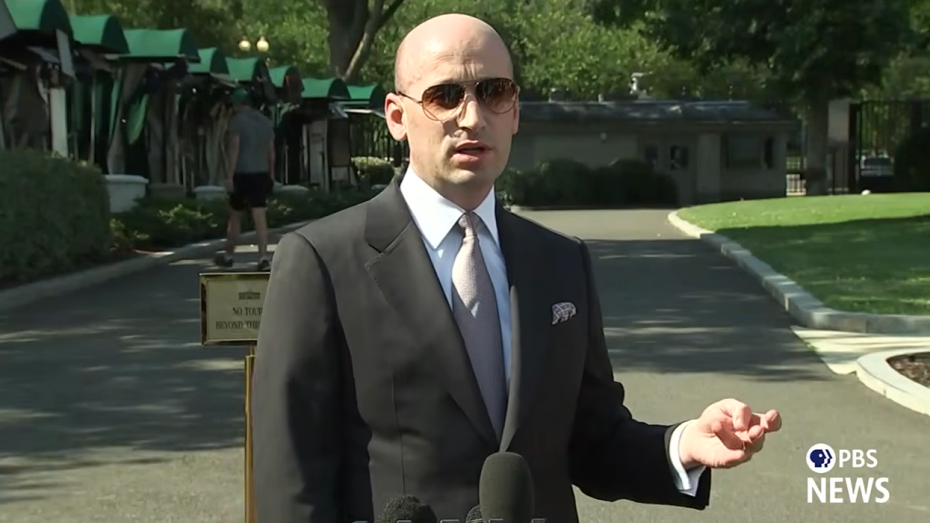
Stephen Miller’s appointment as White House Chief of Staff came with one very routine adjective: “hardliner.” To elitist media operatives, that is defined as “anyone who dramatically disagrees with us.”
Take this November 7 Associated Press headline summarizing Miller’s positions: “In his words: Stephen Miller is an immigration hardliner and a bombastic critic of Democrats.”
It’s not inaccurate to call Miller a “hardliner.” The media-bias problem is obvious when considering the opposite position. You can call Trump “Hitler” and the Republicans “fascists,” but that doesn’t make you a "hardliner" or “bombastic.”
Someone who chants “Abolish ICE” is somehow not a “hardliner.” When Beto O’Rourke told Chris Hayes in 2019 he would take down the border walls in El Paso, he was not a “hardliner.”
Instead, take this NPR headline from September: “A new anti-ICE compilation album benefits immigrants rights organizations.” Marxist musicians like Tom Morello raised money for groups including Union del Barrio, which proclaims on its website “we need a political revolution, and the only way to make a revolution is by building a revolutionary organization.”
This underlines what we call Graham’s Law of Labeling: “The epic political battles of our times are between the ultraconservatives and the nonpartisans.” They can’t really define the Left as aggressively ideological. They present them in positive tones, as civic-minded idealists.
A search of “hardliner” on NPR.org displays the tilt, just in their headlines:

1. “Iran's hardliners angry at talks with U.S.” So the Republicans and the Islamists get the same label. Democrats who don't want to be seen as anti-Iran (Abdul el-Sayed) are not labeled.
2. “Anti-abortion hardliners want restrictions to go farther. It could cost Republicans.” Opposing all abortions is a “hard line.” You never see the term "pro-abortion hardliner." Favoring all abortions, at any time and for any reason, makes you an “abortion rights activist.”
3. From 2023, there was: “GOP makes history when 8 hard-liners succeed in ousting House Speaker McCarthy.” Under that, there are three more NPR headlines about “GOP hardliners.” If the radical leftists in Congress organize to oust Sen. Charles Schumer, they won’t be “hardliners.” When Jim Jordan was elected House Minority Leader, Grok summarized the media: "He is widely described as a hardline conservative who has often challenged GOP leadership from the right.”
They also display this imbalance when they use the term “extremism.” On November 9, NPR news anchor Korva Coleman explained: “Miller has led his most draconian immigration efforts, including mass deportations. Democratic lawmakers have expressed astonishment. They say they will forcefully push back on any extremism.”
Democrats push back on “extremism.” They never embody extremism. The anti-ICE activists can cry “revolution” for the “indigenous peoples,” and they’re painted as normies. NPR’s “domestic extremism correspondent” Odette Yousef did a ride-along with radicals trying to ruin ICE deportation activities in Chicago. You’re not an “extremist” if NPR thinks you’re groovy.
Speaking of extremists, the climate authoritarians of the United Nations are having another global confab, and the Associated Press tweeted: “Climate activist Greta Thunberg emphasized the need to prioritize people and the planet over profits as she arrived at the U.N. climate meeting in Turkey.” As she screams about “very destructive industries” and our “extremely violent status quo,” she’s not a radical leftist. She’s for the “climate,” and “people over profits” isn’t socialism, it’s activism.
Journalists describe the ideological spectrum from their leftist position. So the left-wing hard line is their "mainstream." It's the "progressive wing," if you must use an ideological description. Socialists match their vibe, and capitalists are the "hardliners" and the "extremists." If you proclaim the elitist media cannot be trusted? That's "bombastic."