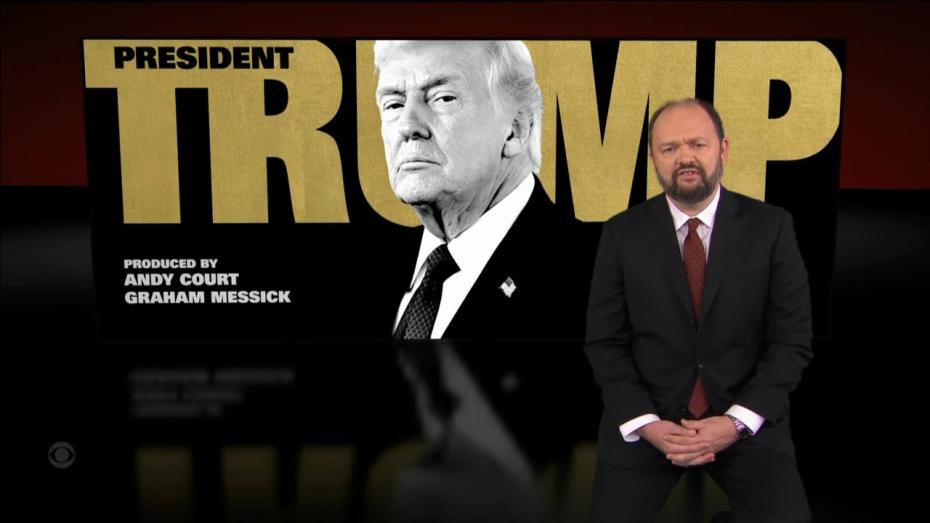
The newest edition of CBS’s 60 Minutes featured a revealing intervie between new correspondent Ross Douthat and President Trump. Douthat asked Trump about the midterms and his mortality , and made it clear when Trump alluded to a possible immigration deal with Democrats.
However, after an interview that showed some signs of the potential of a “revamped” CBS News, new 60 Minutes contributor Trevor Phillips’s story on the riots in France devolved into bashing of France’s populist right leader, Marine Le Pen, and her possible ascension to the presidency. Phillips asked Le Pen if she was a “fascist,” and implied that she and others on the European right were “finger-pointing at immigrants.”
Douthat's introduction of the story mentioned the midterm losses, while invoking liberal election fears in the process:
The introduction to Sunday’s 60 Minutes interview with Trump detailed the midterm losses for Republicans, while showing relief from liberal fears that the midterm election would be stolen, before the unique Ross Douthat interview. pic.twitter.com/ep93I7mrcC
— Nick (@nspin310) November 9, 2026
In the past, this president has met defeat with claims of fraud and the effort to overturn the 2020 election. But when we met with him in the White House on Friday, for his first sit-down interview since the midterms, we found him in a surprisingly reflective mood and seemingly accepting of defeat.
In some of the biggest news of the interview, Douthat asking about what Trump could work with Democrats on led to Trump wishing for a possible immigration deal. Trump said, “I'd love to do something on immigration.”

Full exchange on immigration: Trump is open to doing a deal with the Democrats on immigration, says current policy "helped and hurt", deportation policy was "too tough", and is open to doing something for "landscapers" and "hotel workers" who've been in the country 10-15+ years,… pic.twitter.com/YuTQV1KPFl
— Jorge Bonilla (@BonillaJL) November 9, 2026
Douthat then mentioned Democrat Texas Senator-Elect James Talarico and said, “In the course of the campaign, you did occasionally call him Talafreako. Do you think you could work with the Democrats without insulting them consistently?” Trump then stated, “Yeah, I do. I could. I also call many of them Dumbocrats.”
The most contentious part of the interview came when Douthat asked if there was an heir to ‘MAGA’ before it turned into an insinuation thatTrump was corrupt:
The most contentious part of the interview came when Douthat insinuated Trump or his family was corrupt, leading to a back-and-forth.
Besides the slightly contentious moment, the interview included the big news of Trump claiming to want an immigration deal with Democrats, plus… pic.twitter.com/fDg4LqXrVF— Nick (@nspin310) November 9, 2026
At the close, Douthat mentioned Turmp on his mortality and if he would forgive his enemies, like Former Speaker Nancy Pelosi and former FBI director James Comey, to get into heaven.
Douthat first asked, “What do you think happens to Donald Trump when you die? Not your memory, yourself.” Trump responded, “Well, I'm a religious person, so in theory I go to heaven.”
Imagine a question like this from a 60 Minutes before the Douthat hire.
Compelling question on forgiveness from Douthat pic.twitter.com/QMbSr1sIPK
— Jorge Bonilla (@BonillaJL) November 9, 2026
In a deeper question, Douthat asked, “Let's say you pass away, you're entering the next life, and all you have to do to enter paradise is feel love and forgiveness for James Comey, Nancy Pelosi, anyone who you have expressed hate for over the years. Do you think you can do it?”
Trump later responded, “The answer is no. I want to be honest,” before Douthat followed, “Mr. President. You have had the most charmed and remarkable life of any American in my entire lifetime, and you are telling me you couldn't find it in your heart to forgive some of your enemies? After all that's been given to you?”
In Trump fashion, he closed: “Honestly, Ross, can I be honest? I probably cannot do that, no, because I do hate some of my enemies, and I always will.”
The Douthat-Trump interview and the pre-midterm story on the Michigan Senate race, both by Douthat, have been the bright spots from a 60 Minutes season that has mostly continued its liberal story bias.
To those who disliked Douthat’s interview style, imagine how a post-Midterm Trump interview with longtime correspondent Lesley Stahl would have been handled.

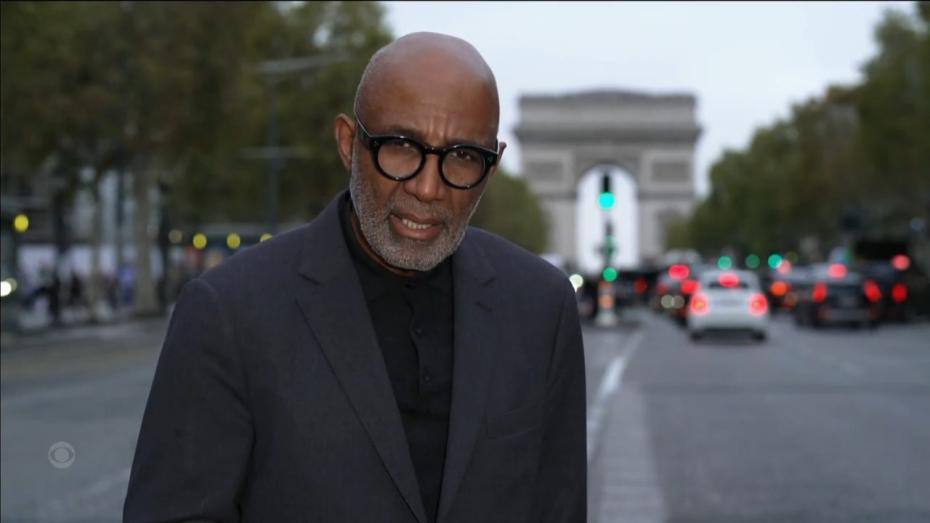
But after the Trump interview, 60 Minutes returned to its liberal roots to bash France’s right-wing leader and possible future president, Marine Le Pen, in a story on the French riots by former Sky News UK host Trevor Phillips.
The piece moved quickly from the riots to Le Pen:
Protests are tearing across France. Violence has erupted in its romantic boulevards, looters have invaded the chic boutiques, and the scent of warm croissants and fresh baguettes has been overwhelmed by the whiff of tear gas.
For many across Europe, particularly the young, conventional, centrist political parties are failing to revive the continent's stagnating economies. Support for extremist politicians has risen dramatically.
We spent a week in Paris trying to understand who and what are driving the demonstrations - and we talked to the leader of France's populist anti-immigration party who now, months away from crucial elections, could benefit from the strife in the streets.
Overlooked from last night's 60 Minutes was a story on the French riots by former Sky News host Trevor Phillips, who covered the riots but eventually devolved into worry about France’s right-wing leader, Marine Le Pen, becoming the country’s president. pic.twitter.com/m5RrNveWF9
— Nick (@nspin310) November 9, 2026
Phillips used much of his story to tie Le Pen to fears of “fascism” from the supporters of a far-left candidate in France’s presidential election, described as a “former communist”:
But his supporters say that only he stands between them and what they would call a right-wing tyranny.
As part of his 60 Minutes story on the French riots and Le Pen, Phillips interviewed a leftist who seemed okay with rioters looting and destroying businesses, after introducing an African immigrant whose bakery was ransacked… https://t.co/XsbuDQc7sw pic.twitter.com/6vjGBphlPI
— Nick (@nspin310) November 9, 2026
Phillips then showcased the hypocrisy of the left in France, perhaps not on purpose, amid the riots, as he highlighted an African immigrant whose bakery was ransacked, and was told by a white leftist who was “half-British, half-French, and hell-bent on ending capitalism” that the looting and destruction was not a big deal.
Later, Le Pen was straight up asked if she was fascist:
Near the close of the 60 Minutes interview on the French riots, Phillips moved to paint Marine Le Pen as a fascist:
“I talked to many of the young people on these demonstrations. And I heard again and again that what they fear is fascism in France. And it's clear to me that when… pic.twitter.com/lXmbVc54Kf— Nick (@nspin310) November 9, 2026
PHILLIPS: I talked to many of the young people on these demonstrations, and I heard again and again that what they fear is fascism in France. And it's clear to me that when they spoke about facism, they were talking about you. Are you a fascist?
LE PEN: (in French/English Translation) No, absolutely not. We support political pluralism. There is no element of fascism in our political program.
Phillips then laughed when Le Pen said there was “no discrimination in France,” before he bashed the European right:
However, Phillips was not done, as, still in a story about the riots, he bashed the European right for “finger-pointing at immigrants":
“Le Pen's finger-pointing at immigrants is echoed by rising populist leaders across Europe. In the Netherlands, in Germany, in Britain, in… https://t.co/3wbCyipFum pic.twitter.com/YeCQlX1Enh— Nick (@nspin310) November 9, 2026
Le Pen's finger-pointing at immigrants is echoed by rising populist leaders across Europe: in the Netherlands, in Germany, in Britain, in Sweden and in Italy.
As much as 60 Minutes tries to implement slight changes, it mostly stays the same.
The transcript from both segments of 60 Minutes is below. Click "expand":
CBS’s 60 Minutes
November 8, 2026
7:38:34 PM Eastern
ROSS DOUTHAT: This past Tuesday, President Donald Trump’s Republican Party suffered an extraordinary midterm repudiation. Losing not just the House and Senate but statewide offices in red states, from Texas to Kansas to South Carolina, that Democrats hadn't won in decades.
In the past, this president has met defeat with claims of fraud and the effort to overturn the 2020 election. But when we met with him in the White House on Friday, for his first sit-down interview since the midterms, we found him in a surprisingly reflective mood and seemingly accepting of defeat. Our wide-ranging conversation covered immigration and corruption, Iran and artificial intelligence. His potential successors and his own mortality. But we began with the election results.
[Story begins
[To Trump] Two years ago, you won a big, some might say historic, victory. Just now, the Republican Party in the midterms suffered a big, some might say, historic defeat. Give me your political analysis of what just happened.
PRESIDENT TRUMP: Well, number one, I was not on the ballot. But I campaigned hard for some people. And-- I think if I was on the ballot, it would've been a much different situation because you saw the level of popularity and love. There was love. We had massive rallies. You had to transfer those voters, however, to candidates that they didn't like. But there's something beyond that. They didn't like the war. They didn't like the fact that gasoline went up, 'cause I had it down at a low, and there's-- a great dislike, incredibly, for Israel.
(...)
7:43:25 PM Eastern
DOUTHAT: You came out after the midterms. You congratulated the Democrats. You said that you were open to working with them.
TRUMP: True.
DOUTHAT: What is one thing you would like to work with a Democratic majority on--
TRUMP: I'd love to do something on immigration.
DOUTHAT: What?
TRUMP: Because-- well, so
DOUTHAT: Do you think immigration hurt you in the midterms?
TRUMP: I think--
DOUTHAT: Do you think the crackdown hurt you--
TRUMP: I think it both helped and hurt. I think I got an A+ for closing up the border. I get very high marks for getting the bad ones out. But I get hurt because we also took people that had good jobs, that-- that created one violation, or breaking of the law, and that was that they came into the country illegally.
Now, there is a large part of the country that think that they should be put out. And there's a large part of the country that think that they should be allowed to stay if they're good people working in a landscaping company, or workin' in a hotel, or doing something, right? And in some cases, paying taxes. And there's a large group of people who think that they should be allowed to stay.
DOUTHAT: So you think your deportation policy went too far?
TRUMP: Too tough.
DOUTHAT: It was too tough?
TRUMP: I think it might be too tough, yeah.
DOUTHAT: What would--
TRUMP: And - and I think-
DOUTHAT: What does a deal look like with the Democrats?
TRUMP: I think ultimately - that hurt me. Well, the deal would be we would work something out. And I think it's something-- I think that's something that's actually doable.
(...)
7:45:30 PM Eastern
DOUTHAT: You think the Democratic Party right now has people in it who would be interested in this kind of deal?
TRUMP: I think so, yeah. People have already called me.
DOUTHAT: So I'll say I saw James Talarico, the new Democratic senator--
TRUMP: Said very nice things, yeah -
DOUTHAT: From Texas, I saw him on Fox News. And he said immigration was one of the things he wanted to work with you on--
TRUMP: Others too. South Carolina said. Numerous- Numerous people that won said that.
DOUTHAT: You did – In the course of the campaign, you did occasionally call him Talafreako.
TRUMP: Yeah, I did.
DOUTHAT: Do you think you could work with the Democrats without insulting them consistently?
TRUMP: Yeah, I do. I could.
DOUTHAT: You think so? But you--
TRUMP: I also call many of them Dumbocrats.
DOUTHAT: You did that just- the other day. If f it took six months of not insulting the Democrats to get a deal done, do you think you could do it?
TRUMP: Very easily.
DOUTHAT: Okay. That'll be interesting to watch.
TRUMP: But you have to understand- I'm here - I'm here to help the country.
DOUTHAT: Do you think you could do it if they're investigating you? If they're running investigations into your administration, can you work with them?
TRUMP: Well, I did it for four years. You know, I - what they did with me was - there's never been weaponization. They impeached me twice. And there are those that say that worked out to my advantage. I mean, you know, 'cause
DOUTHAT: Do you think they'll impeach you again?
TRUMP: I can't imagine it, you know? They - look, what have I done? I've had the best two years in the history of the presidency.
DOUTHAT: All this winning, according to the president, doesn't preclude some change of White House personnel.
[To Trump] In a previous lifetime, you were rather famous for saying, "You're fired" quite often.
TRUMP: Yeah
DOUTHAT: After a big midterm defeat like this, do you expect to fire anyone from your team–
TRUMP: I do. Yeah.
DOUTHAT: You do?
TRUMP: Little bit.
DOUTHAT: Little bit?
TRUMP: I love my Cabinet. I think they're good. But I'll be DOING' maybe a few changes.
DOUTHAT: The first change came an hour after our conversation with the president. Susie Wiles, the president's chief of staff, was replaced by Deputy Chief of Staff Stephen Miller, the architect of the president's mass deportation policy. It's a move that seems to conflict with the president's professed desire to work with Democrats on immigration.
(...)
7:56:52 PM Easter
DOUTHAT: Do you think you can have MAGA without you as the leader?
TRUMP: I think so. Because MAGA is basically common sense, you know? MAGA's strong borders, good military. We have created wealth at a level that our country has never seen before.
DOUTHAT: Including for yourself. There's a Forbes story that said that your net worth, maybe it's changed with the stock market recently, but your net worth went up by $3 billion since you-
TRUMP: Well, so did everyone--
DOUTHAT: - since you returned to office
TRUMP: Okay, you ready? So here's--
DOUTHAT: My net worth did not go up by $3 billion for the record -
TRUMP: Well, you should've had stock--
DOUTHAT: I should've-- I should've--
TRUMP: You should've had stock.
DOUTHAT: I should've had stock.
TRUMP: Excuse me. So I devote--
DOUTHAT: How did it go up by $3 billion
TRUMP: Well, let me explain. I devote almost no time to my net worth. I don't care. I make-- I have a lotta money, and far more than I ever thought I'd have. And I guess it's gone up. I don't even know.
(...)
8:06:19 PM Eastern
DOUTHAT: You have survived multiple assassination attempts.
TRUMP: I have.
DOUTHAT: One came very, very close to you. I imagine that that had some kind of effect on how you think about mortality.
TRUMP: Yeah.
DOUTHAT: What do you think happens when you die?
TRUMP: Well, I hope I'm missed. (LAUGH)
I hope-
DOUTHAT: No, I mean-- I mean to you-
TRUMP: No, but I really mean it. I hope I'm missed. I don't know.
DOUTHAT: I- I understand. I mean to you.
TRUMP: I think I've done a good job as-
DOUTHAT: What do you think happens to Donald Trump when you die? Not your memory, yourself.
TRUMP: Okay. You mean where I go?
DOUTHAT: Exactly.
TRUMP: Well, I'm a religious person, so in theory I go to heaven.
DOUTHAT: Do you think you're going to heaven?
TRUMP: I hope so. I don't want to go to hell.
DOUTHAT: So I watched you at Charlie Kirk's memorial service--
TRUMP: Yes.
DOUTHAT: And Erika Kirk, his widow got up-
TRUMP: Right.
DOUTHAT: And gave some very moving remarks about Christian forgiveness, how you have to forgive your enemies and your opponents--
TRUMP: That's right.
DOUTHAT: And you followed her, and you said, and I know this was a little bit of a joke but I think facts come through jokes. You said, quote, "I hate my opponents and I don't want the best for them." Let's say you pass away, you're entering the next life, and all you have to do to enter paradise is feel love and forgiveness for James Comey, Nancy Pelosi, anyone who you have expressed hate for over the years. Do you think you can do it?
TRUMP: Well, then I wouldn't be real, would I? I mean, if I said to you, sure, the easy answer to that is "Oh, yes, I could forgive."
DOUTHAT: No, I don't think it's an easy question at all.
TRUMP: I found them to be extremely dishonest people, very bad people, very bad for our country. I love our country far more than I can love people and people like that.
DOUTHAT: Is the answer no then?
TRUMP: The answer is no. I want to be honest, no. I think it would--
DOUTHAT: Before the judgment throne of God?
TRUMP: Before the judgment. No, I think they were very bad people and - I dislike, I can use the word hate, I do hate some of my enemies. I think they've been terrible. Look what they've put me through, the weaponization. I got indicted -
DOUTHAT: You have fought --
TRUMP: I got impeached--
DOUTHAT: Mr. President. You have had the most charmed and remarkable life of any American in my entire lifetime, and you are telling me you couldn't find it in your heart to forgive some of your enemies? After all that's been given to you?
TRUMP: I mean, it's such an easy answer. All I have to do is say, "Yes, I can."
DOUTHAT: I, again, I don't think it's an easy answer-
TRUMP: Honestly, Ross, can I be honest
DOUTHAT: That's why I asked it. Yes.
TRUMP: I probably cannot do that, no, because I do hate some of my enemies and I always will.
(...)
CBS's 60 Minutes
November 8, 2026
8:13:51 PM Eastern
TREVOR PHILLIPS: Protests are tearing across France. Violence has erupted in its romantic boulevards, looters have invaded the chic boutiques, and the scent of warm croissants and fresh baguettes has been overwhelmed by the whiff of tear gas.For many across Europe, particularly the young, conventional, centrist political parties are failing to revive the continent's stagnating economies. Support for extremist politicians has risen dramatically.
We spent a week in Paris trying to understand who and what are driving the demonstrations - and we talked to the leader of France's populist anti-immigration party who now, months away from crucial elections, could benefit from the strife in the streets.
[Story begins]
They used to call Paris La Ville de L'amour - the City of Love. But there hasn't been much amour on show lately.
For weeks, France has been in turmoil. 2,500 businesses have been damaged, more than 1,500 police injured, and the bill for damage to property is said to have climbed to more than a billion dollars.
This nation is used to street protests. But the French have been jolted by the violence, and bewildered by their government's failure to get the chaos under control.Now more and more voters are turning to a political alternative that for decades past they regarded as beyond the pale.
MARINE LE PEN: (in French/English Translation) I have a simple rule: if you don't stop criminals, they won't stop. That's it.
PHILLIPS Marine Le Pen is easily the best known face of right-wing populism in Europe. She's the longtime leader of the National Rally Party and now the favourite - after three failed attempts - to win the keys to France's presidential palace next April. Since the protests began, Le Pen's popularity has risen.
[To Le Pen] What is happening in Europe? Has politics here just become more radical? What is the explanation for that, and your own rising popularity?
LE PEN: (in French/English Translation) The extreme left creates chaos. They generate violence against people, against the police, against public property. It's the same phenomenon all over.
PHILLIPS: Le Pen and the protestors may be political opposites, but both agree on one thing: the way that France has done politics for the past few decades has failed.
(...)
8:18:39 PM Eastern
PHILLIPS: Many of the young activists see France's salvation in this man: Jean-Luc Melenchon, a 75-year-old former communist. He declined our request for an interview. But his supporters say that only he stands between them and what they would call a right-wing tyranny.
PROTESTOR 1: I am terribly afraid of fascism.
PROTESTOR 2: The people of France are not for fascism.
PROTESTOR 3: And I'm here because everything is fucked up right now. Fascism is here.
PHILLIPS: You said fascism is here in France, but you're going to vote for a new president. That's your democracy.
PROTESTOR 3: No, this is not how it work, democracy. Democracy, this is the vote. Because when it's unfair, you have to fight.
(...)
8:20:00 PM Eastern
PHILLIPS: Exactly a month after the first school protests, on Oct. 17, all hell broke loose across France.
Arsonists in the city of Limoges set fire to its iconic town hall, which first opened its doors on Bastille Day in 1883. The inferno obliterated more than a century of local history in a single night.
That same day, 250 miles away in Paris, Jhemima Sheilha's bakery had been ransacked by looters.
JHEMIMA SHEILHA: (in French/English Translation) The emotions I felt last Saturday still bring tears to my eyes.
PHILLIPS: Sheilha immigrated to France from the war-torn Democratic Republic of the Congo as a 9-year-old and created her successful bakery business with her husband. She now employs dozens of people.
[To Sheilha] What has it cost you?
SHEILHA: (in French/English Translation) It has cost me five years of hard work. It has cost me the time I couldn't spend with my children. But what it's costing me today? It's having to ask myself, if I do start again, will it last? How long before it happens again?
PHILLIPS:As always in France, the arguments have been passionate. Sheila clashed with a student activist on primetime TV. The confrontation went viral.
LOLA-FLEUR WHITTAKER: The system we're in is literally burning our planet, is burning our home, is killing so many people.
PHILLIPS: 22-year-old Lola-Fleur Whittaker is half-British, half-French, and hell-bent on ending capitalism. Whittaker was accused of playing down the destruction by the looters.
WHITTAKER: I mean, sure, let's just say how bad it is to break a window. But that's just not gonna solve any issue, that's just not gonna help anyone.
PHILLIPS: You met this lady Jhemima. I don't think you attacked her shop. But what would you say to the people who did attack her shop?
WHITTAKER: I don't-- I don't think those people would--
PHILLIPS: But you would say they're wrong, wouldn't you?
WHITTAKER: Yeah, sure. Let's say they're wrong. But, I mean, we live in a society where we walk past people every day that are just sleeping outside. And that doesn't shock anyone. However, a shop being, you know, looted and stuff, that's really shocking. And I don't think that's really fair.
PHILLIPS: The person most likely to gain from the strife in the streets is Marine Le Pen. Her analysis of France's social and economic problems is very different, and so are her answers.
LE PEN: (in French/English Translation) Today, France is facing very serious difficulties. We're at a point where all the bills are coming due at once.
PHILLIPS: In 2011 Le Pen took over leadership of what was then a fringe movement from her father, a tough, army veteran, convicted and fined for Holocaust denial and hate speech. Four years later in a spectacular display of ruthlessness, she ejected him from the party he had founded. The aim was to rid the movement of the stain of bigotry.
[To Le Pen] I talked to many of the young people on these demonstrations And I heard again and again that what they fear is fascism in France. And it's clear to me that when they spoke about facism, they were talking about you. Are you a fascist?
LE PEN: (in French/English Translation) No, absolutely not. We support political pluralism. There is no element of fascism in our political program.
PHILLIPS: Her opponents thought le pen's conviction last year for embezzlement would dent her popularity. It has not.
LE PEN: (in French/English Translation) I am innocent. That's why I have taken the case to France's highest court.
PHILLIPS: The legal setback has not changed le pen's essential message of the past 20 years about what is wrong with France.
LE PEN: (in French/English Translation) When you take in too many immigrants, you create the conditions for destabilizing your society. And that is what has happened in France.
PHILLIPS: And she says too many immigrants are too reliant on welfare.
LE PEN: (in French/English Translation) There is another problem: a problem of numbers. The unemployment rate among foreigners in France is twice the unemployment rate among French citizens. We can no longer import unemployed people.
PHILLIPS: If I go and talk to people in those immigrant communities, they will say that is because of discrimination in France.
LE PEN: (in French/English Translation) No, that doesn't exist. You're not going to import those ideas here.
PHILLIPS: There is no discrimination in France?
LE PEN: (in French/English Translation) No, there is no discrimination in France, sir. It's not true. And I'll go even further: it's the least racist.
LE PEN: (in French/English Translation) Yes, yes, I'm telling you.
PHILLIPS: The British, the Americans, the Canadians?
LE PEN: (in French/English Translation) Yes, yes.
PHILLIPS: Le Pen's finger-pointing at immigrants is echoed by rising populist leaders across Europe: in the Netherlands, in Germany, in Britain, in Sweden and in Italy.
LE PEN: (in French/English Translation) Your world approaches immigration through integration. We believe someone who comes to immigrate to our country must blend into the national community. You have something more like a layered cake: each community can live alongside the others while keeping its own customs. That is not how we see things.
PHILLIPS: And would a president Le Pen say to those people that you feel aren't adopting the French way, it's time for you to go back to where you came from? What people now call remigration?
LE PEN: (in French/English Translation) If someone comes and says, 'I hate you, I despise your culture, I don't want to respect your laws,' well, we say to him, 'Listen, sir, the door is wide open. And we might even, for that matter, force you to leave.
PHILLIPS: It's a startling proposal which critics will say could amount to deportation of legal immigrants. But, Marine Le Pen wears the smile of a woman within touching distance of the keys to the Elysee Palace, and ironically, they could be handed to her by her harshest opponents.
(...)