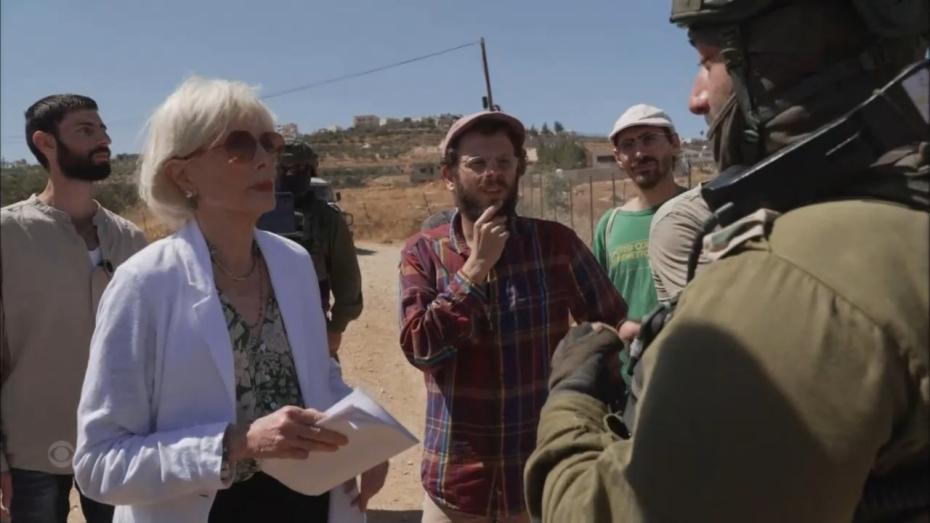
The newest edition of 60 Minutes on Sunday proved once again that the show has not changed much under CBS News editor-in-chief Bari Weiss, even after a media freakout over changes to the Sunday magazine show. Longtime correspondent Lesley Stahl went after Israel over settlers in the West Bank and connected her story back to the midterm elections while implying the problems in Israel would end if Democrats were elected.
The Israel-bashing story came against the opinion of left-wing critics of Weiss, who have labeled her as overtly pro-Israel. A headline from far-left Zeteo from April even read, “Behind the Scenes of Bari Weiss’s Latest Pro-Israel Purge of CBS News.”
In her introduction, Stahl declared, “In recent months, some militant settlers are ramping up their campaign to violently drive out the Palestinians who live there, often with impunity. The Israeli government showing an unwillingness to crack down on the violence.”
Supposedly avidly pro-Israel ‘60 Minutes’ and CBS News under Bari Weiss joined in on media stories on Israelis in the West Bank and went after the Israeli government in the process with veteran correspondent Lesley Stahl. pic.twitter.com/rocaYksM7K
— Nick (@nspin310) October 12, 2026
Interestingly, Stahl framed the story from the basis of a “biblical” old-time war, compared to high-tech AI and drone warfare:
This is a biblical story: you have two populations – Jewish and Arab; the descendants of Abraham's sons: Isaac and Ishmael fighting over ancestral lands. But with all of today's high-tech warfare – AI, drones, supersonic missiles – the weapons they're using here are sticks and stones and sheep!
In the middle of her story, Stahl talked to a settler who asked, “What are you?” She responded, “Oh, I’m an American journalist. Television.” The settler then hilariously asked, “And you in with Hamas?” She responded, “No.”
At the end of her story, Stahl connected the Israel-West Bank situation to the US midterm elections.
She first noted the Trump Administration calls for an end to violence, while accusing Israel of aiding violence:
The Trump administration has called on Netanyahu to deal with the violence and he has condemned it. But his government has poured tens of millions of dollars into expanding the sheep farms, arming them and giving them American-made off-roaders.
Stahl then connected the Israel story to the midterm elections:
“Hanging over all of this are the midterms in the US in three weeks. If the Democrats win, they're threatening to limit military aid to Israel in part because, they say, of the West Bank attacks.” https://t.co/5APFTkjwTk pic.twitter.com/3TAz0LE0kI— Nick (@nspin310) October 12, 2026
Then, she turned to the midterms, while implying Democrats would help end the violence if elected:
Hanging over all of this are the midterms in the U.S. in three weeks. If the Democrats win, they're threatening to limit military aid to Israel in part because, they say, of the West Bank attacks.
Once again, as seen in the three previous episodes of 60 Minutes, the show has not changed in its political leanings and bias, as seen with this season's continued Trump-bashing stories or its continued disapproval of Texas Republican Governor Greg Abbott.
On Sunday’s ‘60 Minutes’, Norah O’Donnell actually highlighted a “spike” in left-wing violence in 2025 in an interview with Secret Service Director Sean Curran.
But she then shifted to declare, “This year, that trend has reversed, with more attacks coming from the right so far.” pic.twitter.com/RuA9fZxHVq— Nick (@nspin310) October 12, 2026
However, the episode did lead off with a mostly non-partisan story on the Secret Service while correspondent Noah O’Donnell interviewed Secret Service Director Sean Curran and Deputy Director Matt Quinn on the threats against protectees, most notably President Trump.
O’Donnell first asked, “President Trump is one of the most polarizing political figures in American history. Is that in some way leading to the increase in these threats?” The Secret Service leaders placed the blame on mental health issues instead.
Then, O’Donnell actually highlighted the rise in left-wing violence in 2025, which she called a “spike in incidents, at the local and national level, from the left in 2025.” She added, “It was the first time left-wing attacks have been higher than right-wing attacks in 30 years.”
New CBS global affairs correspondent Trevor Phillips, formerly of Sky News, highlighted the ongoing protests and riots across Europe at the end of ‘60 Minutes.’
Interestingly, he connected the “student protests” to anti-immigration protests and said, “Political unrest driven by… pic.twitter.com/kSRxXfOFzI— Nick (@nspin310) October 12, 2026
At the close of the show, new CBS senior global affairs correspondent Trevor Phillips, formerly of Sky News in the UK, also highlighted protests in Europe, most notably in France, and connected them to anti-immigration protests.
He said, “Political unrest driven by unease about migration and economic stagnation threatens to change the way Europeans live.”
Still, the show has not wildly changed under Weiss.
The transcript is below. Click "expand":
CBS's 60 Minutes
October 11, 2026
7:07:32 PM Eastern
(...)
NORAH O’DONNELL: President Trump is one of the most polarizing political figures in American history. Is that in some way leading to the increase in these threats?
SEAN CURRAN: We are an apolitical organization. We're here to protect who we're-- we're sworn to protect.
MATT QUINN: Look, I would say there's people on both sides of the aisle that either love or hate any president. I think the biggest factor we're dealing with today is-- mental health issues for sure. And more people are being pushed over the edge in either direction.
CURRAN: The world is different than what it was 20 years ago. You know, social media changes people.
O’DONNELL: Do more threats come from the left or right?
CURRAN: We don't weigh it that way. We - we just look at, you know, who-- who is, you know, making a threat. We investigate it. We run it down, each and every threat.
O’DONNELL: Research by the Center for Strategic and International Studies showed a spike in incidents - at the local and national level - from the left in 2025. It was the first time left-wing attacks have been higher than right-wing attacks in 30 years. This year that trend has reversed with more attacks coming from the right so far. Eight months into a war with Iran, the threats from outside the country are also growing.
[To Curran and Quinn] They have vowed revenge. How do you deal with that when you're in charge of protecting the president?
QUINN: Turn on the TV and you can see the funeral where there are massive banners saying "Kill President Trump." So, do we recognize the threat environment has increased? Absolutely. How we do it and how we change - that's where we prefer to stay in the background.(...)
(...)
7:21:51 PM Eastern
LESLEY STHAL: Israel has been at war with the Palestinian terrorist group Hamas in Gaza, ever since the massacre of October 7, but there's another increasingly volatile battleground: the West Bank, which has been under Israeli military occupation for six decades.
On the West Bank of the Jordan River, it's home to over 3 million Palestinians, who hope to make it the heart of their future state. It's also home to over 500,000 Jews who call this Judea and Samaria their biblical homeland. They built communities here called settlements in the hope of making this part of Israel.
In recent months, some militant settlers are ramping up their campaign to violently drive out the Palestinians who live there -- often with impunity -- the Israeli government showing an unwillingness to crack down on the violence. With the Israeli election two weeks away, we headed to the arid hilltops of the West Bank that have seen shepherds come and go for thousands of years.
This is a biblical story: you have two populations – Jewish and Arab; the descendants of Abraham's sons: Isaac and Ishmael fighting over ancestral lands. But with all of today's high tech warcraft – AI, drones, supersonic missiles – the weapons they're using here are sticks and stones and sheep!
(...)
7:32:02 PM Eastern
STAHL: One of the older boys was particularly belligerent: so much for Jews not attacking Jews.
BNAYA: What are you?
STAHL: Oh, I'm an American Journalist. Television.
BNAYA: And you in with Hamas?
STAHL: No.
(...)
7:33:49 PM Eastern
STAHL The Trump administration has called on Netanyahu to deal with the violence and he has condemned it. But his government has poured tens of millions of dollars into expanding the sheep farms, arming them and giving them American-made off-roaders.
ROIE: People call it "settler violence." I don't agree with that. It is state violence. There is a violence of a government.
STAHL Hanging over all of this are the midterms in the U.S. in three weeks. If the Democrats win, they're threatening to limit military aid to Israel in part because, they say, of the West Bank attacks.
STAHL: What about American public opinion? Do you worry that what's going on here -
MORDEHAI MINSTER: I do.
STAHL: - here is going to result in Israel losing military aid from the United States?
MORDEHAI MINSTER: I am bothered by the fact that America's turning on us, and we're turning on America. It's, like, I see it as losing a friendship. And I'm also concerned that, as a military ally, as a political ally, we may lose America as well. It looks like it's going in that direction. But Israel will find other allies.
STAHL: You're not worried enough about it to dial back?
MORDEHAI MINSTER: No. I am worried about that. But I don't look at it as-- as an existential threat.
STAHL: Meanwhile, over 100 Palestinian communities have been displaced or erased by the settler violence and the ever-encroaching sheep.
(...)
7:57:50 PM Eastern
TREVOR PHILLIPS: I'm Trevor Phillips, one of the new contributors here at 60 Minutes. As you'll already have guessed, I'm not from around here. I'm the son of Caribbean immigrants to London, which is where I've spent most of my life. Like most Brits, I like to keep a close eye on the neighbors, by which I mean the French. Great food, but they do seem to like revolutions. So when their lyceens, that is high schoolers to you and me, took to the streets this past week, building blockades and staring down the cops protesting what they say is a lack of funding for schools, it wasn't a surprise. But France isn't alone in its troubles. This past week, student protests flared up again in Belgium, too.
Right across Europe, political unrest driven by unease about migration and economic stagnation threatens to change the way Europeans live. In this turbulent world, it's our job to understand and explain the who, why, where -- and what comes next.
(...)