He claimed the three situations were connected, as they were examples of President Trump’s “consistent pattern” to “underestimate the ability of their targets.”
Brownstein started with his state visit analysis, calling Trump’s banquet speech “unremarkable.”
Former Trump White House Communications Director Mike Dubke and former Biden White House Director of Message Planning Meghan Hays, focused on the economic positives that could come out of the trip, including possible Chinese imports of American soybeans, while they started a minimization of the summit.
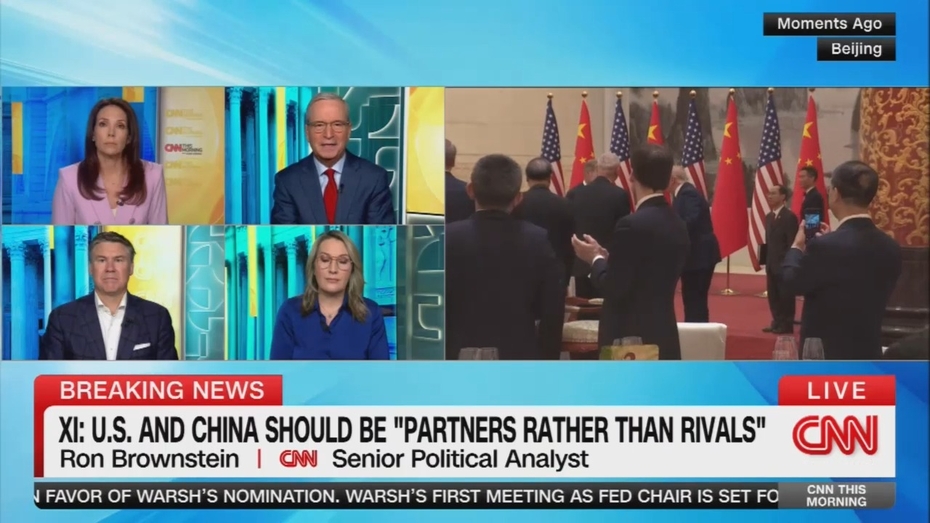
After the US-China State Dinner, CNN senior political analyst Ron Brownstein compared US actions with China and Iran to the ICE unrest seen in Minneapolis earlier this year. He said the three were part of a consistent pattern to "underestimate the ability of their targets.” pic.twitter.com/VgU7o2Ewj8
— Nick (@nspin310) May 14, 2026
Dubke called the summit as “mundane,” and fill-in host Erica Hill continued to echo Dubke and called the summit “low key.”
Hays then implied Trump was weak, even as China rolled the red carpet out for him:
I mean, this pageantry, I don't think necessarily is low-key. I think that's trying to play to Trump's ego here.
But I also think this visit is not the visit of strength that Trump thought he would be going into China with. Like, he needs China to help him open the Strait of Hormuz. We are coming in with a negotiating power here that we didn't necessarily have when - or we had before we entered Iran.
Hill returned to Brownstein, who decided his points about the summit would relate to Minneapolis ICE protests, many of which turned violent, to relations between China and the war in Iran.
Brownstein started by saying Trump’s “initial challenge to any challenge is coercion,” but in a situation where a “target finds a way to push back. And it's not clear there's kind of a plan B.”
He related that point to China and tariffs and Iran strikes, before, somehow, he related the summit to this year’s unrest in Minneapolis over ICE:
It's just kind of - to me, it's a consistent pattern that they seem to underestimate the ability of their targets. We could say the same thing about the people of Minneapolis, by the way, with ICE, to find a way to push back and then to have a counter response to that.
Hill also gave Brownstein the “last word” of the segment, as he continued the minimization of the summit by the rest of the panel and continued to insinuate that for every issue, there is no “plan B.”
The return to Minneapolis unrest by Brownstein continued a liberal obsession with ICE, as he even found an opportunity to relate the unrest to China and Iran amid the high-stakes summit between the U.S. and China, two of the biggest global competitors.
The transcript is below. Click "expand":
CNN This Morning
May 14, 2026
6:51:50 AM Eastern
(...)
ERICA HILL: How much is riding on this visit for President Trump?
RON BROWNSTEIN: Yeah, you know, the speech was kind of unremarkable, which was remarkable in itself from where he started. I mean, you got to remember, I mean, Trump, going back - President Trump, going back to his first term, talked about decoupling from China. He attacked Biden for four years, saying that he was weak on China. He said he would force China to transform its economy with these punishing tariffs.
And, you know, and here we are. When China punched back with threatening, you know, to withhold the rare earth minerals that are so critical to different elements of our economy and the world economy, his goals have shifted to kind of the conventional, go to a country and get them to announce a bunch of agreements to buy American stuff. So, I mean, to me this is - this event so far is just a measure of how much his goals on China have kind of contracted and that he is looking for something very different than what he set out in the campaign, or indeed even toward the end of his - parts of his first term.
HILL: Mike, how much is this about, frankly, maintaining a relationship, as opposed to moving it forward in this moment?
MIKE DUBKE: Well, what really struck me from both of the speeches was that President Trump focused on the US-Chinese relations, and President Xi is focused more on the US and China together and world relations. That's what really struck me as part of this.
But I think to getting to your question and to address where Ron was going with this, in terms of trade agreements, I mean, they are going to talk about soybeans - you know, exciting things like soybeans and LNG. But also the import - potential import of Chinese cars into the United States, which I know frightens a lot of people in Detroit.
But, frankly, one of the things that has come out and is different than the first Trump Administration to this, in terms of relationships with China, is America has made some strides, especially on rare earths, in bringing the rest of the world together to find alternative minerals, in this case, to counter China.
So, I think a lot of the moves that the president's already made is setting us up at this point to have this more mundane bilat and conversations today - or tomorrow in China.
HILL: More mundane. I mean I will say that is sort of the reaction we've seen initially, is this all feels very low key. And not low key in the way the kids talk about things these days, but literally low key, Meghan.
MEGHAN HAYS: I mean, this pageantry, I don't think necessarily is low key. I think that's trying to play to Trump's ego here.
But I also think this visit is not the visit of strength that Trump thought he would be going into China with. Like, he needs China to help him open the Strait of Hormuz. We are coming in with a negotiating power here that we didn't necessarily have when - or we had before we entered Iran.
So, you know, and I also think, to Mike's point about the ag possibilities with soybeans and cars in Detroit, some of these negotiations have a lot of political implications for Trump and the Republican Party. So, he needs to make sure that this is sort of a nothing-burger meeting and that this is maintaining relationships.
So, Trump just doesn't have the strength that he thought he was going to have, you know, going into this first meeting with China.
HILL: Well, you know, I'm going to keep going back to this, but that's because it is so important, the Iran angle that is hanging over all of this and a desire for China to nudge, perhaps, Tehran a bit. That desire does not seem to exist in the same way on the part of the Chinese, Ron.
BROWNSTEIN: Yeah. I think this is revealing of a kind of broader pattern that we see in - particularly in this second Trump term. I mean his initial response to any challenge is coercion, is the assertion of U.S. economic or military power. But he often seems surprised when the target finds a way to push back. And it's not clear there's kind of a plan B.
I mean, what we're watching in the economic relationship with China, when the threat of tariffs did not have the desired effect, and China found an effective way to push back by threatening the rare earth minerals, is very similar to what we're watching in Iran when the bombing campaign did not have the initial effect. Certainly succeeded militarily, but did not change the behavior in the way that he expected. They found an asymmetric way to push back. And now the administration is kind of at sea, literally and, you know, pressuring China to try to help them.
It's just kind of - to me, it's a consistent pattern that they seem to underestimate the ability of their targets. We could say the same thing about the people of Minneapolis, by the way, with ICE, to find a way to push back and then to have a counter response to that. And I think that's one of the reasons why this is so low key, because he has lost a lot of his stomach for the kind of confrontation with China that he promised when he was out of office.
(...)
6:59:09 AM Eastern
HILL: Ron, I'll give you, real quickly, last word. What specifically are you looking for to come out of tomorrow?
BROWNSTEIN: Well, you know, I think, as I said, I think this has become kind of a - devolved into kind of the conventional presidential trip to a foreign country where you give a speech talking about your long, historic ties, working Ben Franklin, and try to negotiate a bunch of business deals, rather than the kind of fundamental reassessment of the relationship that he once promised or threatened, depending on your point of view.
And as I said, I think that's indicative of the challenge they are facing on many fronts. When the targets of their pressure or coercion find a way to push back, it's not clear they have a plan B. It may be better for the world in the long run, but it's very different than what he kind of suggested when he was out of office.
(...)