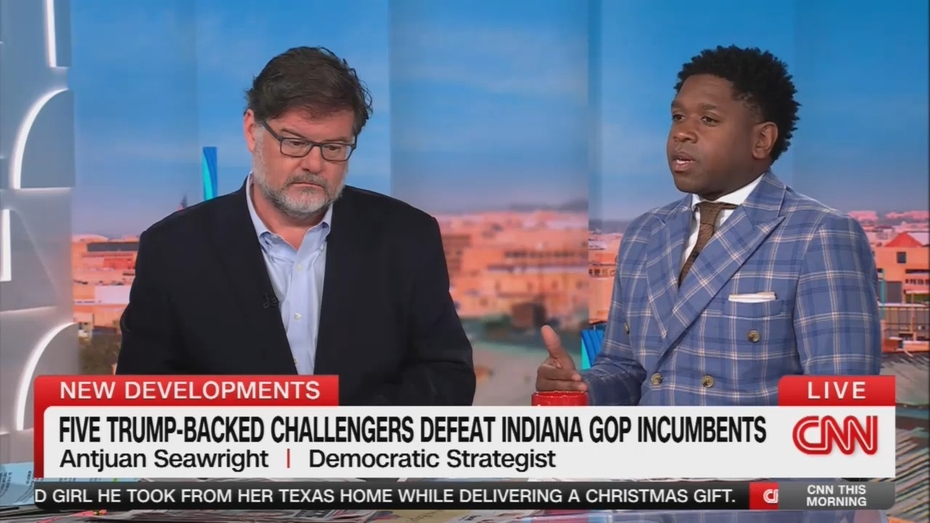
Cornish introduced the segment as Trump’s “revenge” on a state senator who did not approve of plans to redistrict Indiana’s congressional map amid the new redistricting war.
The host also explained how politicos and journalists thought the primaries may show a slip in Trump’s hold of the party, which it did not:
(...) There was a lot of political writing that was like, “cracks in the coalition?” This is people writing. People really thought, " Look at this. It means something.” I don't know if it did.
After the Indiana Primary Election results favored Trump-aligned candidates, CNN This Morning guest Anjuan Seawright labeled the primary voters as "MAGA extremists" who "hijacked" the party. pic.twitter.com/YvPxbDsTm6
— Nick (@nspin310) May 6, 2026
CNN contributor and editor-in-chief of The Dispatch, Jonah Goldberg, said the result signaled “Trump still has a chokehold on the party” and that “he’s not going to be a lame duck. He also said, “even if he loses - even if Republicans lose the House, you better not cross him because he could still screw you.”
Tal Kopan of The Boston Globe echoed Goldberg and called Trump a “chokehold” on the party due to his hold of primary voters.
But then Seawright upped the rhetoric as he started to call Trump-aligned voters in Indiana “MAGA extremists” who “hijacked” the party.”
Seawright continued, “But I think we have to understand who votes in primaries. Some of the most extreme members, particularly on the Republican side, tend to participate more in Republican primaries.”
The democrat strategist also said there were fewer “traditional Republicans voting in Republican primaries,” and instead vote in the general elections: “They do not have to be politically associated with the MAGA extremists who now make up the majority of the Republican Party.”
As Seawright just essentially likened Trump-aligned voters to domestic terrorists, Cornish stepped back at Seawright's comments and did not like the language Seawright used about voters and what they want:
I'm also going to use slightly different language, like when we're saying hijack and chokehold. My thing with that is that these are voters. They have made a decision. They are committed to Trump and they feel that commitment supersedes all other issues. And I don't feel like they don't know what they're doing. You know what I mean? Like this is what they want.
Host Audie Cornish gave some pushback to Seawright's along with other panelists' use of the term 'chokehold': "I'm also going to use slightly different language, like when we're saying hijack and chokehold. My thing with that is that these are voters. They have made a decision." pic.twitter.com/12dARD5jvs
— Nick (@nspin310) May 6, 2026
Goldberg ended with a call to end the primary system as a whole, as he called it a system that’s “really hobbled American politics” and has become “Trump’s superpower.”
Seawright’s label of Republican primary voters as extremists on the airwaves of CNN was just another example of the raised rhetoric against conservative voters in the age of Trump. Amid examples of violence against conservatives, the labeling of voters as extremists expanded that threat level, as voices like Seawright have been constantly platformed on CNN and MS NOW.
The transcript is below. Click "expand":
CNN This Morning
May 6, 2026
6:13:42 AM Eastern
(...)
AUDIE CORNISH: So, it looks like President Trump got his revenge in Tuesday's Indiana primaries and it is proving that it's still his Republican Party.
Last night, at least five of the seven Trump- endorsed challengers defeated incumbent GOP state senators in Indiana, and these are the ones who had broken with the president and voted against the redistricting plan. Indiana Senator Jim Banks wrote on Twitter, “Big night for MAGA in Indiana, proud to have helped elect more conservative Republicans to the Indiana State Senate.”
I wanted to follow up on this. It's a coda to a story, because back in December, when Indiana was looking at its redistricting maps, and I want to put up the map for you, this is the map that Trump wanted, that Republicans wanted in this redistricting battle, okay? Like, the goal was to get rid of those little blue spots there. And a couple of people pushed back. In the end, the Republicans didn't go for it, and there was a lot of political writing that was like, “cracks in the coalition?” This is people writing. People really thought, look at this. It means something. I don't know if it did.
JONAH GOLDBERG: Well, no, I think it meant something, but the blowback also means something, right
CORNISH: Yeah.
GOLDBERG: You know, Mitch Daniels and a bunch of sort of normie Republicans working behind the scenes.
CORNISH: I love that you call them normie. [Laughter]
GOLDBERG: Yeah, At least he's not a closet normie.
CORNISH: Yeah, He's out and proud.
GOLDBERG: He's out and open about his normies. But the - you know, part of the reason why a lot of those state senators didn't want to do the redistricting has to do with not wanting to be part of Indianapolis. I mean, it was like real local stuff.
CORNISH: It was state politics, yeah, which arguably is the whole point of the redistricting conversation.
GOLDBERG: And the revenge stuff has nothing to do with state politics. It is purely to signal that Trump still has a chokehold on the party. That he's not going to be a lame duck, and that even if he loses - even if Republicans lose the House, you better not cross him because he could still screw you.
TAL KOPAN: It's a chokehold on the Republican base, right? So, this is the thing. Primary elections are your most activated, your sort of most true party members. And this certainly is a declaration to anyone in Washington who sort of wants to have some daylight with the president heading into the midterms.
But we can also see Trump is underwater with sort of the overall electorate. And it really puts Republicans in a bind because you know that if you have to face - I mean, we've got Bill Cassidy's election coming up in Louisiana very soon. They're facing a situation where if they cross Trump, if they cross the base, they're at very real risk of losing their primary, even with local, you know, elections.
ANTJUAN SEAWRIGHT: No doubt the MAGA extremists have hijacked the Republican Party and they make up the majority. We see that in Washington, we see that downstream. But I think we have to understand who votes in primaries. Some of the most extreme members, particularly on the Republican side, tend to participate more in Republican primaries. That's been true since Donald Trump came onto the scene in 2016.
I will also note that more and more people are becoming independent thinkers and independent voters. So, that means you have less traditional Republicans voting in Republican primaries. Instead, they're saving their vote for the general elections where they do not have to be politically associated with the MAGA extremists who now make up the majority of the Republican Party.
KOPAN: But how does a politician navigate that?
CORNISH: Yeah.
KOPAN: You can't win the general if you lose your primary.
CORNISH: I'm also going to use slightly different language, like when we're saying hijack and chokehold. My thing with that is that these are voters. They have made a decision. They are committed to Trump and they feel that commitment supersedes all other issues. And I don't feel like they don't know what they're doing. You know what I mean? Like this is what they want.
GOLDBERG: They have agency. But look, I mean, I'm someone who thinks we made a grave mistake adopting the primary system to begin with. And it's really hobbled American politics. But we have it. And - but there's a lot of political science on this. A lot of primary voters don't so much vote for their own parties, they vote against the other party.
And the problem - the reason why this is Trump's superpower is that, particularly in low-turnout primaries, this is the only place where incumbents are vulnerable.
CORNISH: Right.
GOLDBERG: If all of these guys had won their primaries, they would be re-elected. If Cassidy gets the nomination, he will be re-elected. The threat to Republicans in very red states and the threat to Democrats in very blue states and districts is the primaries, not the general election.
(...)