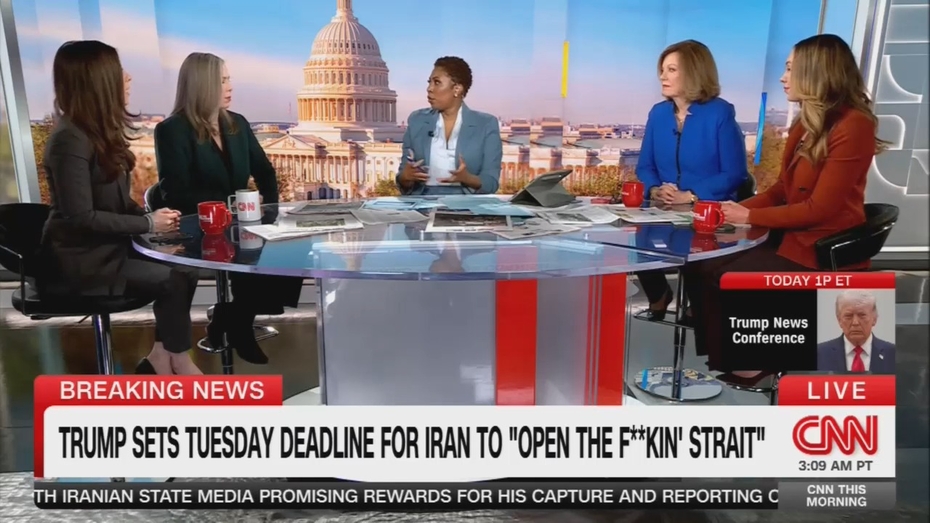
Furthermore, at the end of the hour-long morning show, a discussion ensued between Cornish and Fitzpatrick, which worried almost only about the “cost” of the rescue mission of a U.S. Military pilot.
In the opening salvo of the show, Cornish asked if the original “sense” of the U.S. and Israel’s desire to preserve the infrastructure of Iran had shifted, and Fitzpatrick turned to the "ramifications" of possible strikes.
WATCH: On Monday's CNN This Morning, The Atlantic's Sarah Fitzpatrick decried the "death of expertise" amid the war, as she accused the U.S. Military and Sec. @PeteHegseth of not receiving or ignoring information on possible "legal" and "military ramifications" of some strikes. pic.twitter.com/FeKxkMgTSC
— Nick (@nspin310) April 6, 2026
Fitzpatrick said military and security officials “choose not to strike certain targets because it's just not worth it” because “it might be a war crime.” She also implied that Secretary Hegseth either has not received or has ignored information about targets, not just what the "legal ramifications could be but the national security and the military ramifications.”
Fitzpatrick said the US would be “turning off incubators for babies and things like that” if they carried out strikes.
Unsurprisingly from a The Atlantic employee, Fitzpatrick was upset with what she described as “the death of expertise” amid this war.
In the same panel discussion, CNN Analyst Kim Dozier turned to claim the US might violate the Geneva Conventions, like Russia has in the years-long failure of their “special military operation” in Ukraine. pic.twitter.com/YQATc6sXtu
— Nick (@nspin310) April 6, 2026
Dozier, one of the other panelists, now turned to Hegseth’s comments of “no mercy, no quarter,” something she also discussed in a prior show, to turn to claim the U.S. might violate the Geneva Conventions like Russia has in their years-long failure of their “special military operation” in Ukraine:
DOZIER: You can, militarily, under the Geneva Conventions, hit some parts of the power grid if they're purely for military purposes.
(...)
But if you do it on an extended basis, and you add in things like desalination plants, which is what Trump is threatening to do, that gets you straight into the territory of war crimes.
The U.S. helped write the update of the Geneva Conventions after World War II to go against this kind of action.
Thank you Dozier for demonstrating what the death of expertise looked like!
While they were busy trying to claim Trump was going to commit war crimes, they ignored or were ignorant of the fact that the U.S. had weapons that could disrupt power but not destroy the power plants; weapons such as graphite bombs, which uncoil long filaments of metal wires which as designed to be deployed over power lines and cause them to short circuit. The lines being much easier to replace than an entire power plant.
In the final segment of the show, the panel finally had a large discussion on the pilot rescue mission in Iran. Cornish and Fitzpatrick took the moment to worry about the “costs” of the rescue. https://t.co/oIQ7XLcufC pic.twitter.com/aROc5ZQkqe
— Nick (@nspin310) April 6, 2026
In the final segment of the show, the panel finally had a large discussion on the pilot rescue mission in Iran. Cornish and Fitzpatrick took the moment to worry about the “costs” of the rescue.
Cornish started: “And so, I don't - I am glad that this mission was successful. The question is, are we putting ourselves in the position to have to do more of these?”
Fitzpatrick almost worried only about the “costs”:
Absolutely. And what are the potential costs? I mean, we're all so happy that this worked out, but had this not, it could have been a huge loss of life. Think about how many people were involved in this operation. I mean, this is in a substantial - any time you go into, you know, enemy theater, you are exposing yourself. But also the enemy is learning a lot about what you do and how you do it. So, it's not without cost here.
Discussions like these on CNN This Morning reflect why there was, as Fitzpatrick called it, a “death of expertise.”
The transcript is below. Click "expand":
CNN This Morning
April 6, 2026
6:09:04 AM Eastern
(...)
AUDIE CORNISH: Before, there was a sense that the U.S. and Israel wanted to preserve something of Iran's infrastructure. Do I have that right?
SARAH FITZPATRICK: Absolutely.
CORNISH: Is that shifting?
FITZPATRICK: Absolutely. And I - but I think we see it to the points that we've been making here, in a quarter reckless way, in a way that's not really thinking strategically about what are going to be the ramifications of doing this.
I was with a former NSC official over the weekend, and they were explaining that sometimes you choose not to strike certain targets because it's just not worth it - one, it might be a war crime. And in these cases, I think this is a very legitimate question to be a thing about. What kind of information is Pete Hegseth getting about what targets they're choosing and what the legal, not just the legal ramifications could be but the national security and the military ramifications.
And I've spoken to so many officials who say, like, infrastructure like this for the whole population, when you are going to be turning off incubators for babies and things like that, that is a much, much more serious question to have. And that should be a topic of discussion with expertise.
I think this - we're also seeing in this war kind of the death of expertise. Where are the experts who are coming in and saying, this may not be legal or this may not be the right thing? I don't think those people are getting -
CORNISH: Right. And with that initial strike that landed on a school. There was like, oh, what's - Okay, maybe it's the early start now. We're deep in. And you have even people like Ann Coulter saying online, I really wish legal experts hadn't screamed bloody murder about every little thing Trump did, so they could speak with authority now that he's actually committing war crimes.
KIM DOZIER: Yes. Hegseth saying that no mercy, no quarter towards the forces. And also now talking about, you know, there are international criminal court judgments against Russia for doing this in Ukraine.
You can, militarily, under the Geneva Conventions, hit some parts of the power grid if they're purely for military purposes.
CORNISH: Right.
DOZIER: But if you do it on an extended basis, and you add in things like desalination plants, which is what Trump is threatening to do, that gets you straight into the territory of war crimes.
The U.S. helped write the update of the Geneva Conventions after World War II to go against this kind of action.
CORNISH: And never mind that they're struggling with the Strait of Hormuz right now, right? So, as you try to expand knowing Iran will retaliate in every direction.
(...)
6:55:45 AM Eastern
CORNISH: And just to let people know, inside that mission you had the airman hiding in the mountains, as we mentioned. And he had a pistol. He had a tracking beacon. And then the U.S. launches this rescue, multiple agencies, right. And special ops and Navy SEALs. And so, I don't - I am glad that this mission was successful. The question is, are we putting ourselves in the position to have to do more of these?
FITZPATRICK: Absolutely. And what are the potential costs? I mean, we're all so happy that this worked out, but had this not, it could have been a huge loss of life. Think about how many people were involved in this operation. I mean, this is in a substantial - any time you go into, you know, enemy theater, you are exposing yourself. But also the enemy is learning a lot about what you do and how you do it. So, it's not without cost here.
CORNISH: Trump has said to Axios that the U.S. military had beeping information about the officer's location, the tracker he mentioned. And that after a radio message, officials suspected he might be Iranian captivity and that the Iranians were sending false signals to try to lure U.S. forces into a trap. Is that a thing?
BECCA WASSER: Well, deception is always a thing in any military operation. And in fact, this is very much what the us was doing with the CIA essentially having a false decoy mission over in a different part of geography in order to safely secure the airmen.
(...)