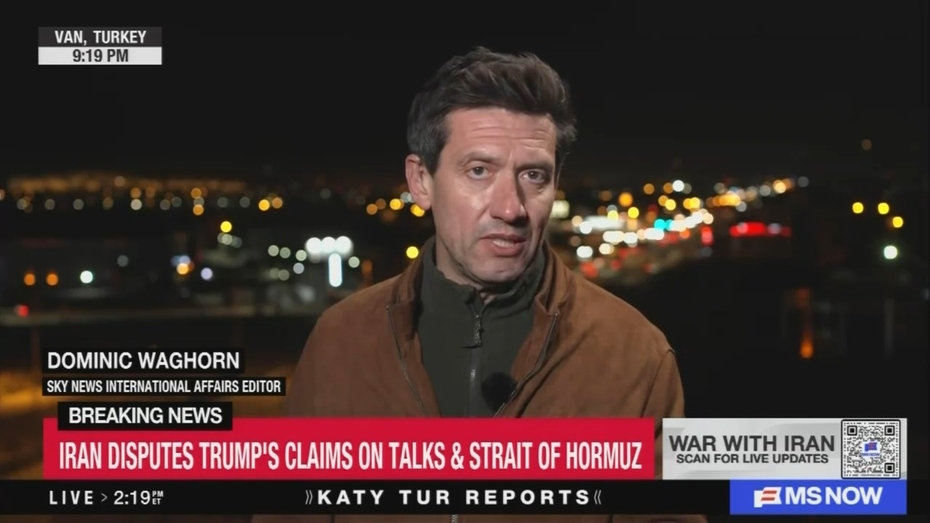
Waghorn was a feature throughout MS NOW’s Monday programing. That afternoon, Katy Tur questioned him on her eponymous about what he was able to understand via his interactions with average Iranians: “Were you able to talk to anybody who you felt was able to give you an honest opinion? Individuals, regular Iranians, about the war and how they felt about the regime and what they wanted.”
It start his answer, Waghorn tried to suggest that the regime wasn’t really in the business of repressing the media. “It was interesting because you have to ask for permission to film in places, but beyond that, you're not really kind of controlled in what you can do.”
He echoed the nonsense of CNN senior international correspondent Fred Pleitgen, who last week claimed he didn’t have a government minder following him around, despite describing having a translator he described as doing the job of a minder.
“We had a translator. There's no real government minder who goes with you, and you can operate as much as you want in the area where you're given permission to film,” Waghorn claimed.
Waghorn did note that “people are reluctant to talk to you,” “But off-camera, they are prepared to share their concerns and their fears.” He added some even shared how they “were resentful of the government.”
Sky News's Dominic Waghorn, a very close ally of the Iranian regime, claims he didn't have a minder following him around (not true), claims only a small portion of the population is "resentful of the regime" and more are very much supportive of the regime," and claims the strikes… pic.twitter.com/suqrvn5kc4
— Nicholas Fondacaro (@NickFondacaro) March 23, 2026
“One man said to us off-camera that the leadership, the dictatorship, he called it in Tehran is extreme, and he hopes it goes after the war. Another person said she just really hopes that we can see change in Iran,” he recalled.
Back on MS NOW, Waghorn down played those against the regime as just a small fraction of the population and countered them by suggesting that a much larger segment of the population supported the regime:
So there is that sense of resentment amongst some people. Others though, are very much supportive of the regime of the government, and they feel that their future, I guess, is bound up with the future of the leadership. Some of them are on the payroll, some of them just sort of ideological supporters.
Further, Waghorn proclaimed that that group of regime was supporters was growing larger every day because of the strikes:
Now, there are a lot of Iranians in the middle there, of course, who aren't necessarily didn't come out to march but don't actively support the government. And they, I think, many of them feel that the attacks on their country are not really aimed at the government. They are taking it rather personally, as you would if you feel the house next to you might go up in smoke at any moment, or your children could be killed on the way back from school. And in a sense, I think that is moving a public opinion to support the government and making it easier for the government to retain control.
“So, if anything, I think the air campaign being waged against Iran is strengthening the government there,” he proclaimed.
Hopefully, nothing terrible had happened to those people badmouthing the regime to Waghorn. It’s worth noting that Waghorn was arguably an ally of the regime.
As NewsBusters had previously reported, Waghorn was caught partying at the Iranian Embassy in London at an event to celebrate the regime back in February, when they were known to have been slaughtering protesters. His loyalty paid off in the form of permission to operate in the country during the war and a softball interview with an Iranian official.
The transcript is below. Click "expand" to read:
MS NOW’s Katy Tur Reports
March 23, 2026
2:19:31 p.m. Eastern(…)
KATY TUR: Were you able to talk to anybody who you felt was able to give you an honest opinion? Individuals, regular Iranians, about the war and how they felt about the regime and what they wanted.
DOMINIC WAGHORN: It was interesting because you have to ask for permission to film in places, but beyond that, you're not really kind of controlled in what you can do. We had a translator. There's no real government minder who goes with you, and you can operate as much as you want in the area where you're given permission to film. So, that was at the site of a airstrike. It was in a market. It was in one of the big funerals that we went to.
And people are reluctant to talk to you. So, the constraint really is that people won't go on camera to talk to you. But off-camera, they are prepared to share their concerns and their fears. And some of them said that they, you know, they clearly were resentful of the government.
And that resentment led, of course, to massive protests back in January and February that the we saw tens of thousands of Iranians come out on the streets, who were then gunned down by their own security forces.
One man said to us off-camera that the leadership, the dictatorship, he called it in Tehran is extreme, and he hopes it goes after the war. Another person said she just really hopes that we can see change in Iran.
So there is that sense of resentment amongst some people. Others though, are very much supportive of the regime of the government, and they feel that their future, I guess, is bound up with the future of the leadership. Some of them are on the payroll, some of them just sort of ideological supporters.
Now, there are a lot of Iranians in the middle there, of course, who aren't necessarily didn't come out to march but don't actively support the government. And they, I think, many of them feel that the attacks on their country are not really aimed at the government. They are taking it rather personally, as you would if you feel the house next to you might go up in smoke at any moment, or your children could be killed on the way back from school. And in a sense, I think that is moving a public opinion to support the government and making it easier for the government to retain control.
And of course, at a time of war, it's easier to suppress unrest. So, if anything, I think the air campaign being waged against Iran is strengthening the government there.
(…)