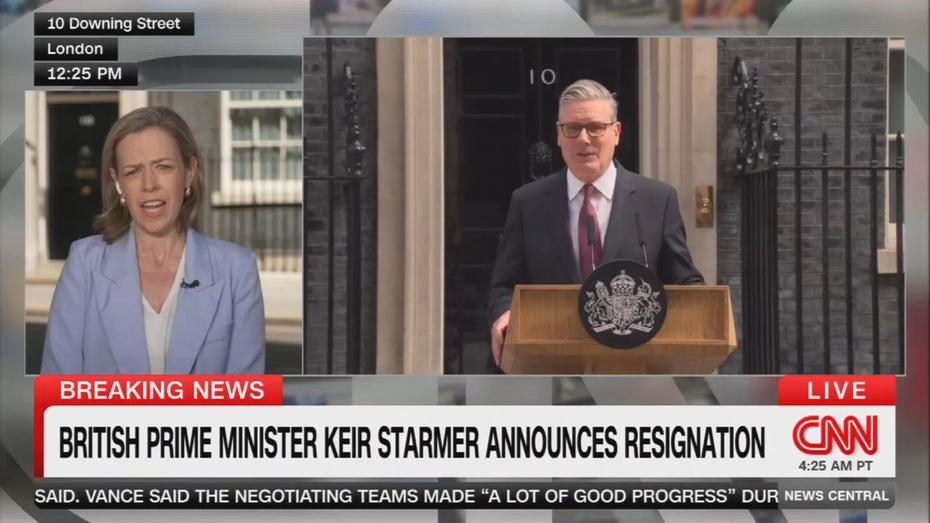
During the morning’s CNN News Central, there was hourly coverage of Starmer’s resignation from the role of Prime Minister. Only once did they go into the reasons behind his resignation, with CNN correspondent Clare Sebastian saying this about the troubles facing the U.K.’s political leadership:
Why, you might ask, can the UK not hold on to prime ministers? Well, there's a number of different reasons. But ten years ago this week, the UK voted to leave the European Union and the turmoil that has followed, the economic turmoil, the political turmoil, certainly has contributed to some of this. There's other economic reasons as well. The big surge in inflation that we saw after the pandemic and the war in Ukraine has really hurt people here, and they are looking for radical change.
CNN's News Central Mentions Keir Starmer's resignation 3 times over 3 hours, even goes into the details once, but NEVER mentions the migrants trying to behead people or the migrant gangs trafficking children. They blame Brexit while kids are being raped & tortured. Horrible. pic.twitter.com/8toHJjANEX
— James Waterman (@jwatermaniv) June 22, 2026
Sebastian was very vague about the conditions surrounding Starmer’s resignation, shifting the blame onto U.K.’s exit from the E.U., the Ukraine war, and COVID, things which occurred years ago. She avoided mention of the actual current disaster facing Starmer’s administration: the UK migration crisis.
For the past few years, concerns among the British public have risen regarding immigration, eventually reaching a breaking point after two massive scandals in the past two weeks.
Firstly, major riots in Belfast after a beheading attempt by a Sudanese migrant. Secondly, the release of a massive report uncovering huge child trafficking networks in the U.K., perpetrated primarily by Muslim immigrants and entirely ignored by the British government. Those who only listen to the media, however, have probably never heard about these crises.
According to Sebastian, Starmer simply just didn’t bring the radical leftist change he promised:
Now, Keir Starmer swept to power in a landslide nearly two years ago, promising that radical change. But most people here, well, certainly most people around the country that we've spoken to, and an increasing number of members of parliament in his party, feel that he hasn't managed to deliver that.
This cover-up of immigration crises like these was part of a larger campaign by the media. They downplay the brutal effects mass immigration has on European societies. They demonize those who try to fight back against the flood of violent criminals into their societies.
By acting as agents of the leftist political order, the media hoped to pull the wool over American eyes, blinding them to the dangers that their mass immigration policies bring upon places they were implemented in. All this to further the implementation of the same disastrous policies in America.
The transcript is below. Click "expand" to read.
CNN News Central
June 22, 2026
07:24:44 AM EasternJOHN BERMAN: All right. Breaking just a short time ago, British Prime Minister Keir Starmer announced he is resigning less than two years after he won the job:
[Cuts to video]
KEIR STARMER (Outgoing UK Prime Minister): Every decision I've taken has been about putting the country I love first. That is why I will resign as leader of the Labor Party.
[Cuts back to live]
BERMAN: Alright. Major political upheaval for one of America's closest allies. And this paves the way for the sixth prime minister in just seven years. Let's get to CNN's Clare Sebastian outside 10 Downing Street for the latest on all this. I think a lot of people saw this coming. Still a political earthquake.
CLARE SEBASTIAN: Yeah, this is still a major moment in British politics, John. We have, I have to say, gotten kind of used to seeing these podiums put out outside number 10 over the last decade. If the new prime minister is installed quickly, that will be the seventh occupant of 10 Downing Street over the past decade.
Why, you might ask, can the UK not hold on to prime ministers? Well, there's a number of different reasons. But ten years ago this week, the UK voted to leave the European Union and the turmoil that has followed, the economic turmoil, the political turmoil, certainly has contributed to some of this. There's other economic reasons as well. The big surge in inflation that we saw after the pandemic and the war in Ukraine has really hurt people here, and they are looking for radical change.
Now, Keir Starmer swept to power in a landslide nearly two years ago, promising that radical change. But most people here, well, certainly most people around the country that we've spoken to, and an increasing number of members of parliament in his party, feel that he hasn't managed to deliver that.
So, that has brought us to this moment. As to what has happened next, well, Andy Burnham, who was up until very recently the mayor of Greater Manchester, he will now be sworn in as a member of parliament this afternoon. He is seen as the man best placed to replace Keir Starmer. We don't know for sure yet whether or not anyone will challenge him. It's looking increasingly like they won't, so this could be over within a matter of weeks.
But unsurprisingly, he is coming in and promising stability. Writing in a post this morning: “...The country expects stability, seriousness and a continued focus on the issues that matter most, and that is what it will get…” now.
As for US Relations, Starmer had been seen as something of a Trump whisperer. He played a lot of sort of big cards early on. The second state visit, lots of sort of meetings and, you know, the famous moments in the Oval Office. But relations had deteriorated in the Iran war, in particular being a bone of contention.
It's not clear how Andy Burnham, if he does become the next prime minister, will play this. But certainly perhaps he has even further to the left. So even further away from Trump on the political spectrum. John?
BERMAN: Yeah. I mean, Andy Burnham will have so many issues internally. It will be unclear even where Trump ranks necessarily in the top three, four, or five items on his list. Clare Sebastian outside 10 Downing Street, getting a new occupant very soon. Thank you very much. Sara?
SARA SIDNER: All right. Thank you John.