Media Research Center President David Bozell joined The Ray Stevens Show Friday morning to discuss a new NewsBusters study that highlights Stephen Colbert’s frequent targeting of right-wing figures and Trump administration officials.
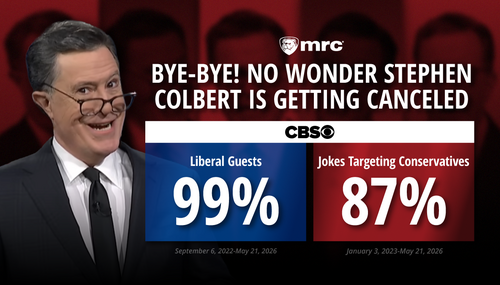
NewsBusters’ Alex Christy found that 87 percent of Colbert’s late-night jokes targeted conservatives, while more than 99 percent of his political guests over the last three years have been liberals.
Bozell said elitist media outlets spend billions of dollars on polarized coverage, prioritizing profitable outrage and negative narratives over objective reporting on the presidency.
Losing $40 million on Colbert is just fine with the Left, so long as they redeem themselves by attacking Trump every night.
— Media Research Center (@theMRC) May 22, 2026
The ends justify the means in their deranged world.@DavidBozell breaks it down on The Ray Stevens Show. pic.twitter.com/8Jgh2Mz8Go
President Donald Trump was the primary target of Colbert’s monologues, the subject of 3,640 jokes since January 2023. By comparison, Joe Biden was the target of 339 jokes — fewer than 10 percent of the total aimed at Trump.
Bozell discussed how constant political criticism, a heavily biased guest list and a lack of creative variety shape late-night television ratings and network losses more than the humor itself. He noted that this polarized information environment has ultimately driven viewers away from CBS.
No wonder Colbert isn't funny anymore; it's just the same bit with the same guests all the time.
— Media Research Center (@theMRC) May 22, 2026
In the past three years, 257/258 of their guests were fellow leftists.@DavidBozell discusses Colbert's fall off on The Ray Stevens Show. pic.twitter.com/LIeHAJ4fak
While it is no secret that late-night comedy shows have long abandoned traditional, family-friendly humor to attack conservatives around the clock, the Media Research Center continues to provide the data proving to the American public that these networks operate as partisan advocates.
Watch the full segment below: