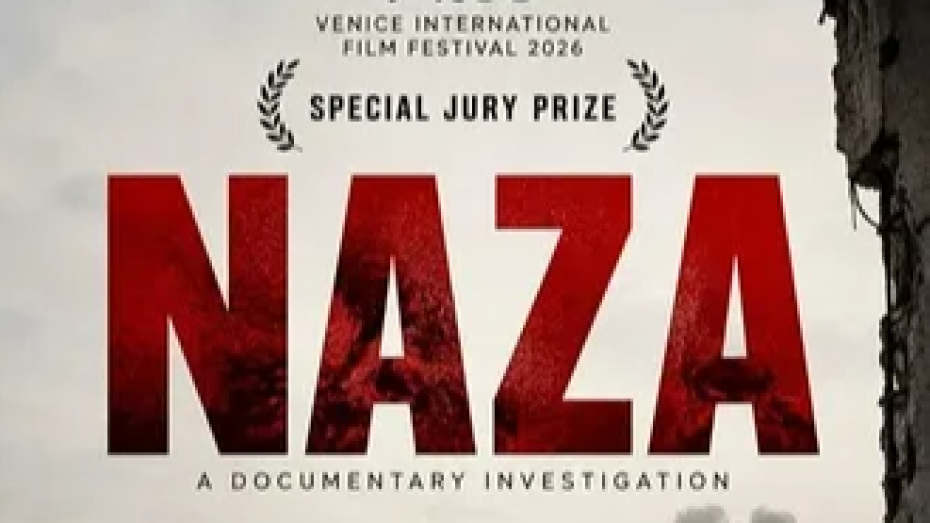
NPR planted its long-waving anti-Israel flag in Friday’s edition of their national talk show Fresh Air, hosted on Friday by regular guest host David Bianculli.
Their film critic Justin Chang touted a slanted documentary of Israeli soldiers in Gaza which has been rapturously received by “pro-Palestinians” -- and apparently anti-semites as well, given one audience’s disgusting reaction to an October 7 survivor who interrupted a showing of NAZA to make her case. The online headline: "Israeli soldiers describe mass killings of Palestinian civilians."
Chang, who also reviews movies for The New Yorker, went beyond the standard media take on Gaza -- pro-Palestinian gullibility and unbalanced focus on the plight of Gazans -- to wholly condemn Israel based on what he saw on screen, taking everything in NAZA (an Israeli military acronym for collateral damage) at face value despite ample reason to doubt the objectivity of filmmakers Yuval Abraham and Rachel Szor.
Justin Chang: For most of the shattering and damning new documentary NAZA, we are on a series of rooftops in Tel Aviv, watching the Israeli journalist Yuval Abraham conduct one-on-one interviews with Israeli soldiers and intelligence personnel. Unsurprisingly, NAZA has already stirred considerable outrage -- much of it, it should be noted, from people who haven't seen and maybe never will see it. Abraham and Szor, both Israeli filmmakers, have been denounced as traitors in Israel, and Prime Minister Benjamin Netanyahu himself has threatened to revoke their citizenship….
Why is it necessary to smear pro-Israel critics as utterly uninformed?
The testimony is riveting. Some of the interview subjects speak about how they were motivated to help the Israeli military annihilate Hamas after Oct. 7. Some express guilt and regret for their involvement. Others see themselves as cogs in a necessary war machine. But for the most part, the filmmakers are less interested in the questions of why than in the mechanics of how. They want us to understand how these systems of remote surveillance and mass killing work, and to grasp the horrific scale of the civilian deaths.
Is the scale truly “horrific,” or remarkably low, especially given the challenges that Israel’s terrorist enemy puts in the way by embedding itself in civilian areas, while Israel employs extraordinary measures to minimize civilian casualties?
Chang worked in the “genocide” lie.
One of the most chilling passages describes a tracking technology referred to as "Where's Daddy?," which uses children's words to confirm whether their targeted fathers are at home. One soldier talks about having used this method on a 12-year-old girl, saying, "You hack her phone and then you kill her." At one point, Abraham asks a subject if Israel is committing a genocide. Without hesitating, he responds, "Yes. Completely." As the film notes, more than 73,000 Palestinians have been killed in Gaza since Oct. 7 — and the death toll continues to rise.
NPR doesn’t wonder if the death count is overstated, or how many of those deaths were terrorists or enemy combatants compared to actual civilian deaths, or note that Hamas purposely embeds among the citizenry to raise fatality rates in a vile but sadly successful attempt to pile up horrendous headlines and foster international obloquy against the enemy it intends to annihilate, Israel. October 7 is barely mentioned.
I've watched NAZA twice now, both times in a state of quiet horror and fury -- and with enormous admiration for Abraham and Szor's courage in holding their government to account. My admiration extends to the unerring precision of their filmmaking. NAZA runs just 77 minutes. It doesn't linger on the atrocities it describes, mainly because there are so many of them to address….
Yair Miron, a lieutenant colonel in the IDF reserves, filed a comprehensive takedown of NAZA. In part:
I came away convinced that NAZA was not made to establish the truth or understand how the strike process worked. In my view, the filmmakers started with a conclusion: Israel had built a sophisticated, automated system for killing Palestinians indiscriminately. They then worked backward, turning the facts into false allegations to fit that story….In its effort to portray the IDF as monstrous, the film loses sight of the reality on the ground. Terrorists, weapons, and hostages were indeed found in residential buildings and civilian facilities, including hospitals, schools, UN facilities, and mosques. For those familiar with Gaza and Hamas's methods, this was a fundamental feature of the battlefield. It is part of Hamas's way of fighting.