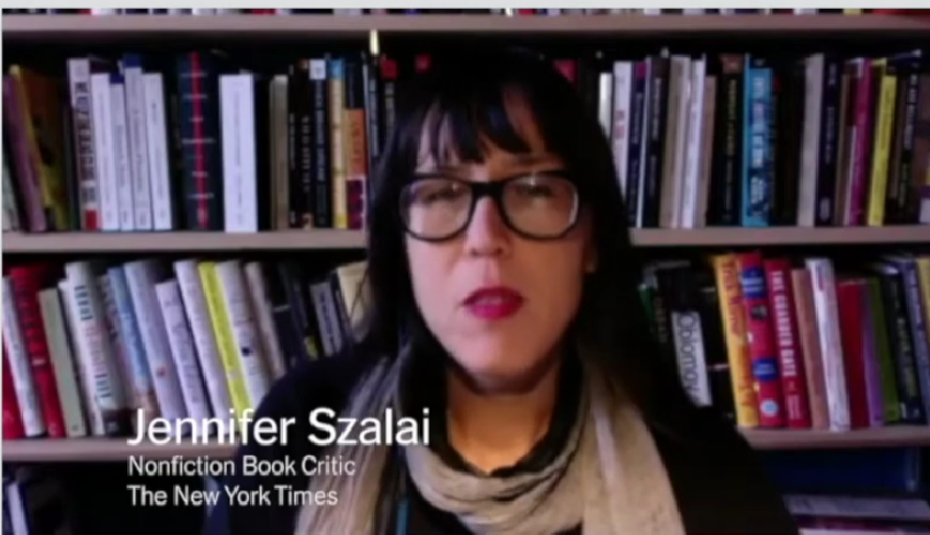
New York Times non-fiction book reviewer Jennifer Szalai warmly reviewed a memoir titled No Land to Stand On by a notorious pro-Hamas activist:
A Quietly Shattering Memoir by a Man Detained by ICE for His Beliefs
Mahmoud Khalil, the Palestinian activist and former Columbia graduate student, offers an account of his ordeal and explains why his work continues.
And what would that “work” be? Not studying. The 31-year-old majored in the organized harassment of Jews and their supporters at Columbia University encampments in 2024, in response to the mass murder by Hamas on October 7, 2023.
Khalil's leadership was explained in Matt Golden’s column at Jewish Community of Louisville:
During [Khalil’s] tenure as a leader of anti-Israel activities at Columbia, Jewish students with mezuzahs on their doorposts were harassed with nightly pounding on their doors. Some were forced out of their dorms. Students wearing kippot were spit on and called baby killers. Others had Judaica necklaces ripped off while on their way to synagogue. Jewish students were videoed, harassed, and intimidated by Khalil’s associates….
Szalai started off by perversely comparing the democratic United States to the failed autocracy of Syria.
As a Palestinian born and raised in a refugee camp in Syria, Mahmoud Khalil grew up with a particularly dark understanding of unchecked state power….
….
In the land of the free, the rules were different — or so he believed. After fleeing Syria for Lebanon, Khalil moved to the United States in 2022 and enrolled at Columbia as a graduate student. In the wake of Hamas’s attack on Oct. 7, he became a constant presence at campus protests against Israel’s bombardment of Gaza….
But Khalil was living in a country with an independent judiciary and a constitutional right to free speech. So when he read the “Know Your Rights” guides online, he only skimmed the sections on ICE: “I was a legal resident. ICE wouldn’t be coming for me.”
Then, on March 8, 2025, they did come for him. In “No Land to Stand On: Notes From Detention,” Khalil recounts in stark detail the terrifying experience of being surrounded by men in the lobby of his Manhattan apartment building, handcuffed in front of his pregnant wife, pushed into an unmarked car and flown to a detention camp in Louisiana.
Szalai was shocked that “a legal resident whose beliefs and behavior are “otherwise lawful” could be booted from the country because the Trump administration said so.”
The keffiyeh-clad organizer of Jewish harassment has had his due process. Szalai demonstrated not the least bit of curiosity about why Khalil was targeted, but just took his self-serving word from his memoir.
It’s quite different from how she treated biographies of people whose politics she disliked. Her take on supposed traitorous Democrat Sen. John Fetterman biography was particularly nasty, calling the work from a man who suffers mental illness a “closed loop of self-pity.”
Szalai also wrote a 2024 book review that drew the headline “The Constitution Is Sacred. Is It Also Dangerous? One of the biggest threats to America’s politics might be the country’s founding document.” So why is she now citing “the constitutional right to free speech” to protect Khalil?
The prose in this prison memoir is matter-of-fact and unadorned, noticeably free of self-pity. Especially striking is Khalil’s account of being caged in a camp apparently designed to get people to give up hope and self-deport by wearing them down. He recalls the harsh glare of bright lights that were never turned off and the unrelenting blast of frigid air that cut like a blade. Even the tiniest decencies were forbidden. At 3 a.m. guards would come around and tear down the sheets that inmates hung around their bunks to keep out the light and the cold.
The solution to such treatment was at hand and remains so: Self-deportation.
Khalil refuses to stay quiet. He could play it safe by dialing back his activism on behalf of Palestinians….But he says that his politics are born of necessity. In “No Land to Stand On,” he regularly points out moral contradictions -- the gap between words and deeds, between “family values” and family separations, between soaring humanist ideals and ruthless dehumanization on the ground.
Speaking of “dehumanization,” Szalai left out her hero’s dehumanizing an entire group of people with his leadership of pro-Hamas demonstrations at Columbia University.
This is a frightening, important book. But there is also a measure of hope in Khalil’s insistent emphasis on such hypocrisies. They indicate that an ideal still exists, something that hasn’t yet been swallowed up by arbitrary power….
Khalil also has powerful friends at the ACLU, the New York Times…some of whom share his hostility to Jews, including the mayor of New York City, Zohran Mamdani, who hosted Khalil for dinner at Gracie Mansion.