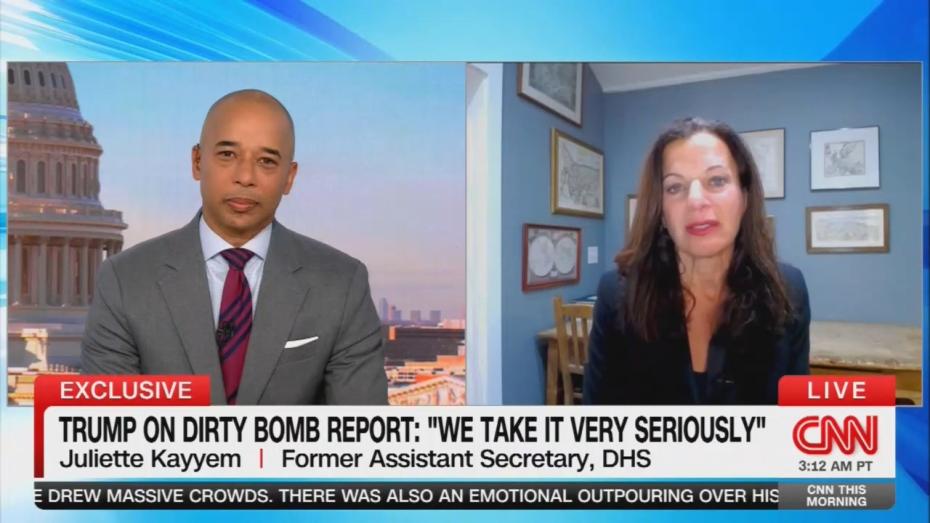
On Tuesday morning, after CNN reported US intelligence feared Iran was “developing plans to potentially detonate a dirty bomb in Washington,” CNN national security analyst Julliette Kayyem did not believe her own employer’s reporting and said, “We have to wonder” if “the White House is now trying to figure out how to get the president of this unpopular war.” She later claimed the report could also be used to “ratchet up attacks.”
Filling in as host of CNN This Morning, Elliott Williams asked Kayyem about dirty bombs and how to counter the threat, leading to Kayyem minimizing the nuclear aspect of a dirty bomb, but said “it would be no different than, say, a Boston Marathon incident.”
After her initial explanation, she turned to skepticism of the report. Kayyem first said, “I'll say right now, the good news is this intelligence is inconsistent with what we know the Iranians prefer, which is, of course, assassinations of targets.”
On Tuesday morning, CNN’s Juliette Kayyem suggested the Iran Dirty Bomb intelligence, reported by her own employer, may be made up and said “we have to wonder” if “the White House is now trying to figure out how to get the president of this unpopular war.” pic.twitter.com/XQh60qn1EZ
— Nick (@nspin310) November 17, 2026
Then, she cast even more doubt and insinuated the intelligence was made up to get out of the conflict. Kayyem opined, “One of the things that we have to wonder at this stage, and I hate saying it, but is just, you know, the White House is now trying to figure out how to get the president out of this unpopular war.”
Williams interrupted Kayyem’s answer to play comments from Trump in Asia, where he said Iran “will pay a price the likes of which no country has ever paid before” if they go through with an attack.”

In response, Kayyem suggested, “It looked like he had not been briefed on this,” because, “he's responding with the sort of clichés that he often does, you know, that we're going to bomb them to oblivion or whatever else.”
After CNN played some Trump comments on the report, Kayyem then worried, “We have to be, as citizens, also skeptical of the kind of intelligence that might be coming out of the White House to justify a ratchet-up by the president.” https://t.co/GFlnLWNUyo
— Nick (@nspin310) November 17, 2026
Continuing her distrust in her own employer’s report, or just her constant disdain for anything related to Trump or Republicans, she continued the skepticism. But now, after suggesting the intelligence to be part of a plan to “get the president out of this unpopular war,” Kayyem suggested it would be a part of a plan to “ratchet up” military action against Iran, even fearmongering about nuclear attacks on Iran:
But we have to be, as citizens, also skeptical of the kind of intelligence that might be coming out of the White House to justify a ratchet-up by the president and, of course, his team. They are looking for an out. Sometimes that out is just saying the war is over. Sometimes it is the threat of nuclear. I mean, this is the range of possibilities that we hear.
She then likened intelligence to the Iraq War: “So one of the things that as consumers of intelligence, like you and I are, in our worlds, is is there a motivation for this, for releasing this that would justify, you know, like the Iraq war in 2003 when there was, you know, lots of intel about chemical weapons that would justify a ratchet-up for the Trump Administration. I would be looking for that now. Is there going to be a ratchet-up?”
For a national security analyst, Kayyem seems to show constant disdain for anything related to the Trump administration, as she did over the weekend when she insisted Transportation Secretary Sean Duffy asking for money to revamp the air traffic control system after an historic ground stop was a “shakedown.”
Kayyem dislikes Trump and anything related to Republicans so much that she distrusts intelligence reported by reporters on the channel she is a national security analyst for.

The transcript is below. Click "expand":
CNN This Morning
November 17, 2026
6:10:10 AM Eastern
ELLIOTT WILLIAMS: Along those lines. Juliette, let's talk about dirty bombs for a second. Sort of what they are and how they work. And a dirty bomb packages radioactive materials into a conventional bomb and can disperse dangerous airborne radiation for blocks or even miles. And, you know, they're relatively easy to develop. So how does that threat even get countered on the ground?
JULLIETTE KAYYEM: It would it would be hard to do. You wouldn't there would be no sort of activity that the entire U.S. population could do to protect itself from a dirty bomb, because the let's just, you know, the radioactive material is often not lethal, so that's good. But the bomb itself, of course, would be lethal. So, it would be no different than, say, a Boston Marathon incident. And then, of course, you have noxious fumes or whatever else that could kill, maybe, possibly people in the immediate area. This is not a nuclear bomb. A nuclear bomb would have a radius that would have fatalities.
So, obviously it's still serious, but, you know, once again, it is part of what has always concerned us intelligence agencies about any threat, which is the cheap, you know, the cheap thing, right? Nuclear is not cheap. This is the cheap thing.
But it is – I'll say right now, the good news is this intelligence is inconsistent with what we know the Iranians prefer, which is, of course, assassinations of targets. And also, you know, one of the things that we have to wonder at this stage, and I hate saying it, but is just, you know, the the White House is now trying to figure out how to get the president out of this unpopular war.
WILLIAMS: Well, hold on.
Well let's – you know, the president is on the ground in Manila right now and just spoke about a lot of this, including this, this, this specific. Let's listen to the president right now. And then we can talk about it on the other side.
PRESIDENT TRUMP: Well, if there is, they will pay a price, the likes of which no country has ever paid before. I, I hope it's not, but it's we take it very seriously because they happen to be crazy. This is why they can't have a nuclear weapon, by the way, in case people had any questions.
WILLIAMS: So you can just pick up your answer right there. You were talking about the popularity of the war, and he was saying, you know, the likes of which – I can't remember what the second part of that was, so proceed
KAYYEM: Yeah. So it looked like he had not been briefed on this, I'll be honest with you. It looked like this was just a threat that he, you know, so so he's responding with the sort of cliches that he often does, you know, that we're going to bomb them to oblivion or whatever else.
WILLIAMS: Right.
KAYYEM: So we don't know how seriously he had been briefed on it. And that means that maybe the intelligence agencies weren't prepared to brief him on it yet.
But we have to be, as citizens, also skeptical of the kind of intelligence that might be coming out of the White House to justify a ratchet-up by the president and, of course, his team. They are looking for an out. Sometimes that out is just saying the war is over. Sometimes it is the threat of nuclear. I mean, this is the range of possibilities that we hear. So one of the things that as consumers of intelligence, like you and I are in our worlds, is is there a motivation for this, for releasing this that would justify, you know, like the Iraq war in 2003 when there was, you know, lots of intel about chemical weapons that would justify a ratchet-up for the Trump Administration. I would be looking for that now. Is there going to be a ratchet-up?
(...)