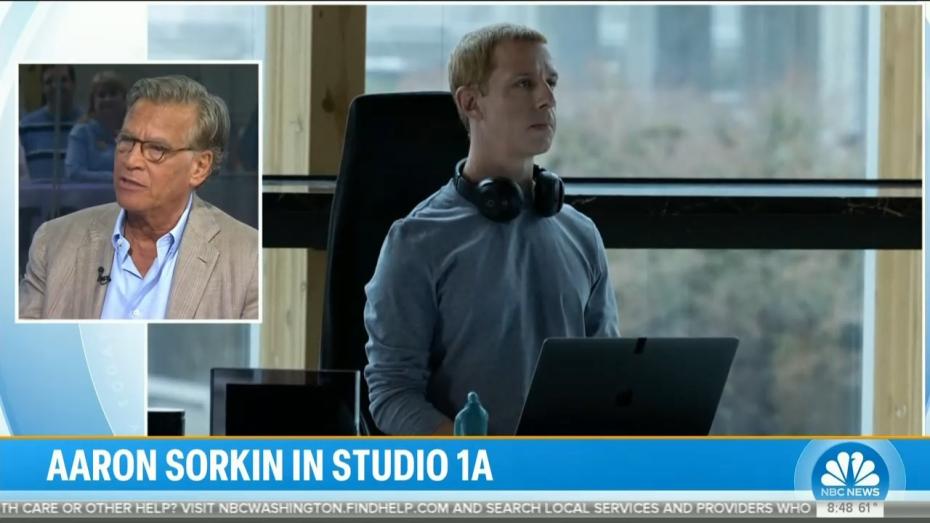
During a Monday appearance on NBC’s Today, Aaron Sorkin insisted that his upcoming movie The Social Reckoning about Facebook wasn’t political. Yet, according to him, who is both writer and director, anyone who sees it that way must be “anti-the truth.”
Amid a gooey interview with NBC’s Craig Melvin, Sorkin promoted his dramatization of Frances Haugen, the Facebook whistleblower who revealed her revelations about the social media platform while employed as a mid-level engineer.
Though Melvin suggested the movie wasn’t “a red or blue film” meant to have a political agenda, Sorkin gave another explanation as to why audiences should not see it that way, suggesting they were in favor of online disinformation:
“The film shouldn’t be political unless you are somebody who is anti-the truth, okay? The — the film is saying that — that the truth is important, and we’re not getting it. So, unless you are anti-the truth, you shouldn’t find the film political. But, yes, it’s — it’s going to be seen as political, primarily…,” Sorkin claimed.
Sorkin’s description of his movie made his “anti-political” stance even harder to buy. Throughout the interview, he presented the premise of the movie in very simple terms, in which Haugen is the whistleblower exposing Facebook, while the company is portrayed as hiding “extremely dark secrets” from the public.
Rather than taking the nonpartisan approach, Sorkin forced the viewer to come away with his own chosen interpretation: Facebook hides valuable information, and the people that expose it are on the right side of history. Rather than question the political implications of the movie and challenge Sorkin’s framing, Melvin accepted his premise and moved on with the interview.
Sorkin was proud of the comparison of his project to All of the President’s Men, The Insider, and Spotlight– films all including journalists and whistleblowers taking down powerful institutions. By placing his movie in this category or “tradition,” Sorkin gave his audience the framework to view the story as good versus evil. This comes as no surprise, having seen Sorkin’s West Wing that depicted Democrats as respected public servants and Republicans as political foils in its seven season run:
Yeah, well, you know, before a movie can be anything else, before it can be thought-provoking or relevant, it has to be good. It has to work as a movie. It has to work as something that you watch while you’re eating popcorn. So, that was my top priority: giving the audience an exciting, fun experience in a theater. You do that by telling a story, and this is a whistleblower story.
This bias became even more ironic when viewed through the post 2016 Russia controversy, in which Russia purchased Facebook ad space to run political ad campaigns in an effort to influence the outcome of the election. Or, Sorkin’s West Wing that depicted Democrats as respected public servants and Republicans as political foils in its seven season run. Talk about an anti-political stance.
Sorkin insisted his movie wasn’t political, but rather about “the truth.” Yet, questioning his version can make you “anti-the truth.” Maybe the truth of the matter was that no one would be running to the theater to see this movie.
The transcript is below. Click "expand" to read:
NBC’s Today
October 5, 2026
08:44:26 a.m. Eastern[ON-SCREEN HEADLINE: Aaron Sorkin in Studio 1A]
CRAIG MELVIN: We are back with legendary writer, director, producer Aaron Sorkin, an Oscar winner, Emmy winner. Behind so many hits, A Few Good Men, The West Wing, Social Network. 16 years later, Aaron is continuing that story, The Social Reckoning, focusing on what Facebook and social media at large have essentially become. Take a look.
[THE SOCIAL RECKONING SCENE]
MELVIN: Aaron Sorkin, good morning. Welcome back.
AARON SORKIN: Thanks for having me.
MELVIN: I’m glad we picked the clip because the argument could be made that, at — at some level, that’s sort of the thesis of this — of this film. It is a look at not just Facebook, but social media. It’s a look at our society’s grappling with it. You said that you didn’t want this to feel like you were eating your vegetables or doing your homework. You wanted to make it entertaining. How did you go about doing that with when you are making a movie about algorithms and whistleblowers?
SORKIN: Yeah, well, you know, before a movie can be anything else, before it can be thought-provoking or relevant, it has to be good. It has to work as a movie. It has to work as something that you watch while you’re eating popcorn. So, that was my top priority: giving the audience an exciting, fun experience in a theater. You do that by telling a story, and this is a whistleblower story. It is a newspaper story. It is in the tradition of All of the President’s Men, and The Insider, and Spotlight. It is about a mid-level Facebook engineer named Frances Haugen, who’s played by Mikey Madison, who enlisted the help of a Wall Street Journal investigative reporter, played by Jeremy Allen White, and ends up revealing some extremely dark secrets Facebook had been hiding from us.
MELVIN: And your — your choice of casting for — for Mr. Zuckerberg, I — I read that he was in character the entire time.
SORKIN: Jeremy Strong, who gives a thunderous performance in the film, is — yes, he is an immersive actor. He showed up on the first day. I — I — I never heard him speak in his own voice. He only spoke, moved, behaved as Mark Zuckerberg, not just on the set but when he went home too, 24 hours a day.
MELVIN: That seems weird.
SORKIN: I know. I know it seems weird. I know it seems perhaps even unnecessary, but the results speak for themselves. It’s — it’s not silly. It’s not nonsense. It’s not like he doesn’t know we’re making a movie.
MELVIN: Yeah.
SORKIN: I mean, he sees the crews and the cameras. This is his process, and I don’t think he knows any other way to do it.
MELVIN: It is thought-provoking. You maintain this is not a red or blue film. It is not a film that’s designed to be political. The President, by the way, never named —
SORKING: Mmhmm.
MELVIN: — at all during the film. Do you think though that this is going to be one of those films that — that people watch through a political lens nonetheless?
SORKIN: The film shouldn’t be political unless you are somebody who is anti-the truth, okay? The — the film is saying that — that the truth is important, and we’re not getting it. So, unless you are anti-the truth, you shouldn’t find the film political. But, yes, it’s — it’s going to be seen as political, primarily, because of the final, climactic sequence, which we’re not going to talk —
MELVIN: We’re not going to give away.
SORKIN: — about right now because —
MELVIN: We’re not going to give away.
SORKIN: — we’re not going to give it away.
MELVIN: And, as a huge fan of The West Wing, I am obligated to ask you, when are we getting it?
SORKIN: That’s really nice of you.
MELVIN: But you’re going to do it, right?
SORKIN: Listen, I loved making The West Wing, and — and I loved all of the people.
MELVIN: This is where you could do it.
SORKIN: All you need is an idea of —
MELVIN: You’re Aaron Sorkin, you have ideas.
SORKIN: I live in a constant state of writer’s block.
MELVIN: I don’t believe you.
SORKIN: I do.
MELVIN: I don’t believe you. So, you’re saying there’s a chance we will get a West Wing reboot?
SORKIN: If I could think of how, I would love to, but in 25 years, I haven’t been able to think of how.
MELVIN: I don’t think about — again, I don’t believe you, but we will talk about when you come back the next time.
SORKIN: Alright.