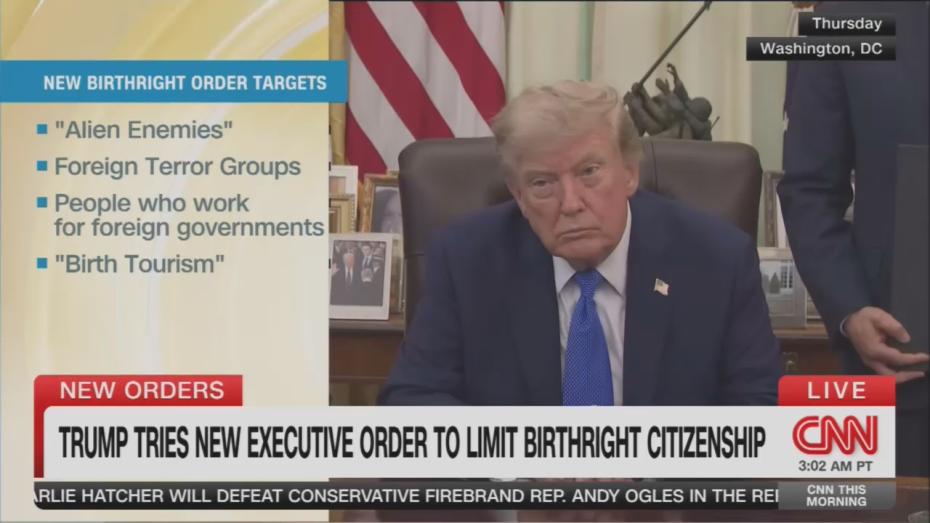
On Friday’s CNN This Morning, Audie Cornish casually dismissed part of President Trump’s latest executive order on birthright citizenship by declaring that banning birth tourism was unnecessary.
“The order also bans so-called birth tourism, even though that is already illegal under U.S. law,” Cornish stated.
Cornish's claim is false.
U.S. law does not make the act of giving birth in the United States illegal. What is restricted is how some people try to get here. A 2020 State Department regulation bars the issuance of tourist visas when the primary purpose is obtaining citizenship for a child. Lying about that purpose on a visa application or to border officers can constitute visa fraud and lead to prosecution. Organized “birth tourism” networks have faced charges for fraud, money laundering, and conspiracy.
But if a foreign national succeeds in entering — whether by deception, overstaying a visa, or simply sneaking across the border — and then gives birth on U.S. soil, the child is still recognized as a U.S. citizen under the longstanding interpretation of the 14th Amendment. The Supreme Court reaffirmed that rule on June 30, in what President Trump described as "a very, very unfortunate decision." The only traditional exceptions are children of foreign diplomats or invading forces.
A woman could give birth in jail, on trial for or even convicted of illegal entry, and her baby would still be recognized as a US citizen.

CNN's Cornish Falsely Claims Birth Tourism ‘Already Illegal’
— Mark Finkelstein (@markfinkelstein) August 7, 2026
That is utterly false. Yes, there are rules calling on officials to crack down on fraud by people trying to enter US for birth tourism. And people who manage to get in can be prosecuted.
But if they give birth… pic.twitter.com/4oVHAshv22
In short: the entry might be illegal. The birth is not. The citizenship still attaches.
Cornish’s formulation ignores that crucial difference. Surprisingly, the normally circumspect legal analyst Elliot Williams later echoed a similar line on the same panel, treating the birth-tourism provision as largely redundant because it is “already barred by the law.”
Both statements leave viewers with the misleading impression that the practice is already prohibited and that the new order adds nothing of substance.
Trump's new executive order targets more birth tourism. It also seeks to deny citizenship to children born to certain categories of people the administration labels “alien enemies,” members of foreign terrorist organizations, and those working for foreign governments. Whether those broader provisions survive judicial scrutiny is a separate question.
On the narrower issue of birth tourism itself, the White House is attempting to close a loophole that current enforcement tools have failed to seal.
Cornish’s assertion that the problem is “already illegal” ignores that reality. The law currently punishes the fraud used to get in. It does not prevent the citizenship that results once the child is born here.
Whether Cornish was unaware of the legal reality or simply chose to ignore it, her claim left viewers with a false impression.
Here's the transcript.
CNN This Morning
8/7/26
6:00 am EDT
AUDIE CORNISH: Today in the Group Chat, the president taking another swing at birthright citizenship, this time targeting alien enemies. So will this one hold up legally?
. . .
STEPHEN MILLER: That practice, of birth tourism, is, as if the signing of this order, hereby banned.
DONALD TRUMP: We had a very unfortunate decision in the Supreme Court concerning birthright. I was close, but a very, very unfortunate decision. So we're making adjustments.
CORNISH: If at first you don't succeed, make some adjustments. But will it succeed?
Good morning, everybody. I’m Audie Cornish, and here is where we begin. President Trump with his second try at limiting birthright citizenship.
Now, just a few weeks ago, the Supreme Court ruled that Trump’s effort to ban birthright citizenship by executive order was illegal. On Thursday, he signed another executive order. The White House says this one will impact several groups specifically, including alien enemies, members of foreign terror organizations, and people who work for foreign governments, by making children born to folks in those groups ineligible for U.S. citizenship.
Now, the order also bans so-called birth tourism, even though that is already illegal under U.S. law.
MILLER: I would put this in the top three in terms of importance, because it ends one of the gravest and most egregious abuses of the American system, and it keeps American citizenship sacred.
. . .
CORNISH: So here’s -- just need the basics. Fourteenth Amendment. Basically, the Supreme Court majority said, “Leave it alone. This is the law.” So what is different about this executive order, functionally?
ELLIOT WILLIAMS: I don’t know. And here’s the challenging thing, Audie. Anytime the president by executive order attempts to redefine or change the definition of citizenship, he’s on murky legal ground. It’s shaky, and the Supreme Court had said this before.
Now, because this is politically sound or smart— I think many people would agree that we don’t want the children of Hamas leadership or of Al Qaeda being citizens of the United States. Okay, that’s politically sound, but that still might run afoul of the Constitution. It’s complicated.
Now, we need to separate out the birthright one from the birth tourism one, which does something totally different and is on stronger legal ground, even if it doesn’t do anything, right? It’s still, it’s already barred by the law, right?
And so, yeah, same thing. These are both political statements, far more than legal ones, and that first one is absolutely going to be challenged in the court.