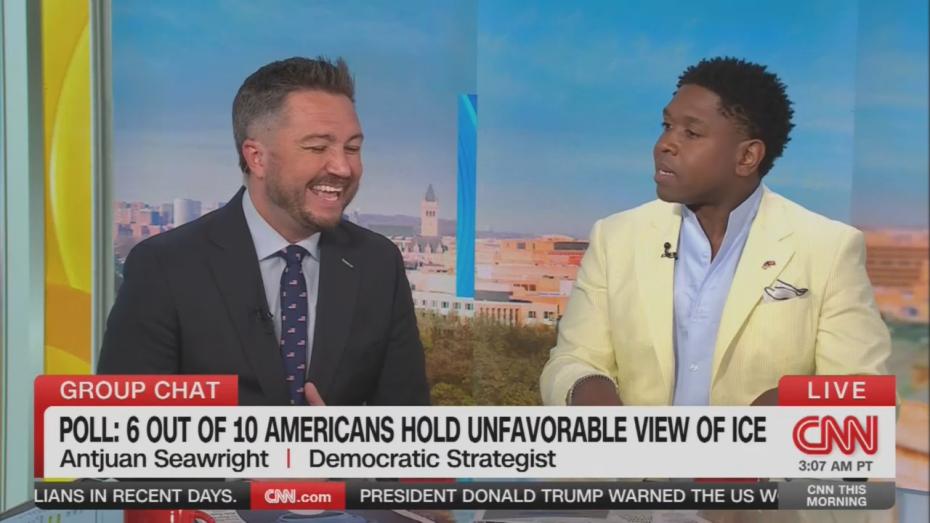
On Wednesday's CNN This Morning, Democratic strategist and frequent CNN contributor Antjuan Seawright accused ICE agents of “cold-blooded murders,” citing the recent Biddeford, Maine, incident involving 26-year-old Colombian national Joan Sebastian Guerrero.
Seawright highlighted video of the incident, claiming ICE agents "drug this gentleman out of the car and handcuffed him after he was shot dead. That's brutal, that's deadly."
But as law enforcement experts note, handcuffing a suspect — even one who appears incapacitated or worse — is standard operating procedure in volatile, high-risk encounters like this. Officers aren’t expected to conduct on-scene medical diagnoses in split seconds when a vehicle has just been involved in a confrontation. Securing the scene comes first.
I have some related experience. Last summer, after ditching my small plane in the waters off Oak Island, NC, rescuers from the water rescue teams of local fire departments pulled me from the wreckage. They later explained to me that their protocol is not to attempt to assess a person's condition on the spot--even whether they are still alive. Their job is to rush the person to medical professionals onshore as quickly as possible, and let them make such determinations.
The same principle applies here: law enforcement prioritizes safety and scene control rather than assuming the role of medical professionals.
The Maine shooting occurred during an immigration enforcement operation. Agents attempted a traffic stop on a vehicle linked to the surveillance address. According to DHS, the driver attempted to flee, accelerating in a manner that prompted an agent to fire in fear for public safety. Guerrero was not the primary target, but the encounter turned deadly.
Seawright also leaned on data from the Cato Institute to downplay the criminality of those arrested by ICE, labeling the libertarian think tank a “conservative” organization. Conservative panelist Terry Schilling, president of the American Principles Project, pushed back, correctly noting that Cato is not conservative but libertarian — and calling it an "open-borders organization." Its statistics on ICE arrests and convictions of violent criminals should thus be discounted, said Schilling.
CNN’s Seawright Accuses ICE of ‘Cold-Blooded Murder’ in Maine Shooting pic.twitter.com/4Cqg4hwO3N
— Mark Finkelstein (@markfinkelstein) July 15, 2026
Host Audie Cornish made an interesting admission toward the end of the segment. When Seawright pushed for body cams, Cornish retorted that the use of body cams:
"Has not exonerated, hasn't helped victims. It's usually ended up the victims are, the police involved are exonerated. So I don't think video solves this problem."
That inconvenient truth underscores why calls for body cams in these cases should be welcomed by all sides — transparency works both ways.
Note: Seawright also played some anti-Collins Maine politics, saying, "Susan Collins is responsible for the budget that funds ICE." Question for Seawright: since you've accused the ICE agents of "cold-blooded murder," would Collins vote to fund ICE make her an accessory before the fact?
Here's the transcript.
CNN This Morning
7/15/26
6:05 am EDT
ANTJUAN SEAWRIGHT: ICE needs to chill. When the Trump administration came in, they promised to get rid of the bad actors, the violent criminals. Democrats agree with that. We do need to get rid of the bad actors.
The problem is, according to the conservative Cato Institute 70% of those who have been arrested have, no, have no history of criminal convictions. Less than 15% have a history of violent, of violent crimes. That's a problem.
Number two, Susan Collins is responsible for the budget that funds ICE, that includes the $70 billion in the Big Ugly Bill, and this additional $75 billion dollars, I think, by way of reconciliation.
And so what Democrats advocated for what some parameters around ICE, body cameras, most people would agree with that. Let's not invade personal spaces, hospitals, schools, polling locations, most people agree with that, but yet Republicans ignored --
AUDIE CORNISH: So much of that fell apart during the government shutdown, the effects of that on, transportation and airports, some of this fell by the wayside.
But to your point, the way Antoine is talking about Senator Collins, even though she isn't the sole whole reason why ICE funding is what it is, means these votes will be held against Republicans in places where the tide is turning. We saw that yesterday in our numbers with Latino voters in Texas.
So what is the counter, other than telling people this is what you wanted, is there another argument starting to develop in Republican circles about how to talk about the moments when ICE makes a mistake?
TERRY SCHILLING: Yeah, look, I think this is why both parties, support body cameras. This is a, it's a necessary thing. It gives a lot of clarity to the people on the ground and the rest of America on what these officers are actually dealing with.
I would go further, Antoine. First of all, I would say you gotta discount anything Cato says about immigration enforcement. They are an open-borders organization. They are not conservative: they're libertarian.
But secondly, we have to do this. This is for the safety of our country. It's not just ICE that needs to chill out. People need to stop resisting arrest. People need to, when you get pulled over, you don't have a right to resist arrest. Your resisting comes in the courts.
SEAWRIGHT: Terry, respectfully, that's why the body cam, cameras matter. Did you -- I don't know if you saw the video, but they drug this gentleman out of the car and handcuffed him after he was shot dead. That's brutal, that's deadly.
We, we see these cold-blooded murders in real time. Unfortunately, we've gone so numb to this till we wanna put it back on the individual. ICE needs to be reined in.
CORNISH: Terry, can I ask a question? Is the acknowledgement that vehicle stops are no longer in the policy? They're saying, "Look, we're gonna pause on this." Is that an acknowledgement that things are going sideways? That their take is not, "Well, they're fleeing so everybody deal," they're saying, "Okay, wait a second, we got, we gotta pause for a minute and figure out what to do."
SCHILLING: I think this is a mistake. I think that --
CORNISH: You think it's a mistake to pause vehicle stops.
SCHILLING: Yes, I think, I think Mullins is, is making a big mistake. He's showing weakness here. Look, the, the reality is, is that no one likes more than the Democratic party of Maine.
They just pulled a 2024 maneuver where they replaced the top of the ticket with a new person. We don't even know who that's gonna be.
CORNISH: I think people remember Platner went through a massive scandal. So I don't think people think they [airquotes] pulled him. It seems like he imploded on the launchpad.
SCHILLING: But, Audie, with all due respect, they were defending him up until it was a Democrat [who accused Platner of sexual assault.]
SEAWRIGHT: Well, there is something about Maine, but what about Minnesota? Because you, you all, you all --
SCHILLING: I was just about to get to Minnesota.
SEAWRIGHT: You all make these claims about people resisting arrest, etc. But yet the footage comes out to say something differently and you want to ignore the reality, the facts that are right in front of your face.
SCHILLING: In Minnesota, she tried to run him over with her car. She did hit him with her car.
CORNISH: This actually gets to something about body cameras, I think, has always been fascinating. For the last twenty years, especially in the anti-police brutality movement, people have talked about body cams.
And it has not exonerated, it, it hasn't helped victims. It's usually ended up the victims are, the police involved are exonerated. So I don't, I don't think video solves this problem, because what we have found is people can argue, good people can disagree on things they see with their own eyes.
You [Seawright] see a body dragged out of the car, lots of people see that. And you [Schilling] see a person who resisted arrest and therefore led to their own death.