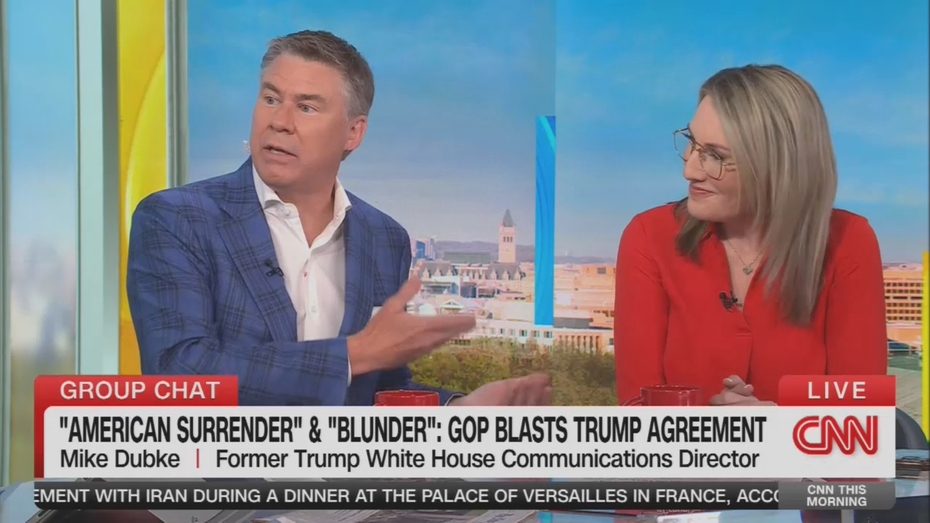
After noting some conservatives were "squawking" over the deal, Cornish turned directly to Dubke and declared, “Mike Dubke, your favorite person just posted to Truth Social.” She then read Trump’s post highlighting record stock market highs and falling oil prices before asking whether critics of the MOU were “jealous, bad people, or stupid?”
Dubke defended the agreement as only a framework for further negotiations, not a finished deal. He noted Iran’s degraded military capabilities, reduced ballistic missile stockpiles, and diminished ability to fund proxies like Hamas and the Houthis.
After co-panelist Meghan Hays -- who like Dubke was a White House communications aide, and was tagged as the costumed Easter Bunny who led Biden away from reporters at the Easter Egg Roll -- snickered at his points, and later claimed the U.S. was spending $300 billion-plus on the deal, Dubke’s irritation was clear. “I appreciate the laughter on my left,” he said sarcastically. And he pushed back hard on the cost figure: “We did not spend $300 billion in this deal, I just can't let you get away with that."
Cornish is not in the habit of mocking Hays with references to "your favorite person" Biden.
Cornish closed the segment with a snide historical shot. Noting the signing of the MOU at Versailles, she remarked that in foreign policy circles, to call something a Versailles agreement is “kind of an insult” — “a self-defeating agreement.”
Cornish Tries To Corner GOP Panelist On MOU: ‘Your Favorite Person’ Trump pic.twitter.com/oPGuiIGDbk
— Mark Finkelstein (@markfinkelstein) June 18, 2026
Cornish was alluding to the Treaty of Versailles, which ended World War I. The United States never signed it, and the harsh terms the treaty imposed on Germany are widely believed to have created conditions leading to the rise of Hitler.
The whole exchange had a familiar CNN feel: personalize the Trump connection to corner the GOP panelist and force him onto the defensive, let the stacked panel do some of the dirty work, then slip in the loaded analogy at the end.
Dubke, no raging MAGA partisan, kept his focus on the pragmatic “stop digging” framework while visibly annoyed by the snickering and spin from his left. CNN's focus was less about the substance of the deal and more about needling anyone who won’t reflexively bash Trump.
Here's the transcript.
CNN This Morning
6/18/26
6:04 am EDTAUDIE CORNISH: Like, why would all these conservative voices be squawking about this, right? Why would the Lindsey Grahams of the world, who were all too happy to be a part of these strikes and have these demands on Iran, be so frustrated with what was signed?
. . .
Yeah, it's interesting. As we are speaking, Mike Dubke, your favorite person just posted to Truth Social. President Trump says, look, "These fools who think I haven't been tough enough on Iran, when the stock market just hit a record high and oil prices are tumbling down, are either jealous, bad people, or stupid." So let's talk messaging.
MIKE DUBKE: Well, first of all, this is just a framework. This isn't the total deal, so we need to keep that in mind. I mean, we keep — all the rhetoric I keep hearing is, "You know, this deal, this deal, that." It's a framework to get to a deal. So we can argue whether or not that's great or not, and I appreciate the, the laughter on my left.
The other thing is, when you're in a hole, what's the first rule? Stop digging. And I think that's where we are with this particular framework, this particular MOU, is that we are at a point: the military in Iran has been degraded, whether or not it's been blasted to the stone age again, we can debate that. The ballistic missile stockpile has been degraded, their ability to fund Hamas, Hezbollah, the Houthis, has been degraded.
. . .
MEGHAN HAYS: We spent a billion dollars a day fighting a war that no one wanted to go to, so we spent over a hundred billion dollars there. We spent three hundred billion dollars in this deal, so now we're four hundred billion dollars when Americans don't have healthcare. We —
DUBKE: We did not spend $300 billion in this deal, it — I just can't let you just get away with that. I just can't let you just get away with that.
CORNISH: Let me give the fact check. There will be a $300 billion dollar investment fund. But a lot of people say, why should Iran have almost immediate access to investments in the world economy if it's still sitting on its enriched uranium, and so much of this is not worked out yet?
Let me give Zina the last word because he's here, and this was signed at Versailles. Lots of things have been signed at Versailles. So usually, when you call something a Versailles treaty, it's a, in foreign language, in foreign policy land, kind of an insult, right? It's a self-defeating agreement.